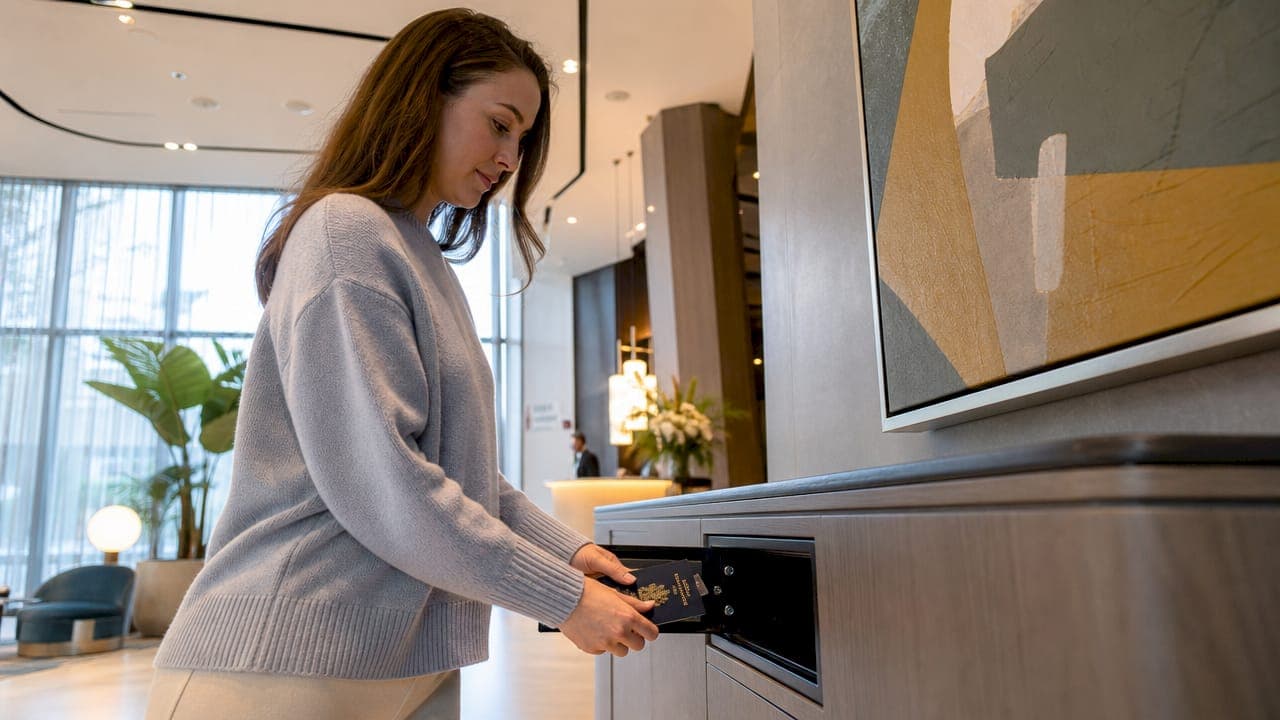
The safest practice for passport handling during international travel is to carry your physical passport only when legally required and lock it in your hotel safe for all other activities. The question of whether you should carry your passport or leave it in the hotel comes down to one core principle: minimize the time your passport spends in public. U.S. travel guidance confirms that keeping passports in hotel safes when not needed reduces theft risk in crowded areas and tourist hotspots. Passportcenter covers this decision in detail because getting it wrong can derail an entire trip.
Should you carry your passport or leave it in the hotel?
The answer depends on what you are doing that day. Carry your passport when the activity legally or operationally requires it. Leave it secured when it does not. This is not a one-size-fits-all rule. It is a situational decision you make each morning based on your itinerary.
You must carry your physical passport in these situations:
- International border crossings — land, sea, or air. No exceptions.
- Airline check-in and boarding — digital copies are not accepted by any airline or immigration authority.
- Hotel check-in — most international hotels require the original document for registration.
- Visa-on-arrival processing — the original passport is mandatory.
- Car rental — many international rental agencies require a passport alongside a driver's license.
The legal requirement to carry an original passport varies by country. Some nations, including several in Europe and Southeast Asia, legally require travelers to carry original photo ID at all times. Others accept a photocopy or a secondary ID for routine police checks. Research your specific destination before you travel. Ignorance of local law is not a defense.
Pro Tip: Before each trip, check the U.S. Department of State's country information page for your destination. It lists local ID requirements and security conditions that directly affect whether you should carry your passport daily.
What are the risks and benefits of leaving your passport in the hotel?
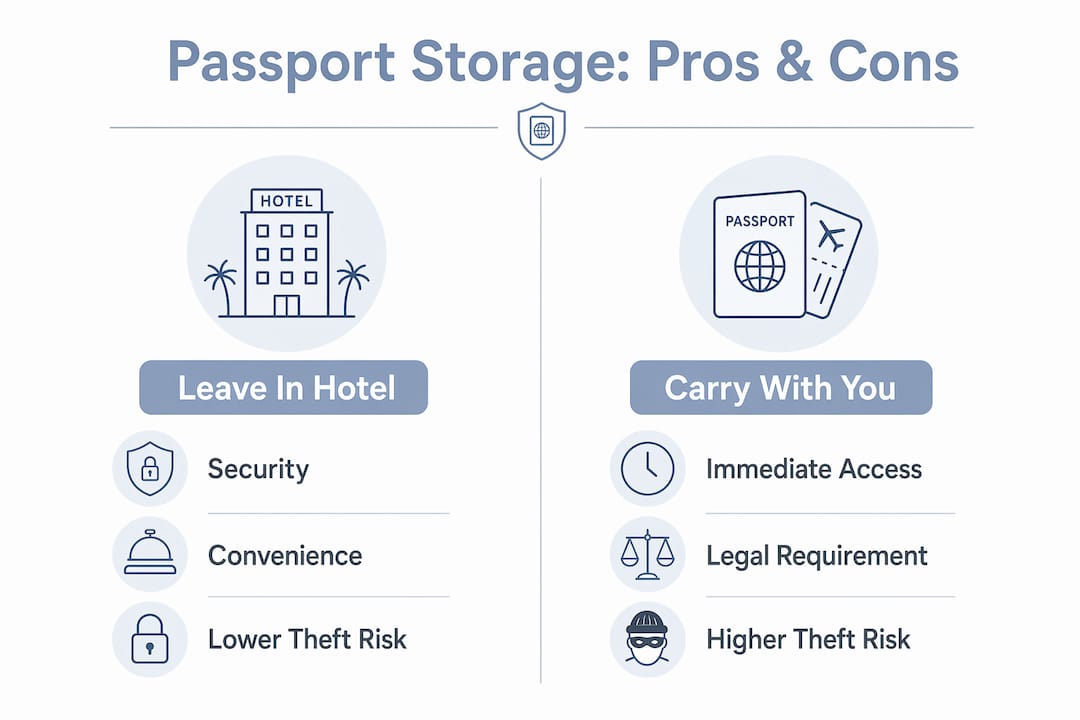
Leaving your passport in a hotel safe is the right call for most sightseeing days, beach trips, and restaurant outings. The hotel safe removes your passport from the highest-risk environments: crowded markets, public transit, and tourist attractions where pickpockets operate.
Most mid-range and upscale hotels provide in-room electronic safes large enough to hold a passport. If your room has no safe, the hotel's front desk typically offers a main safe for guest valuables. If no in-room safe exists, use a locked, anchored bag or request the property's main safe rather than leaving the passport loose in a drawer or suitcase.
The one real downside to hotel storage is the local ID law issue. If a police officer stops you on the street and your destination requires original ID, a photocopy may not satisfy the requirement. Weigh that risk against the far more common risk of theft in public. In most destinations, the theft risk in crowds outweighs the rare chance of a police check.
Here is what to do when leaving your passport at the hotel:
- Store it in the in-room electronic safe, not under a mattress or in a drawer.
- Leave a physical color copy of the data page in your day bag as a substitute for routine checks.
- Note the hotel address and safe combination in a secure digital note in case you return to a different room.
- Tell a travel companion where the passport is stored.
Pro Tip: Take a photo of your hotel safe's serial number and the front desk's phone number before you leave for the day. If the safe malfunctions, you can get help faster.
How to carry your passport safely when you must bring it
When your itinerary requires the physical passport, how you carry it matters as much as whether you carry it. Carrying a passport in external pockets or jacket pockets is the most common reason passports are lost or stolen. That single mistake causes severe travel disruptions.
Follow this order of priority for secure carrying:
- RFID-blocking neck wallet — worn under your shirt, against your chest. This is the most secure option for high-risk areas. It blocks electronic skimming and keeps the passport off your outer clothing.
- Money belt — worn underclothing at the waist. Less accessible than a neck wallet but equally concealed. Good for long walking days.
- Inner jacket pocket — acceptable in lower-risk environments, but only if the pocket zips closed.
- Crossbody bag with a slash-resistant strap — a reasonable option in moderate-risk areas. Keep the bag in front of your body, not behind.
- Backpack outer pocket — never use this. External pockets and backpacks are primary targets for pickpockets in every major tourist city.
Keep your passport separate from your wallet and cash at all times. If a thief takes your wallet, you retain your passport and can still exit the country. If they take your passport, you can still pay for emergency services. Separating the two limits the damage from any single theft.
One more critical point: never put your passport in a carry-on bag that could be gate-checked. Gate-checking a bag separates you from your document at the exact moment you need it for immigration clearance. Keep your passport on your body during all air travel, not in any bag.
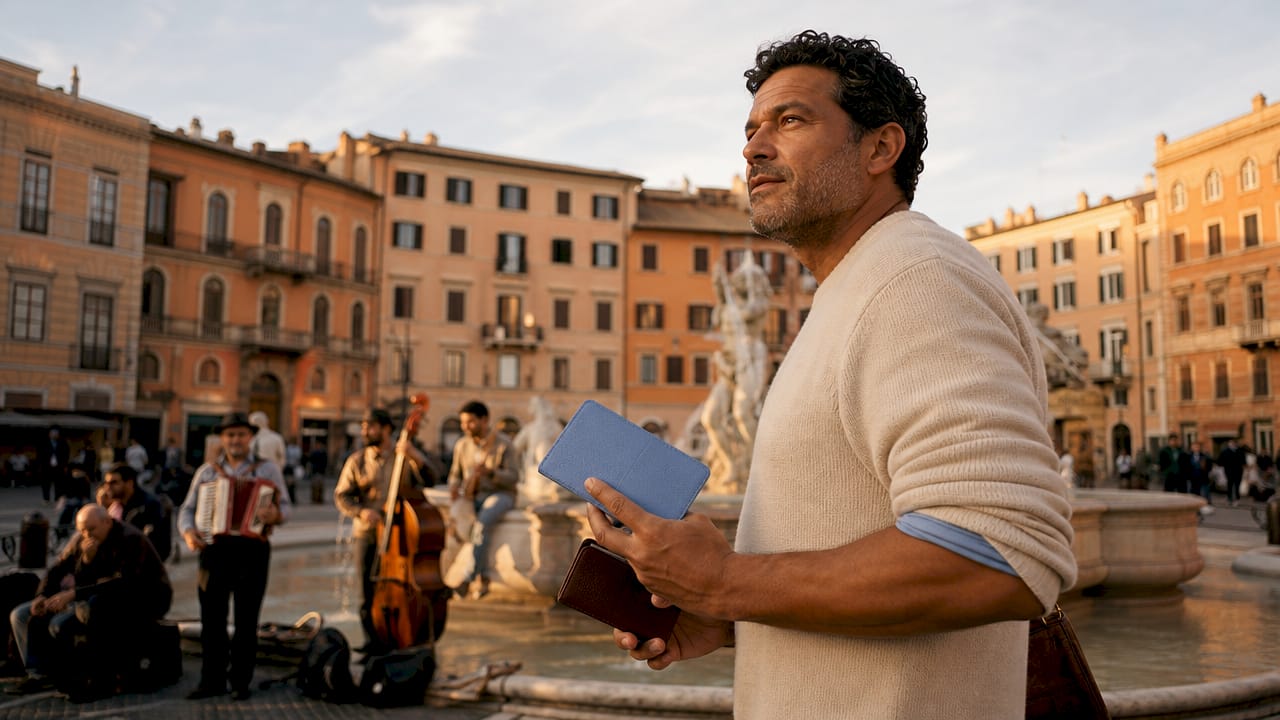
Pro Tip: Use a dedicated passport carrier that is a different color from your wallet. In a stressful moment at a border, you will find the right document faster.
How should you back up your passport for emergencies?
A layered backup strategy is the difference between a minor inconvenience and a multi-day embassy ordeal. A complete backup approach includes encrypted digital copies, physical color prints stored separately from the original, and a trusted contact at home who holds a copy.
Here is how to build that backup before you leave:
- Digital encrypted copy — scan your passport data page at a minimum of 300 DPI and store it in an encrypted cloud folder or a password-protected app. Do not store it in an unprotected photo gallery.
- Physical color print — print a color copy on standard paper. Carry it separately from your original passport in your day bag.
- Second physical copy — leave one in your checked luggage, separate from your carry-on.
- Home contact copy — email a scan to a trusted person at home who can send it quickly if you lose everything.
Do not rely on digital copies alone. Phone batteries die. Data connections fail. A physical color copy works at a police checkpoint or embassy window with no connectivity required. The U.S. Department of State recommends immediate reporting of lost passports with a local police report to invalidate the document globally and speed up emergency replacement. Once reported stolen, a recovered passport cannot be used for travel. That makes the backup copies your fastest path to getting home.
| Backup type | Where to store it | Best use |
|---|---|---|
| Encrypted digital scan | Password-protected cloud or app | Embassy visits, insurance claims |
| Physical color print (copy 1) | Day bag, separate from passport | Police checks, routine ID requests |
| Physical color print (copy 2) | Checked luggage | Backup if day bag is also lost |
| Home contact scan | Trusted person's email | Remote assistance when abroad |
Key takeaways
Carry your passport only when legally or operationally required, and secure it in your hotel safe for all other activities to minimize theft risk and travel disruption.
| Point | Details |
|---|---|
| Default rule | Leave your passport in the hotel safe unless your itinerary requires it. |
| Legal requirements vary | Research your destination's ID laws before travel to know when the original is mandatory. |
| Carry method matters | Use an RFID-blocking neck wallet or money belt, never an outer pocket or backpack. |
| Separate passport from wallet | Keeping them apart limits the damage from any single theft incident. |
| Build a layered backup | Combine encrypted digital copies, physical prints, and a home contact for full emergency coverage. |
What I have learned from years of watching travelers get this wrong
Most travelers treat the passport question as binary: carry it everywhere or leave it behind every day. Neither extreme works. The travelers who carry it everywhere eventually lose it to a pickpocket in a market or leave it in a restaurant. The travelers who leave it behind every day get caught at an unexpected border crossing or a car rental counter without the original.
The right approach is situational. Plan your day the night before. If you are crossing a border, taking a flight, or renting a vehicle, the passport goes with you in a concealed carrier. If you are spending the day at a beach or a museum, it stays in the safe with a color copy in your bag.
The other mistake I see constantly is skipping the backup step. Travelers spend hours researching hotels and flights but ten minutes on document security. A lost passport without backups means days at an embassy, a missed flight, and a ruined trip. A lost passport with a full backup set means a same-day police report, a quick embassy appointment, and a manageable delay. The preparation takes thirty minutes at home. The consequences of skipping it can last a week.
Research your destination's laws. Build your backup set before you leave. Carry concealed when you must carry at all. That is the complete strategy.
— David
Passport security resources from Passportcenter
Deciding where to keep your passport is one piece of a larger travel preparation picture. Passportcenter is a free resource built specifically for U.S. travelers who need clear, reliable answers on passport requirements, renewal timelines, and travel document rules.
Whether you are preparing for your first international trip or managing an urgent renewal before departure, Passportcenter covers passport eligibility, processing times, country-specific entry requirements, and emergency procedures in plain language. The site also connects travelers who need expedited help to trusted passport courier services. No fluff, no guesswork. Just the information you need to travel with confidence.
FAQ
Should I carry my passport every day while traveling abroad?
Carry your passport only when your itinerary requires it, such as for flights, border crossings, or hotel check-in. For sightseeing days, leave it in your hotel safe and carry a physical color copy instead.
Is a hotel safe secure enough for my passport?
Most hotel in-room electronic safes provide adequate security for passport storage. If no in-room safe is available, use the hotel's main safe at the front desk rather than leaving the passport unsecured in your room.
Can I use a photo or digital copy of my passport instead of the original?
No airline or international border accepts a digital or printed copy in place of the original passport for official travel procedures. Copies are useful for emergencies and routine ID checks, not for immigration or boarding.
What should I do if my passport is lost or stolen abroad?
Report the loss immediately to local police and obtain a written police report. Then contact the nearest U.S. embassy or consulate. The U.S. Department of State recommends immediate reporting to invalidate the lost document globally and begin emergency replacement.
What is the safest way to carry my passport when I have to bring it?
Use an RFID-blocking neck wallet worn under your clothing or a money belt at the waist. Keep the passport separate from your cash and wallet, and never place it in an outer pocket, backpack, or any bag that could be gate-checked at an airport.