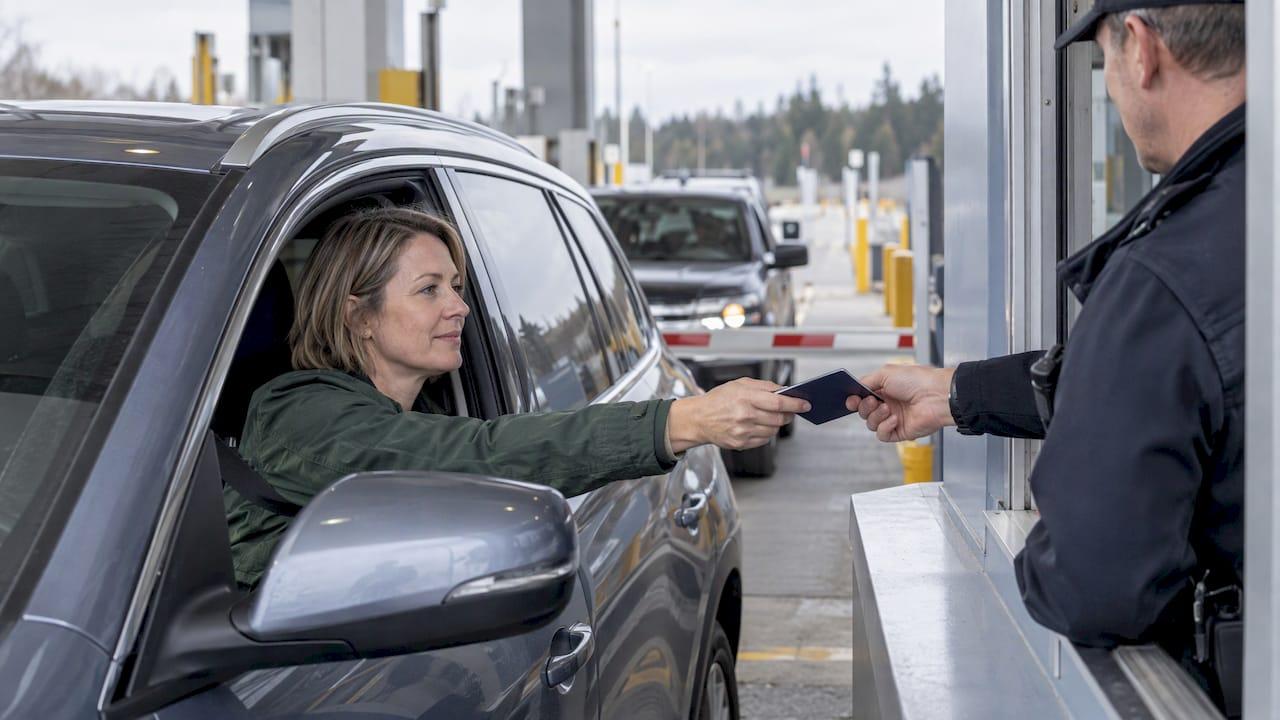
The safest document to carry when you drive to Canada is a valid U.S. passport. A passport card or an enhanced driver's license also works at a land crossing, and you need no visa. A standard driver's license by itself is not the right choice. If your passport is expired or you have never had one, sort that out before the trip. It is the one item you cannot fix at the border.
This guide covers what Canada asks for, what the U.S. asks for on the way home, what to carry for children, which vehicle papers matter, and what to leave out of the car.
TL;DR
- A valid U.S. passport is the document Canada recommends. A passport card or enhanced driver's license also works for land entry.
- U.S. citizens do not need a Canadian visa or eTA to enter Canada with a valid U.S. passport.
- Coming back, U.S. officers accept a passport, passport card, enhanced license or a trusted traveler card such as NEXUS.
- Kids need their own ID, and a consent letter when a parent travels without the other parent or the adult is not a parent.
- Carry your license and proof of auto insurance, and do not bring cannabis, undeclared firearms or pepper spray.
Table of Contents
- What Canada asks for at a land crossing
- Getting back into the United States
- Traveling with children
- Papers for the car and the driver
- What to leave at home
- Pre-trip checklist
- Passport expired or missing? Act before the trip
- Perspective
- Need a passport fast?
- FAQ
- Sources
What Canada asks for at a land crossing
The Canada Border Services Agency (CBSA) is the officer you meet at the booth. It recommends that U.S. citizens travel with a valid passport. It also says you may present documents that show your full name, date of birth and citizenship. You can combine documents, and an officer may ask for separate photo ID if your proof of citizenship has no photo.
The Government of Canada's own entry page says the same thing: a valid passport is the universally reliable document, and U.S. citizens entering by land without one may present identity documents that establish name, birth date and citizenship.
In practice, that gives you a ranked list:
- U.S. passport book. Works at every crossing, and the only one of these that also works for flying.
- U.S. passport card. The wallet-size version. The U.S. Embassy in Canada says the card can be used at the land border or on a ferry, but it is not a substitute for the passport book on a flight.
- Enhanced driver's license (EDL). CBSA lists a U.S. enhanced license as an acceptable supporting document. Only some states issue them, and a regular license, including a REAL ID, is not an enhanced license. Our guide to the enhanced license for Canada explains how to tell what you hold.
- Birth certificate or certificate of citizenship or naturalization, plus photo ID. CBSA lists a U.S. birth certificate and a certificate of citizenship or naturalization as acceptable proof of citizenship. Pair either with a government photo ID.
A birth certificate and a license can get you in. But the officer decides, and a passport leaves no room for questions. Any delay costs you time in a line of cars, and it can cost you the trip if something is missing.
Do you need a visa or an eTA?
No. Immigration, Refugees and Citizenship Canada states that American citizens do not need a visa or an eTA (electronic travel authorization) when traveling with a valid U.S. passport. The eTA is the online permission that visa-exempt visitors from other countries need when they fly. It is not part of a U.S. citizen's drive.
If you are a dual citizen, the passport question gets more complicated. Our dual citizen travel rules page covers which passport to show and when.
Getting back into the United States
Canada is only half of the trip. Re-entry to the U.S. by land falls under the Western Hemisphere Travel Initiative. The Department of Homeland Security lists these accepted documents for U.S. citizens returning by land or sea: a U.S. passport, passport card, enhanced driver's license, or a trusted traveler card such as NEXUS, SENTRI or FAST.
The same DHS page lists a few narrower options:
- U.S. military ID when you travel on official orders
- A U.S. Merchant Mariner document for official maritime business
- A Form I-872 American Indian Card or an Enhanced Tribal Card, where available
Notice what is missing: a plain driver's license and a birth certificate on their own. Use the same document in both directions and you never have to wonder which one works where.
Traveling with children
Children are where most families get stuck, because the rules involve ID and permission.
Identification. CBSA says minors under 18 should have acceptable identification and travel in the same vehicle as the accompanying adult. For a land trip, a birth certificate can serve as proof of citizenship, but a child's own passport or passport card is simpler to carry and simpler to explain.
Permission letters. CBSA advises a consent letter in two cases: a parent with shared custody who is traveling without the other parent, or an adult who is not the child's parent or guardian. Immigration, Refugees and Citizenship Canada describes what the letter for a child traveling without both parents should include: authorization signed by both parents or guardians, their contact details, and details of the adult caring for the child in Canada. A copy of the birth certificate belongs in the folder too.
Custody papers. For separated or divorced parents who share custody, the same page advises carrying custody documents and says it is best to have authorization from the other custodial parent. With sole custody, carry the custody decree. The sole-custody parent may sign the authorization.
A simple family folder:
- Each child's passport, passport card or birth certificate
- A signed consent letter if one parent is missing
- The custody decree, if one applies
- Phone numbers for both parents on the letter
Border officers ask questions to protect children, so a well-organized folder makes the stop short. Carpooling with other families, or renting a group vehicle? Rental vehicles often have their own cross-border rules, so read up on group van rental to Canada and get permission before you book.
If your child has no passport yet, start the application early. We cover the child's route in our guide to passport or card for Canada, including rules for kids.
Papers for the car and the driver
The CBSA officer cares mostly about people, but you should carry the vehicle's papers too.
Driver's license. The State Department's Canada page says a U.S. driver's license is valid for visitors driving in Canada. That is a different question from crossing the border: the license lets you drive, but it does not prove your citizenship at the booth.
Proof of insurance. The same page says proof of auto insurance is required. The State Department also warns that U.S. auto insurance may not cover you abroad, so call your insurer before you leave and ask whether your policy covers Canada. Ask for a printed proof-of-insurance card for the glovebox.
Registration. Keep the vehicle registration in the car. If the car is a rental, bring the rental agreement. If it is a loan or lease, a letter from the lender is worth having.
Put all of it in one place, together with the passports. You do not want to dig through a glovebox at the booth.

What to leave at home
Documents get you to the booth. What is in the trunk decides how long you stay there. The U.S. Embassy in Canada warns against bringing cannabis across the border, including edibles, extracts and anything containing CBD, and says undeclared firearms and ammunition are illegal to transport across it. It advises you to check bags, pockets and the vehicle for prohibited items before you go.
CBSA guidance says you must declare goods you bring in for personal use, including purchases and gifts. It lists controlled, restricted or prohibited weapons as including firearms, mace, pepper spray, stun guns, switchblades and butterfly knives. Weapons brought in without declaration are seized, and you may face criminal charges.

The quick rule: if you are not sure whether something is allowed, declare it, or leave it at home. Check the official CBSA site for specifics on food, alcohol and plants.
Pre-trip checklist
| Item | Who needs it | Notes |
|---|---|---|
| Passport book | Every traveler | Check the expiration date before booking |
| Passport card or enhanced license | Alternative for land travel | Not valid for flights |
| Child's ID | Every child | Passport, card or birth certificate |
| Consent letter | Child with one parent or a non-parent adult | Both parents' contact details |
| Custody papers | Shared or sole custody | Carry the decree |
| License and insurance proof | The driver | Confirm Canada coverage with your insurer |
| Registration or rental agreement | The driver | Keep in the glovebox |
| Trusted traveler card | Optional | Accepted for U.S. return by land |
Passport expired or missing? Act before the trip
The common failure is not a wrong document. It is no document, because the passport lapsed or was never applied for. Routine government processing can take weeks, and the time left before a trip is often shorter than people think. Check the dates on every family member's passport now, and apply early rather than the week before.
If your departure is close, expedited help exists. Registered passport courier services handle rush applications for travelers who need a passport quickly, which suits people far from a Regional Passport Agency. The government still issues the passport. A courier helps get the application in and moving.
Perspective
We built Passportcenter around a simple fact: most border-day problems start weeks earlier, at the kitchen table. Someone assumes a license is enough, or a child's passport is expired, or nobody checked the custody letter.
Our advice for a Canada drive is plain. Carry a passport book if you can, because it works everywhere and in both directions. A passport card is a sensible add-on for a family that drives across often. Check every date, every name and every child's paperwork a month out, not a day out.
Our guides are free and written in plain language, so you can work out what you need without wading through agency pages. If your timeline is tight, we connect you with registered expedited passport courier services we consider vetted, so a missing passport does not cancel the trip.
David
Need a passport fast?
Passportcenter's guides explain what you need, the steps to get it, and how to tell a routine application from one that needs expediting. If your trip is close and a passport is missing or expiring, we point you to registered passport courier services for expedited processing. Start at Passportcenter.
For the full picture of who needs which document, see our guide to Canada entry requirements for U.S. citizens.
FAQ
Can I drive to Canada with just a driver's license?
A standard license alone is not what Canada recommends. Canada accepts documents that show your name, birth date and citizenship, and an enhanced license is one of the listed examples. A regular license shows identity but not citizenship, so pair it with proof such as a birth certificate, or better, bring a passport.
Can I get back into the U.S. from Canada without a passport?
Yes, if you hold another accepted document. DHS lists a passport card, an enhanced driver's license and trusted traveler cards such as NEXUS, SENTRI and FAST for land re-entry. A regular license or birth certificate alone is not on that list.
Can I drive in Canada with my U.S. driver's license?
Yes. The State Department says a U.S. license is valid for visitors driving in Canada. You also need proof of auto insurance, and your insurer can tell you whether your policy covers a Canada trip.
What can't I bring into Canada by car?
Leave cannabis, including edibles and CBD products, at home. Undeclared firearms and ammunition are illegal to bring in, and CBSA lists pepper spray, mace, stun guns, switchblades and butterfly knives among restricted or prohibited weapons. Declare any goods you bring for personal use, including gifts.
Do my kids need their own documents?
Yes. Minors under 18 should carry acceptable ID and travel in the same vehicle as the adult. Add a consent letter if a parent travels without the other parent or the adult is not a parent or guardian, and carry custody papers if they apply.
Sources
- Travel and identification documents for entering Canada (CBSA)
- What you need to enter Canada (Canada.ca)
- I am an American citizen. What do I need to enter Canada? (IRCC)
- U.S. Citizens Visiting Canada (U.S. Embassy in Canada)
- Western Hemisphere Travel Initiative (DHS)
- Minor children travelling to Canada (Canada.ca)
- Canada Travel Advisory (Travel.State.gov)
- Driving and Transportation Safety Abroad (Travel.State.gov)
- The Commercial Driver Registration Program (CBSA)