
You do not need a visa or an eTA to visit Canada as a U.S. citizen for short-term tourist stays. A valid U.S. passport book is required for air travel, while a passport card, NEXUS card, or Enhanced Driver's License can work for land or sea crossings. Either way, the border services officer decides who gets in, not the document in your hand.
TL;DR:
- U.S. citizens can enter Canada without a visa or eTA for stays under six months, relying solely on a valid U.S. passport book for air travel.
- For land or sea crossings, a passport card, NEXUS, or Enhanced Driver's License can replace a passport book, but acceptance depends on border officer discretion.
- Travelers should prepare documents for minors, including consent letters and guardianship papers, to avoid delays or refusals at the border.
- Additional entry risks include criminal records, immigration violations, misrepresentation, or insufficient ties to the U.S., which can lead to denial despite valid documents.
- Applying for NEXUS is advisable for frequent travelers to reduce wait times and simplify land border crossings, especially for regular drivers into Canada.
Table of Contents
- Canada Entry Requirements Checklist for U.S. Citizens
- Documents by Travel Method: Air vs. Land and Sea
- Do U.S. Citizens Need a Visa or eTA for Canada?
- Traveling to Canada With Children: What Parents Need
- Why Can You Be Denied Entry Into Canada?
- Should Frequent Travelers Enroll in NEXUS?
- Your Pre-Trip Timeline for Canada Travel
- How Passportcenter Helps You Prepare
- What I'd Actually Tell a Friend Crossing Into Canada
- Get Your Passport Sorted Before You Book Anything
- Sources
Canada Entry Requirements Checklist for U.S. Citizens
Before you head north, run through this list. It takes ten minutes and it catches the mistakes that actually cause delays at the border.
- Confirm your passport type and check the expiration date. If it expires within six months, plan to renew before you go.
- If you are a lawful permanent resident, pack your green card along with your passport from your country of nationality.
- If a minor is traveling without both parents, prepare a signed consent letter with the absent parent's contact information.
- Bring copies of parental or guardian identification if a child is traveling with only one parent or a non-parent adult.
- Give yourself enough lead time for a routine passport renewal, or budget for an expedited courier service if your trip is close.
- Pack proof of ties to the U.S., such as a return ticket, pay stub, or hotel booking, in case an officer asks about your travel intent.
None of this is complicated, but skipping it is exactly how travelers end up pulled aside for a second interview at a land crossing.
Documents by Travel Method: Air vs. Land and Sea
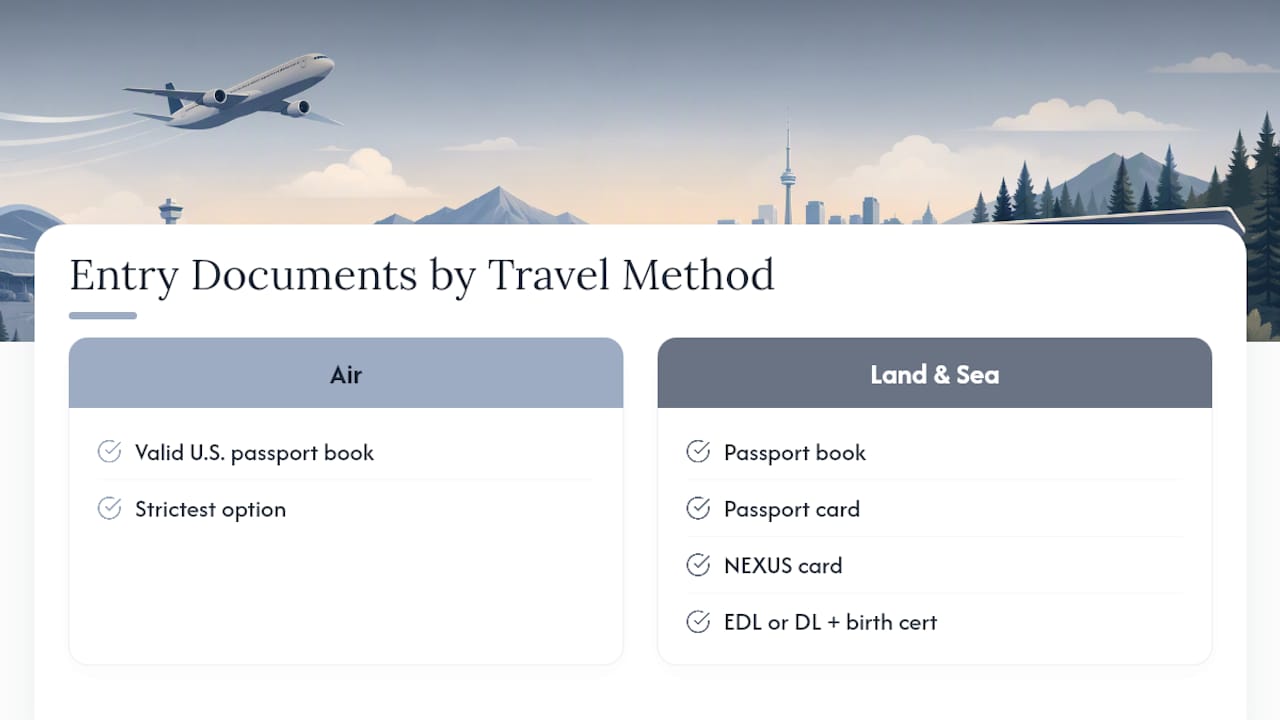
The rules change depending on how you cross, and this is where most confusion starts. Flying into Canada is the strictest option. Driving or arriving by ferry gives you more flexibility, but that flexibility comes with tradeoffs worth understanding before you rely on it.
Flying into Canada
If you are boarding a plane, you need a valid U.S. passport book. Airlines will not let you check in without one, and Canadian border officers will not admit you through an airport without one either. There is no substitute here. A passport card does not work for air travel under any circumstance, according to the Canada Border Services Agency. If your passport is damaged, expired, or missing a visa page stamp, you are not getting on the plane.
Driving or arriving by land or sea
Crossing by car, bus, or ferry opens up more options. The CBSA accepts WHTI-compliant documents such as the U.S. passport card, a NEXUS card, or an Enhanced Driver's License issued by certain states, in addition to a full passport book. These are real alternatives, not workarounds. Millions of travelers use a passport card every year to cross at land ports without ever opening a passport book.
That said, acceptance still runs through officer discretion. A passport card proves both citizenship and identity, which is why it clears most land crossings without extra questions. An Enhanced Driver's License does the same job in the states that issue one. If you are combining documents, such as a standard driver's license plus a birth certificate, make sure between them you cover two things: who you are, and that you are a U.S. citizen. A photo ID alone does not prove citizenship, and a birth certificate alone does not prove you are the person standing at the booth.
Pro Tip: Carry your passport book even on a land crossing if you own one, even when a card would technically work. It removes any ambiguity, and it means one lost or damaged document does not strand you if your travel plans change mid-trip and you suddenly need to fly home.
A few practical habits protect you regardless of travel method:
- Bring original documents. Photocopies and photos on your phone do not satisfy identification requirements at the border.
- Check your airline's specific boarding policy before departure, since some carriers apply stricter document rules than CBSA itself requires.
- Keep your passport card and passport book in different bags if you are carrying both, so a lost bag does not cost you both documents.
- Confirm document validity dates before booking; a passport card with a near-term expiration can cause problems even if your passport book is fine.
Do U.S. Citizens Need a Visa or eTA for Canada?
No. U.S. citizens do not need a visitor visa or an electronic travel authorization for tourist stays less than six months, and a valid U.S. passport remains the most reliable document across every travel method. This exemption is one of the more generous entry policies Canada extends to any nationality, and it is a big part of why cross-border weekend trips are so routine for Americans living near the border.
U.S. lawful permanent residents get the same eTA exemption, but the paperwork looks different. An LPR needs a valid passport from their country of nationality plus proof of U.S. status, typically the green card. Canada is checking two things at once here: that you are legitimately a resident of the U.S., and that your home-country passport is valid for the trip. Forgetting the green card is a common, easily avoided mistake among LPRs who assume their U.S. residency alone is enough.
A visa becomes necessary in narrower situations:
- Staying longer than 180 days as a visitor
- Studying at a Canadian institution beyond a short course
- Working in Canada, which typically requires a work permit rather than a standard visa
- Certain prior immigration issues that require a formal application rather than routine entry
Check current category rules directly with Immigration, Refugees and Citizenship Canada before booking anything tied to study or work, since these categories shift more often than the tourist exemption does.
One more distinction worth knowing: airline boarding checks and CBSA entry checks are not the same review. An airline can deny boarding over a document issue even when CBSA would have admitted you. Always confirm document requirements with your airline directly, especially if you are flying a route you have not taken before.
Traveling to Canada With Children: What Parents Need
Kids get extra scrutiny at the border, and for good reason. Border officers are watching for custody disputes and trafficking risks, not just paperwork completeness. Here is how to prepare a child's documents properly.
- Get the child their own passport. A child passport is the cleanest, most recognized document for any Canada trip, and it avoids the gray areas that come with alternative documents.
- Know the alternative for land and sea trips. For crossings that are not by air, a birth certificate combined with other identifying documents may satisfy CBSA for travelers under 19, though a passport remains the more dependable choice.
- Write a proper consent letter if one parent isn't traveling. Include the non-traveling parent's name, address, and phone number, a clear statement granting permission for the trip, and a photocopy of that parent's government-issued ID.
- Carry legal paperwork for non-standard family situations. Adoptive parents, legal guardians, and grandparents or other relatives traveling with a child should bring adoption or guardianship documents, since a birth certificate alone will not explain a mismatched last name.
- Keep custody orders on hand if they exist. If there is a custody arrangement in place, bring the relevant court paperwork. Officers who spot a red flag, like a child with a different last name than the accompanying adult, will ask for it.
CBSA officers check children carefully, and a family without the right paperwork can be delayed or turned back even when every intention is innocent. A consent letter costs nothing and takes fifteen minutes to write. There is no good reason to skip it.
Why Can You Be Denied Entry Into Canada?
Having a valid passport does not guarantee admission. The border services officer has final authority to admit or refuse any traveler, and the decision often comes down to judgment calls, not just paperwork.
Officers evaluate admissibility based on a handful of recurring factors:
- Criminal record. Even older or minor U.S. convictions, including some DUI charges, can make a traveler inadmissible to Canada.
- Immigration violations. A history of overstays or removals from Canada raises immediate flags.
- Health and security concerns. These are assessed case by case and rarely affect routine tourist trips.
- Misrepresentation. Giving inconsistent or misleading answers about your trip purpose is treated seriously, even over small details.
- Insufficient ties or unclear intent. An officer unconvinced you plan to leave Canada on schedule can refuse entry on that basis alone.
The best defense against a subjective refusal is boring, verifiable proof. Bring a return ticket, a pay stub or letter from your employer, evidence of where you live, and a hotel or itinerary confirmation. None of this is required paperwork in the way a passport is, but it answers the questions an officer is actually asking themselves.
Pro Tip: If you are refused entry, ask the officer directly for the stated reason and request written documentation if it's offered. Keep every receipt and ticket from the trip. That paper trail matters if you ever need to sort out the issue with a future application or with consular support.
Should Frequent Travelers Enroll in NEXUS?
If you cross the Canadian border more than a couple of times a year, NEXUS pays for itself fast. It is a trusted traveler program that functions as an accepted travel document at land crossings, marine reporting locations, and dedicated airport lanes, and it is one of the most recommended tools for people who cross regularly.
Here is what makes it worth the application:
- NEXUS cardholders use dedicated fast lanes at major land crossings, cutting wait times that can otherwise stretch past an hour during peak travel periods.
- The card doubles as WHTI-compliant proof of citizenship and identity for land and sea travel, similar to a passport card.
- Approved members clear both U.S. and Canadian screening with a single enrollment, rather than juggling separate trusted traveler programs.
- Eligibility requires a background check and an in-person interview, and approval is not guaranteed for applicants with certain criminal or immigration history.
For someone who drives into Canada regularly, whether for work, family, or a cottage across the border, NEXUS tends to be more reliable than a passport card alone, since it is built around fast processing rather than baseline document compliance. Applications and current processing timelines are published through the official Trusted Traveler Programs enrollment system, and it is worth pairing NEXUS with a look at how Global Entry works for air travel if you fly internationally as well.
Your Pre-Trip Timeline for Canada Travel
Work backward from your departure date and you avoid nearly every last-minute passport scramble.
- 8 to 12 weeks out: Check your passport's expiration date. Routine renewal through the State Department typically takes several weeks, so this is the window to start if your passport is aging or damaged.
- 4 to 6 weeks out: If your renewal is delayed or your trip came together fast, this is when considering an expedited service may be necessary to meet your timeline.
- 2 weeks out: Gather secondary documents. Write consent letters for any traveling minors, print proof of ties like hotel bookings and return tickets, and confirm your airline's document policy if you are flying.
- 48 hours out: Pack passports and cards in your carry-on, not checked luggage. Scan every document, including consent letters, into cloud storage so you have backup access if anything is lost.
If a passport is lost or stolen while you are already in Canada, the nearest U.S. embassy or consulate can issue an emergency travel document to get you home, though it requires an in-person appointment and proof of citizenship, so keep that scanned copy handy.
Pro Tip: Carrying both your passport book and passport card, if you have one, covers you for last-minute flight changes on a trip you planned as a land crossing. It costs nothing to bring both.
How Passportcenter Helps You Prepare
Passportcenter publishes country-specific entry guides, renewal timelines, and plain-language breakdowns of passport eligibility rules, built for travelers who want the official requirement without digging through government pages themselves. The UK entry guide and the eVisa versus visa explainer follow the same approach for other destinations, since travel document rules trip people up well beyond just Canada.
The goal is straightforward: give you the requirement in plain language, tell you how much lead time renewal actually needs, and point you toward vetted expedited courier services when your timeline is tight. Check the renewal timelines published on the site before you assume you have enough time.
What I'd Actually Tell a Friend Crossing Into Canada
Bring the passport book, even for a land crossing where a card would technically work. I've seen too many trips get complicated by a flight change, a missed ferry, or a last-minute rebooking that suddenly requires air travel. A passport book covers every scenario a passport card doesn't.
If you cross more than occasionally, apply for NEXUS. The interview and background check take effort upfront, but they remove document uncertainty from every future trip. And before you travel, check current passport renewal timelines. Passport processing backlogs happen, and the worst time to learn about them is the week before your flight.
— David
Get Your Passport Sorted Before You Book Anything
Passportcenter is the resource to check before you assume your passport is trip-ready, not after a delay forces the question. Unlike guesswork based on how long your last renewal took, Passportcenter's guides walk through current processing timelines, what a routine renewal actually requires, and when an expedited courier service is worth paying for versus when standard mail-in processing will comfortably make your departure date.
If your passport is within six months of expiring, or you're not sure whether you need a new passport card versus a renewal, start with Passportcenter's country and passport guides to check your specific timeline and confirm what your Canada trip actually requires before you book flights or hotels around a document that might not be ready in time.