If you need a passport for a life-or-death emergency, here is the short answer: you may qualify for an emergency appointment at a U.S. passport agency if you must travel abroad within a short period because an immediate family member outside the United States has died, is dying, or is in hospice care. Act on these three steps right now:
- Book an emergency appointment at a regional passport agency or center through the State Department's official appointment system — do not use third-party booking sites.
- Gather proof of the emergency: a death certificate, a mortuary statement, or a signed letter on hospital letterhead from a physician describing the condition.
- Have a confirmed travel itinerary (airline ticket or booking confirmation) and your full application package ready before you go.
One important boundary: if you are traveling abroad for your own medical treatment, that does not qualify as a life-or-death emergency. You would need to pursue the separate urgent travel pathway instead.
Key Takeaways
A life-or-death emergency passport appointment requires travel within 14 calendar days for an immediate family member who has died, is dying, or is in hospice care outside the United States.
| Point | Details |
|---|---|
| Qualify first | Life-or-death service applies only when an immediate family member abroad has died, is dying, or is in hospice — travel must be within 14 days. |
| Book through official channels | Use the State Department's appointment portal or official phone lines only; third-party bookings may not be honored. |
| Bring complete proof | Accepted emergency proof includes a death certificate, mortuary statement, or a signed hospital letter on official letterhead with a physician's name and date. |
| Expect in-person pickup | Emergency passports are not mailed; you must return to the agency in person to collect the document. |
| Passportcenter guides | Free regional guides and courier referrals at passportcenter.ai help you prepare documents and find your nearest agency quickly. |
Table of Contents
- Who qualifies for a life-or-death emergency passport appointment?
- What documents do you need at the appointment?
- How do you book the emergency appointment?
- What happens at the agency, and how long does it take?
- What does an emergency passport cost?
- Special cases: minors, renewals, first-time applicants, and expired passports
- Emergency appointment checklist and ready-to-use templates
- Sources
Who qualifies for a life-or-death emergency passport appointment?
The State Department draws a firm line between two categories, and misclassifying your situation wastes time you do not have.
Life-or-death emergency applies when an immediate family member (parent, spouse, child, sibling, grandparent, or in-law) outside the United States has died, is actively dying, is in hospice care, or has a life-threatening illness or injury. You must need to travel within a short time frame. This is the fastest pathway, and it is the one this guide covers.
Urgent travel covers situations where you need to travel within roughly 2–3 weeks for reasons that are serious but not life-or-death — or within 28 days if the destination country requires a visa. The State Department's fast-passport overview explains both categories clearly, and treating those thresholds as strict cutoffs is the right approach. Experts who work with these applications consistently note that misclassifying a need is one of the most common causes of avoidable delays.
What does not qualify for life-or-death service:
- Traveling abroad for your own medical care or surgery
- Routine business travel with a tight deadline
- Tourism or personal trips with non-refundable bookings
If your situation falls outside the life-or-death definition, apply under the urgent travel pathway rather than attempting to use the emergency channel.
What documents do you need at the appointment?
Arriving with the wrong paperwork — or missing a single item — can end your appointment before it starts. Here is exactly what to bring.
Proof of the emergency (one of the following):
- Death certificate (official, certified copy)
- Statement from a mortuary or funeral home
- Signed letter on hospital letterhead from a physician, including the patient's name, your relationship to the patient, the nature of the condition, and the date
Non-English documents must include a professional translation with a signed translator's statement. The State Department will not accept untranslated foreign-language documents as proof.
Proof of imminent international travel:
- Confirmed airline itinerary or ticket showing travel within a short time frame
- A booking confirmation with your name, flight number, and travel dates
Standard application package:
- Completed DS-11 (first-time applicants or those who cannot use DS-82) or DS-82 (eligible renewals — passport issued within the last 15 years, issued after age 16, and not reported lost or stolen)
- One passport photo meeting State Department specifications (2×2 inches, white background, taken within the last 6 months)
- Primary government-issued photo ID (driver's license, state ID, or military ID) plus a photocopy
- Proof of U.S. citizenship if required (birth certificate or naturalization certificate) plus a photocopy
- Acceptable secondary ID if your primary ID has expired or is unavailable
Pro Tip: When requesting a hospital letter, ask the physician to include four specific elements on the letterhead: the date of writing, the physician's full name and title, your relationship to the patient, and a brief clinical description of the condition. Letters missing any of these are frequently rejected at the agency window.
How do you book the emergency appointment?
Speed matters here, but so does use the right channel. The official State Department appointment system is the only reliable way to secure a slot. Third-party booking services are not authorized, and the State Department may not honor appointments made through them — a risk you cannot afford in a crisis.
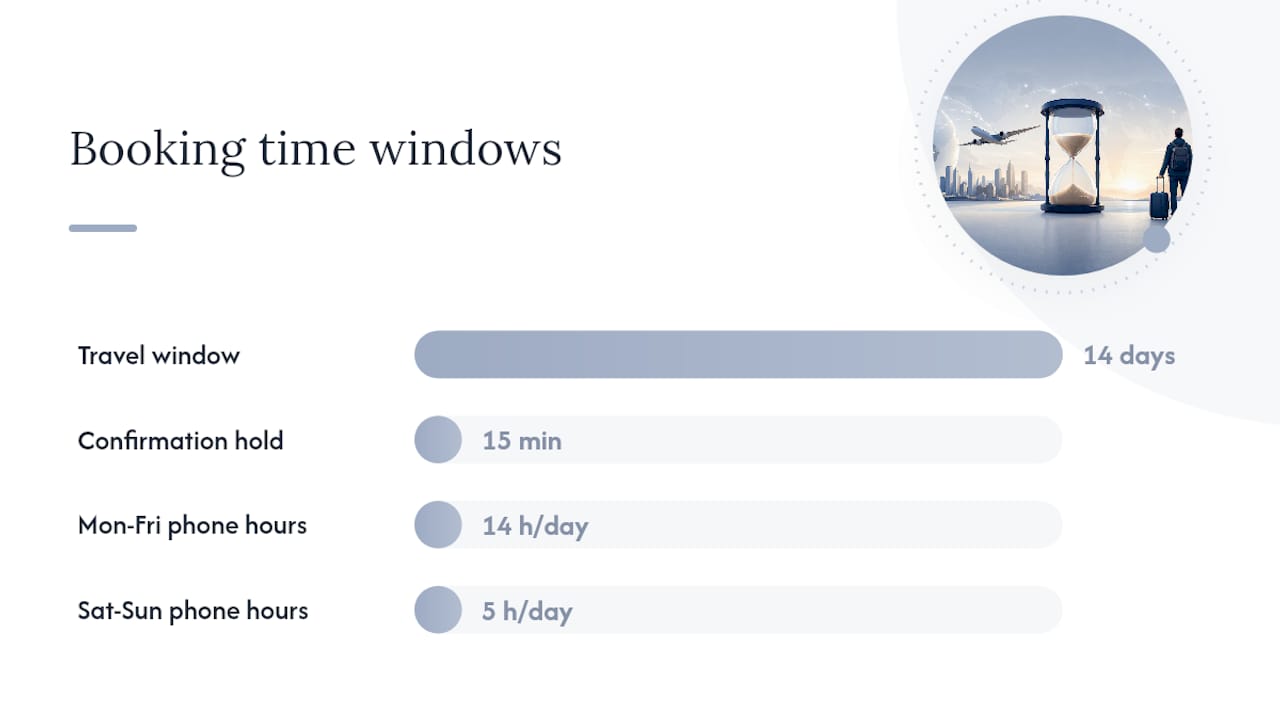
- Go to the official appointment portal at travel.state.gov and select a passport agency or center near you. Check availability for dates within your 14-day travel window.
- Complete the verification steps immediately. The system sends email and SMS confirmation codes. You have a 15-minute hold window to confirm. If you miss it, the slot is released and you must start over.
- If no online slots are available, call the State Department's National Passport Information Center. Phone lines are available Monday through Friday, 8:00 AM to 10:00 PM Eastern Time, and Saturday through Sunday, 10:00 AM to 3:00 PM Eastern Time. A TDD/TTY line is also available for accessibility. The official contact page lists current numbers and hours.
- If you are abroad and cannot reach a domestic agency, contact the nearest U.S. embassy or consulate directly using their emergency-passport contact form. Include your full name, date of birth, travel date, and a brief description of the emergency.
- If all channels fail, contact your U.S. congressional representative's office. Congressional caseworkers can sometimes intervene with the State Department on behalf of constituents in genuine emergencies.
Check regional passport agency locations and eligibility rules before you call, so you know which office serves your area.
Pro Tip: Before opening the booking portal, scan or photograph every supporting document and save them as PDFs on your phone. Some booking flows ask for attachments during the session, and having files ready prevents the clock from running out while you search.
What happens at the agency, and how long does it take?
Emergency appointments are designed to produce a passport quickly, but the exact turnaround depends on the agency's workload that day.
| Pathway | Travel window | Typical processing |
|---|---|---|
| Life-or-death emergency | Within 14 calendar days | Same day to a few business days |
| Urgent travel | Within 2–3 weeks (or 28 days with visa) | 2–3 business days at agency |
| Overseas embassy (example: Bern) | Case-by-case | During office hours |
What to expect at the appointment:
- Arrive 15 minutes early. Agencies have security screening similar to a federal building — no liquids beyond small amounts, no large bags in some locations.
- A clerk reviews your documents at the window. Have everything organized in the order listed in the checklist above.
- You may be asked brief questions about your relationship to the patient and your travel plans. Answer directly and factually.
- Fees are collected at the appointment (see the next section).
- Pickup is always in person. Emergency passports are not mailed. You or an authorized representative must return to the agency to collect the document. Bring the same photo ID you used at the appointment.
For state-specific agency hours and local notes, the Florida fast-passport guide is one example of the regional detail that can save a wasted trip.
What does an emergency passport cost?
Emergency passport fees follow the same structure as full-validity passports. There is no separate "emergency surcharge" from the State Department, but you should budget for several line items:
- Passport book application fee (adult): set by the State Department; check the official fees page for the current amount, as fees are updated periodically.
- Execution fee: paid at the acceptance facility if you are filing DS-11 for the first time; not required for DS-82 renewals.
- Expedite fee: an additional charge if you request expedited processing at the agency level.
- Overnight or priority courier fee: if you arrange return delivery through a courier service, that cost is separate and paid directly to the courier.
Most passport agencies accept credit cards, debit cards, checks, and money orders. Cash acceptance varies by location — confirm with your specific agency before you arrive. Courier or expedited shipping fees are paid separately from government fees and are not collected by the State Department.
Special cases: minors, renewals, first-time applicants, and expired passports
Minors (under 16): Both parents or guardians must appear in person at the appointment, or one parent must bring a notarized statement of consent from the absent parent. Additional documentation includes the child's proof of citizenship and proof of the parent-child relationship. There are no shortcuts to this requirement, even in a genuine emergency.
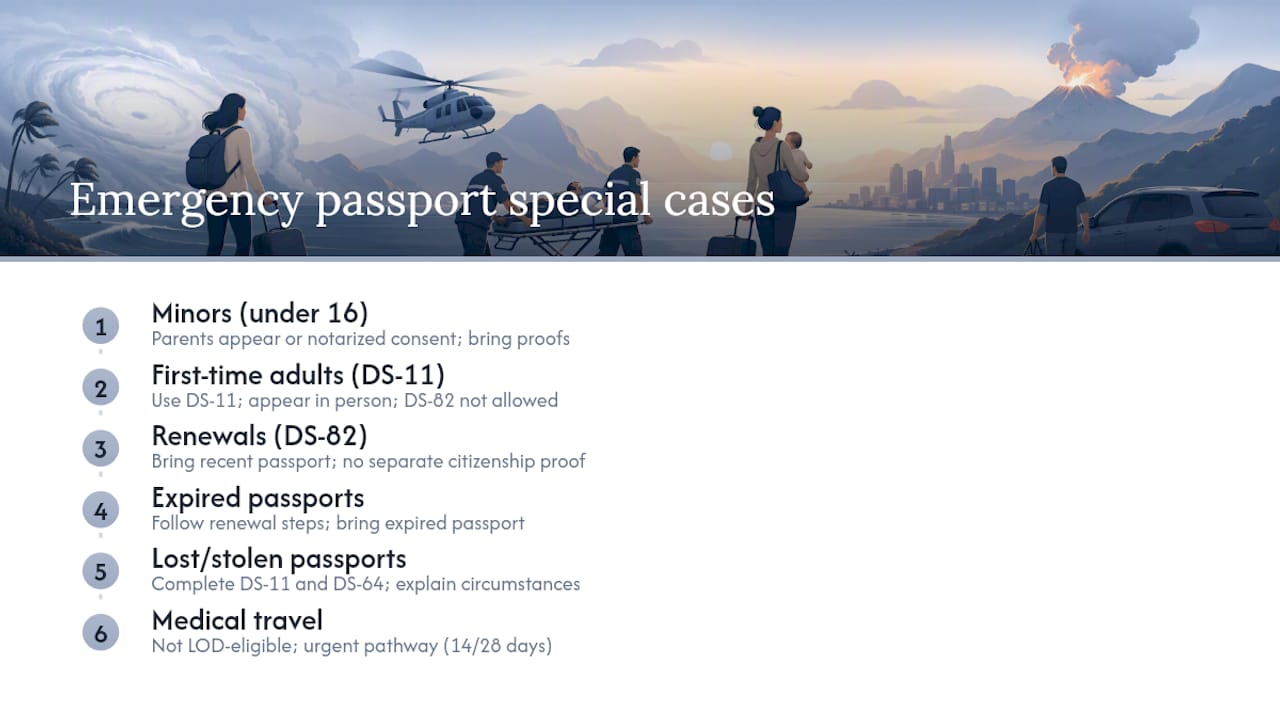
First-time adult applicants: You must use DS-11 and appear in person. You cannot use the DS-82 renewal form if you have never held a U.S. passport or if your most recent passport was issued more than 15 years ago, issued before age 16, or reported lost or stolen.
Renewals: If you qualify for DS-82, the process is faster because you do not need to provide proof of citizenship separately. Bring your most recent passport book along with the completed form.
Expired or lost passport in an emergency: If your passport is expired, follow the expired passport renewal process steps and bring the expired document to the appointment. If it is lost or stolen, you must complete a DS-11 and a DS-64 (lost/stolen declaration) and be prepared to explain the circumstances at the window.
Traveling for your own medical care: This does not qualify for life-or-death service. Apply under the urgent travel pathway, which requires travel within 14 calendar days (or 28 days if a visa is needed).
Emergency appointment checklist and ready-to-use templates
One-page appointment checklist
- Completed DS-11 or DS-82 (correct form for your situation)
- One 2×2 passport photo (white background, taken within 6 months)
- Primary government-issued photo ID + photocopy
- Proof of U.S. citizenship + photocopy (if required)
- Proof of emergency (death certificate, mortuary statement, or hospital letter)
- Certified translation + translator's statement (if document is not in English)
- Confirmed airline itinerary or ticket showing travel within a short time frame
- Payment for all applicable fees
- Appointment confirmation (printed or on your phone)
- Arrive 15 minutes early with documents organized in the order above
Template A: Hospital/doctor letter
Template B: Mortuary/death statement
Pro Tip: For non-English documents, hire a professional translator and ask them to include a signed statement certifying that the translation is accurate and complete. The State Department requires this statement — a bilingual friend's translation will not be accepted.
What the author has seen go wrong
The most common errors at the agency window are not missing documents — they are wrong documents. A hospital letter typed on plain paper instead of official letterhead, a death certificate that is a photocopy rather than a certified original, or an itinerary that shows a booking hold rather than a confirmed ticket. Each of these sends you back to square one.
Following the checklist above and using the templates as a starting point cuts those errors significantly. Passportcenter's regional guides also include agency-specific notes — hours, parking, and local quirks — that are worth checking before you leave the house.
Passportcenter can help you prepare faster
When you are facing a family crisis and a tight travel window, the last thing you need is to spend hours hunting for the right State Department page or wondering whether your documents will pass inspection.
Passportcenter offers free, plain-language guides covering every step of the emergency passport process — from which form to use, to what a valid hospital letter must include, to which regional passport agency serves your area. For readers who want hands-on help beyond the guides, the site connects you to registered expedited passport courier services that know these requirements inside out. Visit Passportcenter to find your regional guide and get the right documents together before your appointment.
Sources
The rules in this guide come directly from official State Department and embassy sources. For final verification, always use these primary pages:
- Make an Appointment at a Passport Agency
- Emergency Passports - U.S. Embassy in Switzerland and Liechtenstein
If you are abroad, contact the nearest U.S. embassy or consulate directly. Their local emergency-passport page will have procedures specific to that post, which may differ from domestic agency rules.