
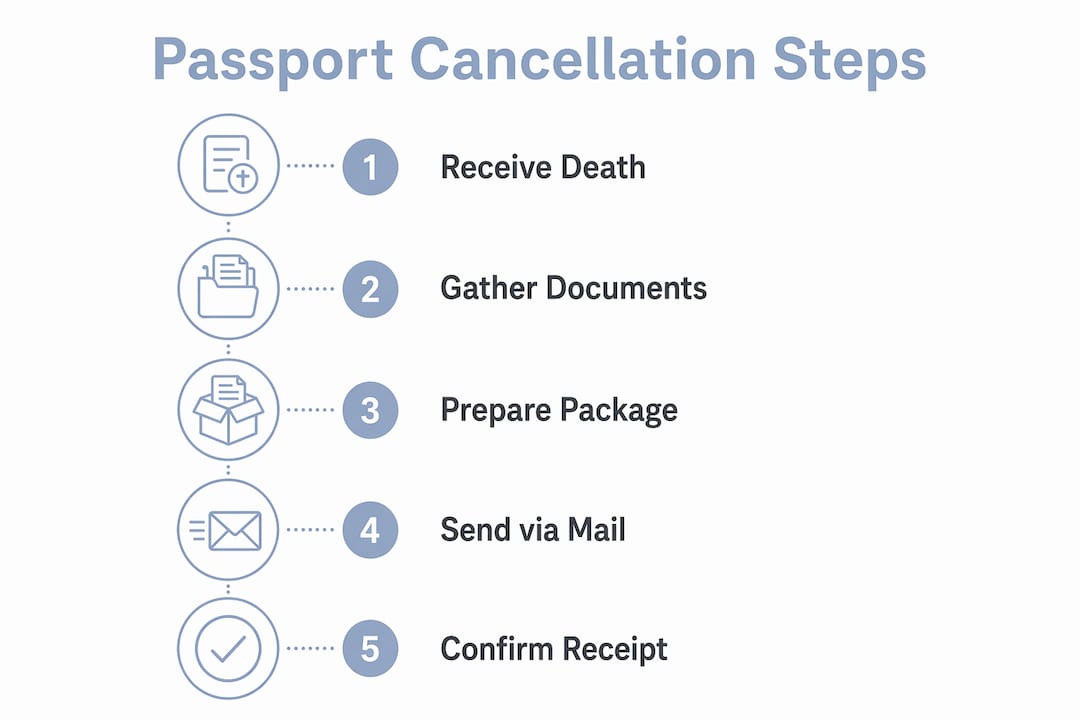
When someone dies, their U.S. passport needs to be returned to the U.S. Department of State for official cancellation. The process is not legally required, but the U.S. Department of State strongly recommends it to prevent identity theft and fraudulent use of the document. Here is what you need to do:
- Mail the physical passport to the State Department's Consular Lost and Stolen Passport Unit (CLASP)
- Include a certified copy of the death certificate
- Include a signed letter requesting cancellation and stating whether you want the passport returned or destroyed
- Mailing address: U.S. Department of State, CLASP, 44132 Mercure Circle, P.O. Box 1227, Sterling, VA 20166-1227
- If you want to keep the passport as a keepsake, request its return in your letter; the State Department will send it back with a cancellation mark
Why canceling a deceased person's passport matters
The passport does not become void automatically at death. Under 22 CFR § 51.7, a U.S. passport remains government property, and any unauthorized use by another person is a federal offense. That legal reality makes cancellation more than a formality.
- A valid, uncanceled passport can be used for identity fraud, account takeovers, or illegal border crossings
- Cancellation removes the document from active status, closing off those risks
- Official guidelines treat cancellation as a proactive security measure, even though no law mandates it
- The difference between a legal requirement and best practice is real here: you will not face a penalty for skipping it, but the exposure you leave open is serious
How to cancel a deceased person's passport with the U.S. Department of State
The entire process happens by mail. There is no online form for a deceased person's passport, and passport agencies in major cities do not handle cancellations for deceased individuals. Follow these steps:
- Gather the passport. Locate the physical document. If it has expired, you can still submit it; cancellation applies to valid passports, but submitting an expired one for recordkeeping is also acceptable.
- Obtain a certified death certificate. This must be a certified copy, not a photocopy. Order extras now because banks, insurers, and other agencies will each need one.
- Write a cancellation letter. Per State Department guidance, the letter should include the deceased's full name, date of birth, passport number (if available), your name and contact information, and a clear instruction to either return or destroy the passport after cancellation.
- Mail everything securely. Send the packet to CLASP at the Sterling, VA address above.
- Request the return of your documents. Ask in your letter for the canceled passport and certified death certificate to be sent back. You will want both for estate records.
"You can return the passport of a deceased relative for cancelation. After we cancel it, we will return the passport if requested." — U.S. Department of State
Cancellation requests can take several weeks, so plan accordingly when coordinating other estate tasks.
Pro Tip: Use USPS Certified Mail with return receipt when sending the passport and death certificate. You get a tracking number and a delivery confirmation, which protects you if anything goes missing in transit.
Can you keep the passport as a keepsake?
Yes. Many families want to hold onto a loved one's passport as a personal memento, and the State Department accommodates that. The key is making sure the document is officially canceled before you keep it.
- Request the passport's return in your cancellation letter; the State Department will punch or stamp it to mark it invalid
- Once returned, store it safely with other important documents, away from anyone who might mistake it for a valid travel document
- Do not keep an uncanceled passport as a keepsake. An unmarked passport sitting in a drawer is still a usable identity document if it falls into the wrong hands
- If you plan to display it, a note or label confirming cancellation is a simple extra precaution
What to avoid and what else to consider
A few common mistakes can create real problems during an already difficult time.
- Do not use the passport. Using a deceased person's passport for travel is a federal crime under 22 CFR § 51.7. Do not allow family members or anyone else to attempt it.
- Do not report it as lost or stolen. The lost/stolen reporting process is for living passport holders. Reporting an expired passport as lost or stolen is explicitly prohibited, and the deceased person's passport follows a separate cancellation path.
- Do not discard it without canceling. Throwing away an uncanceled passport creates an identity theft risk. The document remains valid until the State Department cancels it.
- If the passport is lost or cannot be found, you cannot submit it physically. In that case, contact the State Department directly to report the situation. The process differs from the standard cancellation mail-in.
- Notify airlines, travel insurers, and booking agencies independently if the deceased had upcoming travel. Each organization has its own protocol and will typically require a death certificate.
How passport cancellation fits into estate administration
Passport cancellation is one task within a broader set of responsibilities. Handling it early reduces the risk of the document being misused while you work through everything else.

The estate administration process typically requires notifying Social Security, financial institutions, credit bureaus, and government benefit programs. Each of those agencies will ask for a certified death certificate, which is why ordering multiple certified copies upfront saves time. The canceled passport and returned death certificate from CLASP also serve as useful documentation for estate records.
For broader passport guidance and resources, Passportcenter covers the full range of U.S. passport procedures in plain language.

Key Takeaways
Canceling a deceased person's U.S. passport by mailing it to CLASP with a certified death certificate is the most direct way to prevent identity theft and close out the document properly.
| Point | Details |
|---|---|
| Cancellation is not legally required | The State Department strongly recommends it to prevent identity theft and fraud. |
| Mail to CLASP in Sterling, VA | Send the passport, certified death certificate, and a cancellation letter to the official CLASP address. |
| Request the passport back | Ask in your letter if you want the canceled document returned as a keepsake or for estate records. |
| Processing takes several weeks | Plan for the timeline when coordinating other estate and legal tasks. |
| Order extra death certificates | Banks, insurers, and other agencies each require a certified copy. |