
For entry into any of the Schengen Area countries, your U.S. passport must be valid for at least three months beyond your planned departure date from the Schengen Area. It also needs to have been issued within the last 10 years, with at least two blank visa pages left inside.
That's the core rule. But it's not the whole picture.
- Schengen minimum: Valid 3+ months past your departure date
- Issuance limit: Passport issued within the past 10 years
- Blank pages: At least two required
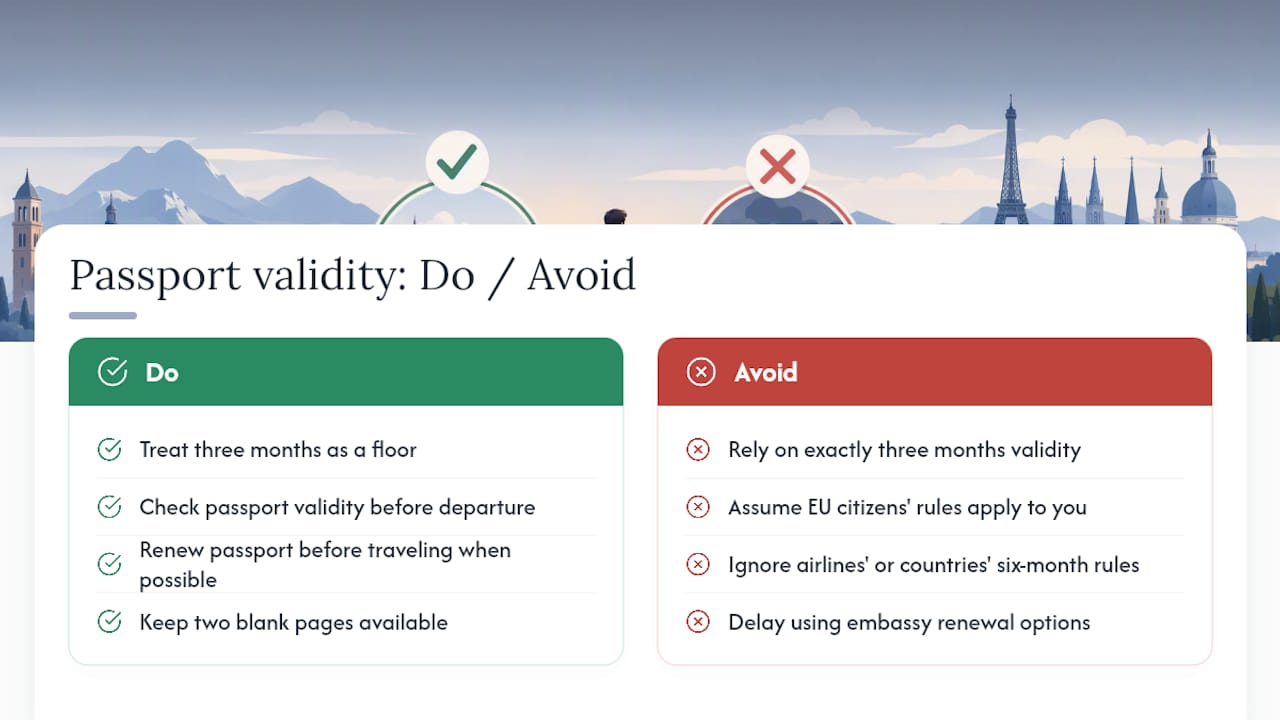
- Watch for stricter checks: Some non-Schengen countries and individual airlines apply six-month rules or run their own automated validity checks, regardless of what EU law technically requires
Pro Tip: If your passport expires within a year of your trip, don't cut it close. Renew now, before you book anything.
Key Takeaways
Meeting Schengen's three-month, 10-year, and two-blank-page rules is necessary but not sufficient. Airlines and destination-specific rules can be stricter.
| Point | Details |
|---|---|
| Three-month buffer | Your passport must be valid beyond your final Schengen departure date, with an appropriate margin, not just your arrival date. |
| Ten-year issuance rule | A passport issued more than 10 years ago fails Schengen entry even with time left before expiration. |
| Non-Schengen exceptions exist | The UK requires an ETA and its own validity standard; other countries may apply six-month rules. |
| Airlines can be stricter than the law | Check-in systems sometimes enforce six-month rules even where three months is legally sufficient. |
| Renew early if margins are tight | Standard renewal takes weeks; expedited couriers and regional agencies exist for last-minute trips. |
Table of Contents
- Passport Validity for Schengen Travel: Your Pre-Trip Checklist
- Schengen Area Rules Explained: What Article 12 Actually Requires
- Non-Schengen Europe: The UK and Other Exceptions
- Airlines and Visa Applications: Where the Real Enforcement Happens
- Calculating Passport Validity for a Multi-Country Europe Trip
- Renewing Your U.S. Passport Before a Europe Trip
- What the Passport Rules Don't Tell You
- Frequently Asked Questions
- Sources
Passport Validity for Schengen Travel: Your Pre-Trip Checklist
Before you book a single flight, run through three checks. Skipping any one of them is how travelers end up stuck at check-in.
- Check your expiration date against your last day in Europe. Not your first day, your last. Count forward three full months from that date.
- Confirm your issue date. Flip to the photo page. If it was issued more than 10 years before your travel date, it fails the Schengen rule even if the expiration date looks fine.
- Count your blank pages. You need two completely empty visa pages, not pages with old stamps or amendment notes.
If any of those checks fail, you have three options: renew now, pay for expedited processing, or call the airline and destination country's embassy to confirm before you travel. Don't guess.
Schengen Area Rules Explained: What Article 12 Actually Requires
The three-month buffer, the 10-year cap, and the two-blank-page rule all trace back to one regulation: Article 12 of Regulation 810/2009, which governs entry conditions for non-EU nationals across the Schengen bloc.
Article 12 sets three mandatory conditions for entry: the passport must be valid for at least three months beyond the intended date of departure from the Schengen Area, it must have been issued within the previous 10 years, and it must contain at least two blank pages.
Here's the part that trips people up: that three-month window is measured from your planned departure from the entire Schengen Area, not from the country you're visiting first. If you fly into Paris, spend a week in France, then continue to Italy and Greece before flying home, the clock runs from your exit date out of Greece, your last Schengen stop.
The 10-year issuance rule exists independently of expiration. A passport issued 11 years ago with 2 years of validity left still fails, because the issuance window matters as much as the remaining time.
Blank pages matter for a practical reason too. Border officers still use physical stamps in many Schengen countries, and the EU's rollout of the Entry/Exit System (EES) is shifting some of that to digital records, but not everywhere at once. Until that transition is complete, arriving with a passport full of old stamps and no room left can cause real delays.
- A validity period extending beyond your final Schengen departure date
- Issued within the last 10 years
- Two blank visa pages minimum
Non-Schengen Europe: The UK and Other Exceptions
Not every European destination follows Schengen rules, and this is where a lot of travelers get tripped up planning multi-country itineraries.
The United Kingdom isn't in the Schengen Area and has its own entry system entirely. U.S. travelers now need an Electronic Travel Authorisation (ETA) before arrival, and the UK's passport-validity expectations differ from Schengen's three-month rule. Check GOV.UK directly before you fly, since ETA requirements have been rolling out in phases.
Beyond the UK, a handful of European countries and territories outside the Schengen framework may apply six-month validity rules more commonly associated with destinations in Asia or the Middle East. This isn't universal, but it's common enough that assuming "Europe means three months" everywhere is a mistake.
Before booking:
- Confirm whether your destination is inside or outside the Schengen Area
- Check that specific country's embassy website for its own passport-validity standard
- Don't assume UK rules mirror EU rules, they don't
Airlines and Visa Applications: Where the Real Enforcement Happens
The law is one thing. What actually happens at the gate is another. Airlines run their own automated document checks before you ever reach a border agent, and those systems are often programmed to the stricter six-month standard, even for Schengen-bound flights where three months is the legal minimum.
That mismatch is where U.S. travelers get denied boarding, not because they broke Schengen law, but because an airline's check-in software flagged their passport anyway. Consulates add another layer: some require longer validity at the time you apply for a visa, and a passport nearing expiration can result in a visa issued for a shorter window than you expected.
What to do about it:
- Call the airline's customer service line before departure and ask specifically about passport-validity requirements for your route
- Carry printed proof of onward or return travel in case a gate agent asks
- Save the destination country's embassy or consulate contact information in case a document question comes up mid-trip
Pro Tip: When in doubt, meet the six-month standard even for Schengen travel. It costs you nothing and it satisfies every airline's automated check.
Calculating Passport Validity for a Multi-Country Europe Trip
Get this math wrong and you could book flights, hotels, and tours for a trip you can't legally take. Here's how to do it correctly.
- Identify your final departure date from the Schengen Area (or from the specific country, if it's non-Schengen like the UK).
- Add three months to that date. Your passport's expiration date must fall after that new date.
- Verify the issue date falls within the last 10 years.
- If traveling to a non-Schengen country in the same trip, check that destination's rule separately, it may require six months instead.
If your passport clears the calculation with less than a couple of weeks to spare, renew before you go. Border agents have discretion, and a razor-thin margin invites questions you don't need.
Renewing Your U.S. Passport Before a Europe Trip
If your passport fails any of the checks above, timing determines your options. Standard renewal processing through the State Department typically takes several weeks, while expedited service cuts that down for an added fee. If your trip is close and you're not eligible to renew by mail, an in-person appointment at a regional passport agency is usually reserved for travel within about two weeks, and requires proof of imminent departure.

For travelers who can't get a same-day slot or don't want to navigate agency scheduling themselves, a registered expedited passport courier can handle the paperwork and hand-deliver applications to speed things up. It's not free, but it solves the problem when time is the constraint.
Before you start any renewal:
- Confirm which renewal form applies to your situation
- Gather an acceptable secondary ID plus your most recent passport
- Check current processing times before deciding whether to expedite
- Review what happens if you're traveling on an expired passport by mistake
| Situation | Best Option |
|---|---|
| Trip is 3+ months away | Standard renewal by mail |
| Trip is 2–4 weeks away | Expedited renewal, possibly with agency appointment |
| Trip is under 2 weeks away | Regional agency appointment or expedited courier service |
What the Passport Rules Don't Tell You
Most articles on this topic stop at reciting Article 12. That's the easy part. The harder truth is that legal minimums and real-world enforcement are two different things, and the gap between them is where travelers get stranded.
The conventional advice, "just make sure you have three months," treats Schengen's rule as the only rule that matters. It isn't. Airline check-in systems, consulate visa timelines, and non-Schengen entry systems like the UK's ETA all operate on their own logic, and none of them are required to match EU law exactly. A passport that's technically compliant with Article 12 can still get you turned away at a gate agent's counter.
If there's one thing worth prioritizing over memorizing the exact rule, it's building in margin. Renew early. Treat six months as your personal standard even where three is the legal floor. Confirm your specific airline and destination separately rather than assuming Schengen compliance covers your whole itinerary.
The rules are knowable. The mistake is assuming they're simple.
Frequently Asked Questions
Is passport validity for Schengen really just three months? Yes, three months beyond your planned departure from the Schengen Area is the legal minimum under Article 12. But airlines and some non-Schengen countries apply stricter six-month standards, so treat three months as a floor, not a target.
Do EU citizens face the same passport validity for Europe travel as U.S. travelers? No. EU/EEA citizens travel under freedom-of-movement rules and don't face the three-month, 10-year, or blank-page requirements. Those rules apply specifically to non-EU nationals, including U.S. passport holders.
What happens if I show up with insufficient passport validity? You can be denied boarding by the airline before you ever reach European soil, or denied entry by a border agent if you do arrive. Some travelers have also faced truncated visa terms when applying with a passport nearing its 10-year or expiration limits.
Do European microstates like Monaco or San Marino have separate rules? Monaco and San Marino don't maintain independent border control from their surrounding Schengen neighbors (France and Italy, respectively), so Schengen's validity rules effectively apply when you cross into them.
Can I renew my U.S. passport while I'm already traveling in Europe? Yes, U.S. embassies and consulates abroad can process passport renewals, though timelines vary by location and case. It's far better to confirm validity before departure than to handle it mid-trip.
Does the two-blank-pages rule still matter with the EU's new Entry/Exit System? It still applies for now. The EES is shifting some border processing to digital records, but the physical blank-page requirement remains in effect during the transition.
This article is general information, not a substitute for advice from a qualified lawyer. Consult a qualified legal professional about your own circumstances before acting on anything here.
Sources
- U.S. Travelers in Europe - State Department
- Travel documents for non‑EU nationals - Your Europe
- Travel-europe
- Gov
- Schengen entry passport validity rules - SchengenVisaInfo