
As of July 8, 2026, the U.S. Department of State reports the following official processing times:
- Routine processing: 4–6 weeks
- Expedited processing: 2–3 weeks
These figures cover only the State Department's internal review. They do not include the time your application spends in the mail. Add up to 2 weeks for your application to reach the agency, and up to 2 more weeks for your passport to arrive after it ships back. In a realistic worst case, a routine application takes close to 10 weeks from the day you drop it in the mail.
Table of Contents
- What does the U.S. Department of State actually say about processing times?
- What is the realistic total timeline from application to passport in hand?
- When should you choose expedited service or book an agency appointment?
- How do you get an urgent passport appointment at a regional agency?
- How do you check your passport application status?
- What causes passport delays, and how do you avoid them?
- How Passportcenter helps you plan around official processing times
- Key Takeaways
- The honest case for applying earlier than you think you need to
- Passportcenter makes passport planning straightforward
- Official sources and further reading
What does the U.S. Department of State actually say about processing times?
The State Department is clear about what "processing time" means and what it doesn't cover.
In plain terms: the clock the State Department publishes starts when your application arrives at a passport agency or center, and it stops when they put your passport in the mail. Everything before and after that window is on you to plan for.
Key points from the State Department's guidance:
- Routine service: 4–6 weeks (processing only)
- Expedited service: 2–3 weeks (processing only), available for an additional $60 fee
- Urgent travel: Requires an in-person appointment at a regional passport agency; you must show proof of international travel within 14 calendar days
The $60 expedited fee is on top of the standard application fee. It buys you faster processing at the agency, not faster mail delivery. If you want faster delivery on the return trip, you pay separately for that shipping upgrade.
What is the realistic total timeline from application to passport in hand?
The official numbers are a starting point, not the full picture. Here is how the timeline actually stacks up when you factor in every stage.
Timeline components:
- Inbound mail (application to State Dept): up to 2 weeks
- State Dept processing — routine: 4–6 weeks
- State Dept processing — expedited: 2–3 weeks
- Outbound mail (passport to you): up to 2 weeks
What that means in practice:
A routine application can take anywhere from 8 weeks on the short end to 10 weeks in a realistic worst case. An expedited application runs as little as 6 weeks, but up to 7 weeks total when mailing is included. The State Department advises applicants to factor total time, not just processing time, when booking travel.
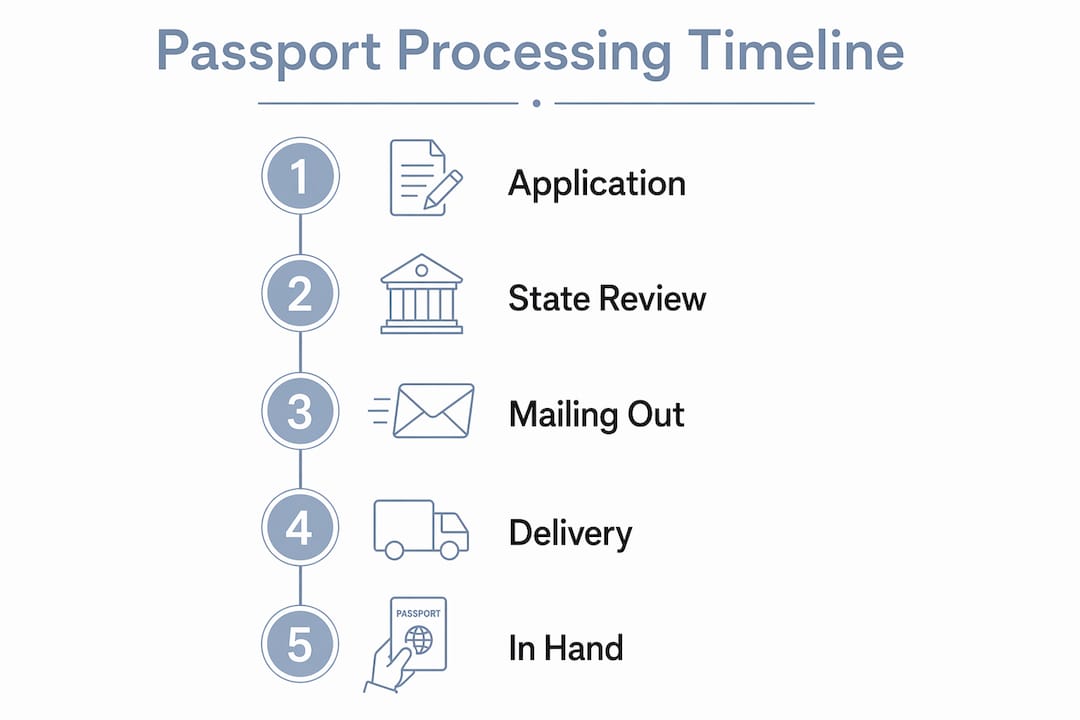
One detail many people miss: it can take up to 2 weeks from the day you apply before your status even shows as "In Process." That lag is normal, but it can feel alarming if you are watching the tracker daily.

Pro Tip: Pay for 1–3 day return delivery when you submit. It won't speed up the State Department's review, but it cuts the back-end wait from up to 2 weeks to a few days. On a tight schedule, that margin matters.
When should you choose expedited service or book an agency appointment?
The decision comes down to how much time you have before your travel date. Here are the practical cutoffs.
Use expedited service if you are traveling in less than 6 weeks. Routine processing alone runs 4–6 weeks, and that excludes mailing. Anyone departing in under 6 weeks from submission should pay the additional $60 for expedited service as a baseline. Experts consistently recommend expedited service for travelers with less than six weeks between submission and departure.
Book a regional agency appointment if you are traveling within 14 days. The State Department requires proof of international travel within 14 calendar days to qualify for an urgent appointment. This is not a suggestion; it is the eligibility threshold. You cannot walk into a passport agency without an appointment and expect service.
The 28-day visa rule: If you need a foreign visa before you travel, the State Department's status and appointment pages note that travelers who need a visa within 28 days may also qualify for an expedited appointment. Check the official guidance for your specific situation.
Decision summary:
- Travel in 6+ weeks: Routine service is likely fine; monitor status closely
- Travel in 3–6 weeks: Pay for expedited service
- Travel in under 14 days: Book an urgent agency appointment immediately
- Need a visa within 28 days: Contact the agency; you may qualify for an appointment
Pro Tip: Don't book non-refundable flights until your passport is in hand or your application is confirmed "In Process." Applying 3 months ahead for routine travel and 6–8 weeks ahead for expedited gives you a real buffer.
How do you get an urgent passport appointment at a regional agency?
If your travel is within 14 calendar days, here is exactly what you need to do.

Eligibility requirement: You must have documented international travel within 14 calendar days, or need a foreign visa within 28 days.
Acceptable proof of travel:
- Airline itinerary or confirmed ticket showing departure date
- Cruise booking confirmation
- Hotel reservations tied to international travel
Step-by-step checklist:
- Go to the Make an Appointment page on travel.state.gov
- Select the regional passport agency nearest to you
- Book the earliest available slot; agencies are in high demand during peak season
- Gather your documents before the appointment (see below)
- Arrive on time; agencies run on tight schedules
What to bring to your appointment:
- Completed DS-11 or DS-82 form (whichever applies to your situation)
- Proof of U.S. citizenship (birth certificate, previous passport, or naturalization certificate)
- Government-issued photo ID and a photocopy
- Passport photo meeting official size requirements
- Proof of travel (itinerary, tickets, or booking confirmation)
- Payment for applicable fees (check, money order, or credit card depending on the agency)
For New York-area travelers, Passportcenter's New York expedited passport guide covers agency-specific logistics and appointment tips.
How do you check your passport application status?
The State Department's online status tool is at passportstatus.state.gov. You will need three pieces of information to use it.
Required inputs:
- Last name (exactly as it appears on your application)
- Date of birth
- Last four digits of your Social Security Number
How to troubleshoot a "no match" error:
The tool is sensitive to formatting. If your name contains a hyphen, apostrophe, or suffix (Jr., Sr., III), try entering it multiple ways. The status tool can fail to locate your application if the punctuation or suffix doesn't match what was entered on your form. Try without hyphens, without suffixes, and with alternate capitalizations before assuming there is a real problem.
Your 9-digit application locator number also tells you something useful: the first two digits identify the specific regional passport agency or processing center handling your case. Reference that number any time you contact the State Department directly.
When to escalate:
- Status has not changed to "In Process" after 2 weeks: normal, but monitor it
- You receive a letter or email requesting additional documents: respond immediately; the clock pauses until they receive your response
- Travel is within 14 days and status shows no movement: call the National Passport Information Center or book an urgent appointment
For a detailed breakdown of what each status code means, Passportcenter's guide on supporting documents mailed explains what happens after the State Department requests more information.
What causes passport delays, and how do you avoid them?
Most delays are preventable. The common culprits:
- Incomplete or incorrect forms: Missing signatures, wrong dates, or blank required fields trigger a request for evidence that pauses processing entirely
- Photo rejections: Wrong dimensions, improper background, glasses, or shadows on the face are among the most frequent rejection reasons. Review the official photo requirements before submitting
- Name discrepancies: The name on your application must match your supporting documents exactly. A middle name on one document but not another can stall review
- Missing supporting documents: First-time applicants and those with name changes must include original documents. Copies are not accepted for most items
- Postal delays: Applying during peak season (late winter through summer) means both inbound and outbound mail moves slower. October through December tends to avoid the worst backlogs
- Rare but serious: Outstanding legal issues, including a passport warrant or restriction, can block issuance entirely. Passportcenter's guide on passport warrants covers what that means for your travel rights
A request for additional evidence doesn't just add paperwork. It can add weeks to your timeline, because processing doesn't resume until the State Department receives and reviews your response.
How Passportcenter helps you plan around official processing times
Passportcenter is a free informational resource built specifically for U.S. travelers trying to make sense of passport timelines, requirements, and options. The site translates the State Department's processing-only numbers into realistic total timelines, covers state-specific agency logistics, and refers travelers who need professional help to registered expedited courier services.
What you'll find on Passportcenter:
- Plain-language guides on passport renewal steps, eligibility, and required documents
- State-specific expedited guides (Florida, New York, and more)
- Status-tracking walkthroughs and explanations of every status code
- Referrals to vetted, registered passport courier services for travelers who want professional help managing submission and return transit
Pro Tip: A registered courier service can't speed up the State Department's internal review, but it can reduce errors on submission, handle overnight delivery to the agency, and manage the return shipment. For travelers with tight timelines, that reduction in logistical risk is worth considering. For trip-planning resources that align your travel bookings with realistic passport arrival dates, Planytera's travel planning blog is a practical complement.
Passportcenter links to official State Department sources for final authority on all processing times and requirements. The site is an informational resource, not a government agency.
Key Takeaways
Routine passport processing currently runs 4–6 weeks and expedited runs 2–3 weeks, but mailing adds up to 4 weeks on top, making realistic total timelines 8–10 weeks for routine and 6–7 weeks for expedited.
| Point | Details |
|---|---|
| Official processing times | Routine: 4–6 weeks; Expedited: 2–3 weeks (processing only, per State Dept as of July 2026). |
| Mailing adds real time | Budget up to 2 weeks inbound and 2 weeks outbound; total routine timeline can reach 10 weeks. |
| When to expedite | Pay the $60 expedited fee if your travel date is less than 6 weeks from submission. |
| When to book an agency appointment | Travel within 14 calendar days requires an urgent in-person appointment with proof of travel. |
| Passportcenter as a planning tool | Use Passportcenter for plain-language timelines, state-specific guides, and courier referrals. |
The honest case for applying earlier than you think you need to
Most people underestimate how much the mailing window changes the math. The State Department's published times look manageable until you add two weeks on each end and realize a "6-week" routine application can stretch to 10. My recommendation: treat the expedited window as your baseline if travel is within 8 weeks, not 6. That extra buffer absorbs a postal delay, a minor document issue, or a status hold without forcing you into an emergency agency appointment.
For anyone managing a renewal alongside other travel documents, Passportcenter's guide on Global Entry application timing is worth reading before you book. Stacking two slow-moving government processes without a plan is how people end up at a regional agency the week before departure.
Passportcenter makes passport planning straightforward
Passportcenter is the free resource U.S. travelers use to cut through the confusion around passport timelines. Instead of piecing together information from multiple government pages, you get plain-language guides that translate official processing times into realistic planning deadlines, state-specific agency logistics, and honest explanations of what expedited service does and doesn't do.
When you need more than information, Passportcenter refers travelers to registered passport courier services that handle submission, overnight delivery to the agency, and return shipment. That's not a replacement for the State Department's review, but it removes the logistical variables that cause preventable delays.
For final authority on processing times and fees, always verify at travel.state.gov. Passportcenter is an informational resource, not a government agency, and all official requirements are subject to change.
Check your options at Passportcenter and start your application with a realistic timeline in hand.
Official sources and further reading
Last checked: July 2026
- Current Processing Times — travel.state.gov: The primary source for routine and expedited processing times, updated regularly by the State Department.
- Check Your Application Status — travel.state.gov: The official status tracker; use this to monitor your application and understand what each status means.
- Make an Appointment — travel.state.gov: Book an urgent appointment at a regional passport agency if your travel is within 14 days.
- Get Your Passport Fast — travel.state.gov: Official guidance on expedited options, faster shipping, and total timeline planning.
- Passport Application Status Tool — passportstatus.state.gov: Direct link to the online status checker; have your last name, date of birth, and last four of your SSN ready.
- Passportcenter.ai — Plain-language guides, state-specific expedited information, and referrals to registered courier services for U.S. travelers.
This article is general information, not legal or government advice. Always confirm current processing times and requirements directly with the U.S. Department of State or a qualified professional before making travel plans.