What is a secondary ID for a passport application?
A secondary ID for a passport application is an official document that helps prove your identity when you cannot present a primary photo ID. The U.S. Department of State requires at least two secondary IDs if you lack a qualifying primary photo ID. These documents work together to establish a credible identity record.
Here is what you need to know upfront:
- Primary photo IDs include a fully valid driver's license, enhanced driver's license, military ID, or previously issued U.S. passport.
- Secondary IDs are supporting documents, not replacements for primary IDs. They are used only when a primary ID is unavailable.
- You must submit at least two secondary IDs if no primary photo ID is available.
- Secondary IDs can include documents with or without photos, such as Social Security cards, student IDs, or expired driver's licenses.
- Out-of-state applicants face a specific rule: if your driver's license was issued in a different state than where you are applying, it counts as a secondary ID, not a primary one.
- Gather your documents well before your appointment to avoid delays.
Table of Contents
- Acceptable secondary IDs for your passport application
- Rules you must follow when submitting secondary IDs
- What to do if you lack a primary photo ID
- Instructions for out-of-state applicants
- Special provisions if you lack primary IDs entirely
- How to get acceptable secondary ID documents if you do not have them
- How minor status affects acceptable secondary IDs
- Key Takeaways
Acceptable secondary IDs for your passport application
The State Department publishes a specific list of documents that qualify. Some carry photos; others rely on your name and signature. Both types count.
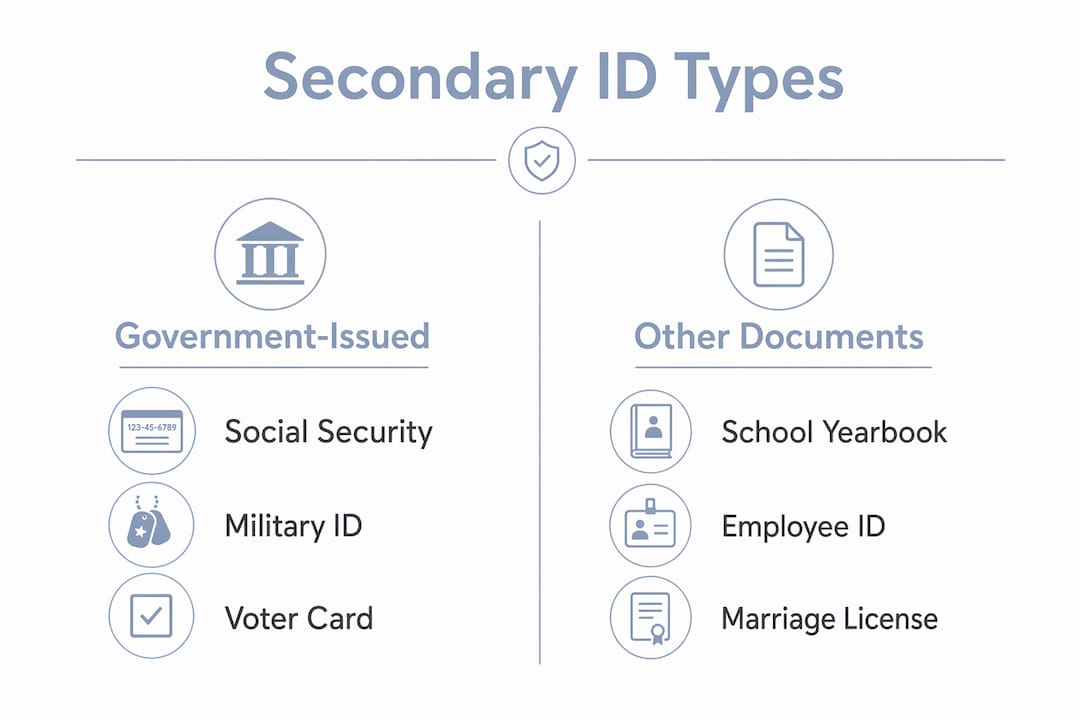
Documents accepted as secondary identification:
- Out-of-state driver's license or enhanced driver's license with photo
- Learner's or temporary driver's permit (without a photo)
- In-state, fully valid non-driver ID (without a photo)
- Out-of-state non-driver ID
- Temporary driver's license (without a photo)
- Social Security card
- Voter registration card
- Employee work ID
- Student ID
- School yearbook with an identifiable photograph
- Selective Service (draft) card
- Medicare or other health card
- Expired driver's license
The school yearbook entry surprises most applicants. As long as your photo is clearly identifiable, it qualifies. The role of affidavits and supporting documents in identity verification follows a similar logic: multiple pieces of evidence build a credible picture of who you are.
| Category | Document | Has Photo? |
|---|---|---|
| Government-issued | Social Security card | No |
| Government-issued | Voter registration card | No |
| Government-issued | Selective Service card | No |
| Government-issued | Medicare / health card | No |
| Government-issued | Expired driver's license | Sometimes |
| Government-issued | Out-of-state driver's license | Yes |
| Government-issued | Learner's / temporary permit | No |
| Educational / Institutional | Student ID | Usually yes |
| Educational / Institutional | School yearbook with photo | Yes |
| Employment | Employee work ID | Usually yes |
Rules you must follow when submitting secondary IDs
Getting the documents together is only half the job. How you submit them matters just as much.
Key submission rules:
- Two documents minimum. If you have no primary photo ID, at least 2 secondary IDs are required. One is never enough on its own.
- Out-of-state license = secondary ID. Many applicants assume their driver's license covers them everywhere. It does not. Applying in a state different from where your license was issued means it is classified as a secondary ID, and you will need additional documents alongside it.
- Bring a second photo ID if your license is out-of-state. The State Department specifically advises this for out-of-state applicants.
- Name consistency matters. Every document you submit should reflect the same legal name. Discrepancies can trigger delays or requests for additional evidence.
- Photocopies are required. You must provide a photocopy of the front and back of any photo ID you submit.
- Expired IDs have limits. An expired driver's license is on the accepted list, but an expired primary photo ID does not automatically qualify as a primary ID. It drops to secondary status.
- No photo? No problem, but bring more. Documents without photos are accepted, but they carry less weight individually. Pair them with at least one document that includes your photo or signature.
A secondary ID that lacks your name, photo, or signature is the most common reason documents get rejected. Check each one before you leave the house.
What to do if you lack a primary photo ID

If you genuinely cannot produce a primary photo ID, the State Department has two formal options beyond the standard secondary ID list.
Form DS-71: Identifying Witness. This form lets someone who has known you for at least two years vouch for your identity in person. The witness must appear with you at an acceptance facility, present their own valid primary ID, and sign an affidavit. This option is only available when applying in person. It cannot be used for mail-in applications or requests for vital records.
Form DS-5520: Supplemental Questionnaire. In complex cases where identity is difficult to verify, a passport agency may send you Form DS-5520. This is not something you request proactively. The agency triggers it when your submitted documents raise questions. You respond by mailing detailed supporting documentation back to the agency.
Pro Tip: Bring every secondary ID document you own to your appointment, even ones you are unsure about. The acceptance agent makes the final call, and more evidence always works in your favor. Prioritize documents that show your photo or signature first.
Instructions for out-of-state applicants
If you are applying for a passport in a state other than the one that issued your driver's license, your license does not function as a primary photo ID. The State Department classifies it as a secondary ID in that situation, which means you need to bring additional documents to meet the two-secondary-ID minimum, or a second qualifying photo ID.
The practical fix is straightforward: bring a second photo ID alongside your out-of-state license. A valid passport card, military ID, or another government-issued photo ID from any state will satisfy the requirement. If you only have one photo ID and it is out-of-state, pull together two additional secondary documents from the accepted list above before your appointment. Check the passport renewal process guide for more on what to bring when your documents are not straightforward.
Special provisions if you lack primary IDs entirely
Some applicants, particularly those who have never held a driver's license or whose documents were lost or destroyed, arrive without any primary photo ID at all. The State Department does not turn these applicants away, but the bar for identity verification is higher.
Your best path is to combine as many secondary IDs as possible, prioritizing documents with your photo, then those with your signature, then name-only documents. Form DS-71 with an identifying witness is the strongest supplemental option available. If the agency still cannot verify your identity after reviewing your submission, Form DS-5520 may be requested. For applicants navigating unusual document situations, supporting documents guidance covers what happens after your application is submitted and additional materials are needed.
How to get acceptable secondary ID documents if you do not have them
If you are short on secondary IDs, several are obtainable quickly:
- Social Security card: Request a replacement through the Social Security Administration online or at a local SSA office. Processing typically takes 10–14 business days.
- Voter registration card: Contact your county or state election office. Many states allow same-day or next-day reprints.
- Student ID: If you are currently enrolled, your school's registrar or student services office can reissue one.
- Employee work ID: Your HR department can usually reprint a badge within a day or two.
- Medicare card: Request a replacement through Medicare.gov or by calling 1-800-MEDICARE.
None of these require a passport or primary photo ID to obtain, which makes them accessible even when you are in a documentation gap. The citizenship eligibility assessment process outlines how supplemental documentation works in broader identity verification contexts, which follows similar principles.
How minor status affects acceptable secondary IDs
Children under 16 applying for a passport do not present their own primary photo ID. Instead, both parents or guardians must bring their own physical photo identification to the acceptance facility. The child's identity is established through their birth certificate and parental documentation, not through the child's personal ID.
For teenagers between 16 and 17, the same primary photo ID rules apply as for adults. A valid driver's license from the state of application works as a primary ID. If the teen does not yet have a license, a school ID combined with another secondary document from the accepted list satisfies the requirement. School yearbooks with an identifiable photo are particularly useful for younger applicants who have not yet accumulated a standard ID portfolio.
Key Takeaways
Without a primary photo ID, you need at least two secondary IDs from the State Department's accepted list to support a U.S. passport application.
| Point | Details |
|---|---|
| Minimum secondary IDs required | Submit at least 2 secondary IDs if you cannot present a primary photo ID. |
| Out-of-state license rule | A driver's license from another state counts as secondary ID, not primary. |
| Strongest secondary documents | Prioritize documents with your photo or signature to maximize acceptance. |
| Witness option available | Form DS-71 lets a two-year acquaintance vouch for your identity in person. |
| Minors follow different rules | Children under 16 rely on parental ID and birth records, not their own secondary IDs. |
Need more guidance on U.S. passport requirements? Passportcenter covers application steps, renewal timelines, and document rules in plain language, with connections to trusted expedited passport courier services when you need faster processing.