
For domestic U.S. flights, an expired passport can work as ID under current TSA rules. For international travel, the honest answer is no: virtually every country requires a valid, unexpired passport, and many enforce a six-month validity window beyond your travel dates.
Before you do anything else, check three sources:
- TSA identification rules for domestic flights
- Travel country pages for your destination's entry requirements
- Your airline's check-in policy directly (call or check their website)
These three checks take less than 15 minutes and can save you from a denied boarding or a missed trip.
Key Takeaways
Expired passport travel is allowed domestically under TSA rules for up to two years after expiration, but international travel requires a valid passport and often six months of remaining validity beyond your travel dates.
| Point | Details |
|---|---|
| Domestic vs. international | TSA accepts expired passports up to two years past expiration; international travel requires a valid, unexpired passport. |
| Six-month rule | Many countries require six months of passport validity beyond travel dates; check the State Department country page for your specific destination. |
| If you're abroad | Contact the nearest U.S. embassy or consulate immediately; embassies can issue emergency limited-validity passports for return travel. |
| Renewal eligibility | You can renew by mail only if your passport was issued within the last 15 years; otherwise apply in person using Form DS-11. |
| Passportcenter | Use Passportcenter for renewal checklists, expedited courier referrals, and plain-language guidance when your timeline is tight. |
This article is general information, not a substitute for advice from a qualified lawyer. Consult a qualified legal professional about your own circumstances before acting on anything here.
Table of Contents
- What the official international travel rules actually say
- Can you fly domestically with an expired passport?
- What to do if you're abroad with an expired passport
- How to renew an expired passport and your fastest options
- What happens to a valid visa in your expired passport
- How to avoid getting denied at airline check-in
- Where to verify entry and passport-validity rules before you travel
- Quick checklist: what to do right now if your passport is expired or expiring soon
- What travelers consistently get wrong about expiring passports
- Passportcenter helps when time is short and the stakes are high
- Sources
What the official international travel rules actually say
International passport validity is not set by the U.S. government. Each destination country sets its own rules, and the State Department's country information pages are where you find them.
The six-month rule explained:
- Many countries require your passport to remain valid beyond your planned departure date from their territory, often with a buffer period.
- Some countries require only that your passport is valid for the duration of your stay.
- A handful require validity for 90 days beyond your stay.
- The rule is a destination policy, not a universal law. Always check the specific country page rather than assuming the six-month standard applies everywhere.
Who actually enforces these rules:
- Airlines check your passport at check-in because carriers face government fines for boarding passengers who fail destination entry requirements.
- Foreign immigration officers at the border make the final call on entry, even if the airline let you board.
- CBP officers handle re-entry to the U.S. on your return.
Once you submit a renewal application, your old passport becomes invalid for travel, even if it hasn't physically expired yet. The State Department's after-you-apply guidance is explicit on this point.
Pro Tip: Airline staff sometimes apply stricter internal policies than the destination country requires. Treat airline check-in as your first enforcement gate, not just a formality. If an agent tells you verbally that your passport is fine, ask them to note it in the booking record.
Can you fly domestically with an expired passport?
For U.S. domestic flights, the rules are more forgiving than most travelers realize.
TSA currently accepts certain expired IDs, including U.S. passport books and passport cards, up to two years after the expiration date. This applies only at the TSA security checkpoint and only for ID types already on TSA's approved list. It does not apply to international travel, and it does not override airline boarding policies.
Acceptable ID types for domestic TSA screening:
- U.S. passport book (expired up to two years)
- U.S. passport card (expired up to two years)
- DHS trusted traveler cards (Global Entry, NEXUS, SENTRI)
- REAL ID-compliant state driver's license or ID card
- Military ID
- Permanent resident card
Practical caveats to keep in mind:
- TSA's expired-ID acceptance is a convenience, not a guarantee. Policy can change, and individual officers have discretion.
- Airlines may run their own identity checks at the gate, separate from TSA screening. An expired passport that clears TSA may still flag an airline agent.
- If your state-issued ID is not yet REAL ID-compliant, check your state DMV's timeline. Full REAL ID enforcement is in effect, and a non-compliant state ID will not work at TSA checkpoints.
- Bring a secondary form of ID whenever you rely on an expired document. Two forms of ID give you a fallback.
Treat TSA's expired-passport acceptance as a short-term bridge, not a long-term plan. Renew as soon as your schedule allows.
What to do if you're abroad with an expired passport
If you're already overseas and your passport is expired, lost, or stolen, follow these steps in order.
- Contact the nearest U.S. embassy or consulate immediately. Find the location at Step. If you haven't enrolled in the Smart Traveler Enrollment Program (STEP) yet, do it now so the embassy can reach you directly.
- Call the embassy's American Citizens Services line. Most embassies have a 24-hour emergency number. Explain your situation and ask specifically about emergency passport services.
- Gather your documents before the appointment. Bring whatever you have: a photocopy of your expired or lost passport, a second form of ID, proof of U.S. citizenship (birth certificate copy if available), two passport photos, and proof of your travel itinerary.
- Request an emergency or limited-validity passport. Embassies can issue emergency passports valid for a limited period, typically sufficient for direct return to the U.S. These are not full 10-year passports, but they get you home.
- If your passport was lost or stolen, file Form DS-64. This reports the document as lost or stolen and prevents misuse. You can complete it at the embassy or online through the State Department.
- Check whether any CBP exceptions apply. During 2021 and 2022, the CBP Carrier Liaison Program issued bulletins allowing some U.S. citizens to return directly on certain expired passports. Those exceptions extended through June 30, 2022. No standing exception exists now, but check CBP's current guidance before assuming none applies.
- Contact your airline. Once you have an emergency travel document, call the airline to update your booking and confirm they will accept the document for boarding.
Pro Tip: Keep a digital copy of your passport photo page, your visa pages, and one extra passport photo stored in your email or cloud storage before every international trip. If you're lost or your passport is stolen abroad, those files cut your embassy appointment time significantly.
How to renew an expired passport and your fastest options
The right renewal path depends on how much time you have and when your passport was issued.
Eligibility: mail renewal vs. in-person
You can renew by mail only if your passport was issued within the last 15 years and you meet the other criteria: you were over 16 when it was issued, it's undamaged, and your name hasn't changed or you have legal documentation of the change. If any of those conditions don't apply, you must apply in person using Form DS-11 at an acceptance facility or regional passport agency.
Service levels and typical timelines:
| Service Level | Typical Processing Time | Notes |
|---|---|---|
| Standard (mail) | 6 weeks | Routine applications with no travel urgency |
| Expedited (mail) | 2–3 weeks | Additional fee required; add mailing time |
| Regional agency (urgent) | Same day to 3 days | Requires appointment; travel must be within 14 days |
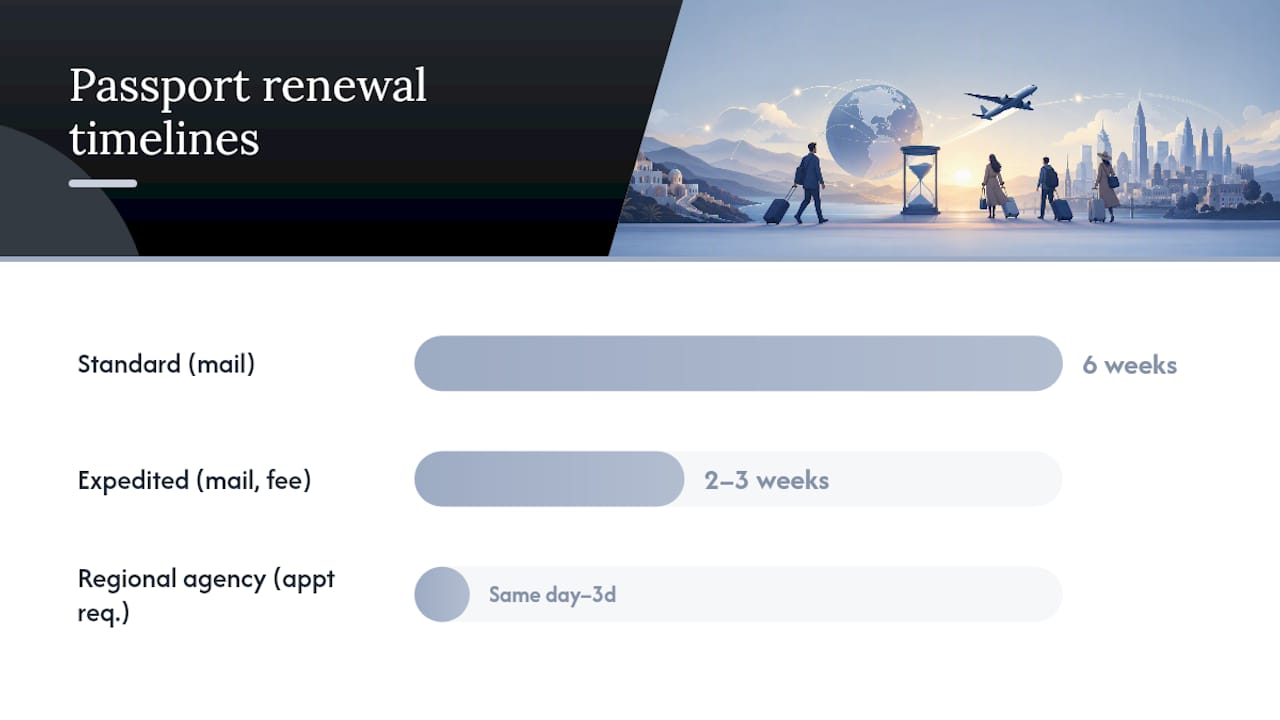
Track your application status at Passportstatus after you submit.
Fees to expect (verify current amounts at travel.state.gov before applying):
- Standard adult passport book application fee
- Execution fee (charged at acceptance facilities)
- Expedite fee (added on top of application fee for faster processing)
- Optional overnight courier fees for return delivery
What to prepare before you apply:
- Your most recent expired passport (submitted with the application)
- Completed Form DS-82 (mail renewal) or DS-11 (in-person)
- One passport photo meeting current State Department photo specifications
- Proof of name change if your legal name has changed since the last passport was issued
- Payment for applicable fees
For a complete document checklist and step-by-step walkthrough, the expired passport renewal guide at Passportcenter covers every scenario.
Pro Tip: If you need a regional passport agency appointment, book it the moment you know your travel date. Appointment slots at agencies in major cities fill days in advance. Check the regional passport agency guide for locations and eligibility rules before you call.
You can also start the online renewal process directly through the State Department for eligible applicants. Avoid any unofficial third-party site that charges a fee just to submit your application form.
What happens to a valid visa in your expired passport
A valid visa stamped into an expired passport does not automatically become invalid when the passport expires. Many countries allow you to travel using a valid visa in an old passport, provided you carry both your expired passport and your current valid passport together.
Key rules to follow:
- Verify with the embassy or consulate that issued the visa. This is the only authoritative source for whether your specific visa type and destination country allow dual-passport travel.
- Carry both passports at every checkpoint: airline check-in, immigration entry, and exit. Border officers need to see the visa in the old passport alongside your valid travel document.
- Update your Trusted Traveler Program accounts (Global Entry, NEXUS) with your new passport number before travel. Mismatched passport numbers can trigger delays at automated kiosks.
- Some visa types, particularly certain work or student visas, require the visa holder to apply for a new visa when the passport expires. Do not assume the dual-passport rule applies universally.
When in doubt, contact the embassy of your destination country directly. A five-minute phone call is faster than a denied boarding.
How to avoid getting denied at airline check-in
Most boarding denials for passport issues are preventable. The problem is almost always that travelers check country rules or airline rules, but not both.
Pre-departure checklist:
- Confirm your passport's expiration date and compare it against your destination's validity requirement (check the State Department country page).
- Call your airline's customer service line and ask specifically whether your passport will be accepted for your route. Note the agent's name and the date of the call.
- Bring a backup photo ID to every flight, domestic or international.
- Arrive at the airport at least 30 minutes earlier than usual if you have any document uncertainty. Document checks take longer when agents need to escalate.
- If the airline confirms your document is acceptable, ask them to add a note to your booking record. A verbal confirmation that isn't logged helps no one if a different agent checks you in.
Pro Tip: If an airline refuses to board you, ask immediately for a written denial stating the specific reason. That document is your strongest tool for requesting a refund, rebooking, or filing a dispute. Without it, airlines can attribute the denial to "passenger error" and decline compensation.
Where to verify entry and passport-validity rules before you travel
The fastest way to get an authoritative answer is to go directly to official government sources. Third-party travel blogs, including this one, summarize rules, but the primary sources are what airlines and border officers actually follow.
Official sources to check:
- Travel: Use the "Learn About Your Destination" search box. Look for the "Entry/Exit Requirements" section and search specifically for "passport validity."
- TSA identification page: Covers acceptable IDs for domestic security screening, including the expired-ID policy.
- CBP travel pages: Check for any current Carrier Liaison Program bulletins affecting return-to-U.S. travel.
- U.S. embassy or consulate websites: Each embassy posts country-specific entry requirements and emergency contact information.
- Your airline's official website or customer service line: Airline policies sometimes exceed destination requirements.
Register at Step before any international trip. If a crisis, natural disaster, or civil unrest affects your destination, the embassy uses STEP enrollment to contact you directly.
Quick checklist: what to do right now if your passport is expired or expiring soon
Work through this list in order. Don't skip steps.
- Stop and verify. Check your passport's expiration date against your travel dates and your destination's validity requirement.
- Check the State Department country page for your destination's entry and passport-validity rules.
- Check TSA's ID page if you're flying domestically and plan to use an expired passport as ID.
- Call your airline and confirm whether your passport will be accepted. Log the agent's name and call date.
- If you're already abroad: Call the nearest U.S. embassy or consulate immediately. Enroll in STEP at Step if you haven't already.
- Start your renewal. If you have time before travel, begin the passport renewal process immediately. Choose expedited service if your trip is within three weeks.
- Book a regional agency appointment if your travel is within 14 days and you need an urgent in-person appointment.
- Gather your documents: expired passport, DS-82 or DS-11, passport photo, proof of citizenship, and any name-change documentation.
- Keep digital copies of your passport photo page and travel documents in your email or cloud storage.
For a printable version of this checklist and step-by-step renewal guidance, visit Passportcenter.
Emergency contacts:
- State Department emergency line (for Americans abroad): 1-888-407-4747 (from the U.S.) or +1-202-501-4444 (from overseas)
- Your airline's customer service line (on your booking confirmation)
- Nearest U.S. embassy or consulate (find at Step)
What travelers consistently get wrong about expiring passports
The most common mistake isn't ignoring the six-month rule. It's assuming the rule is universal and stopping there.

Travelers check one source, usually a travel blog or a friend's advice, confirm the six-month rule applies to their destination, and consider the job done. What they miss is that the airline may apply a stricter internal standard, or that their specific destination only requires validity for the duration of stay. Both errors produce the same outcome: a boarding denial or a refused entry, and a ruined trip.
The second mistake is relying on verbal airline confirmation without documentation. An agent who tells you at the phone that your passport is fine has no binding authority. A different agent at check-in can make a different call. The only protection is a written note in your booking record or a printed policy statement from the airline.
One practical move most travelers skip: photograph the airline's written policy on your phone before you leave for the airport. If a dispute happens at the counter, you have the policy in hand rather than scrambling to recall what the website said.
Verify both the country rules and the airline rules, independently, from primary sources. One check is not enough.
Passportcenter helps when time is short and the stakes are high
When your passport is expired and your trip is close, the last thing you need is to wade through conflicting information across a dozen government pages.
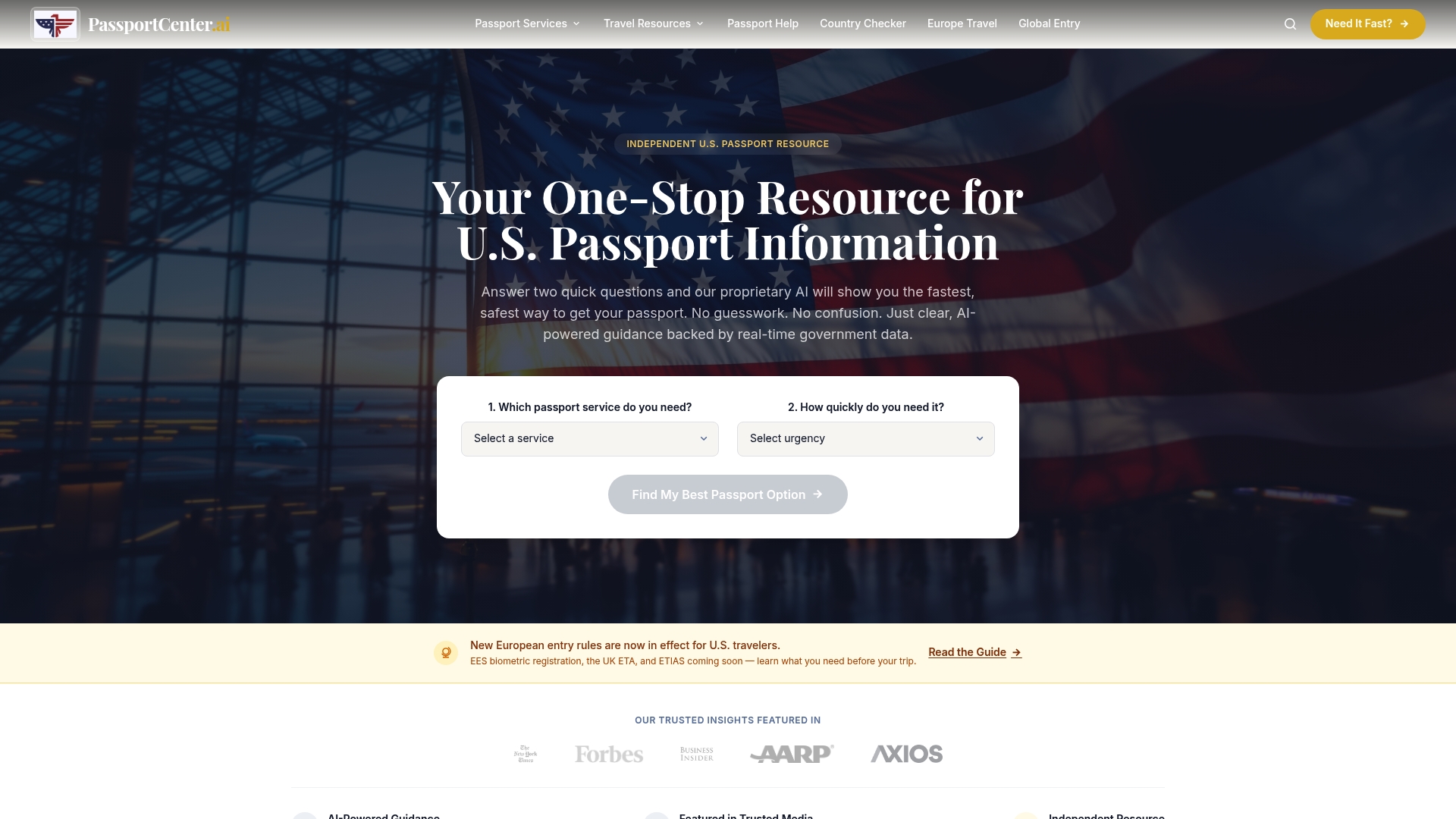
Passportcenter is a free resource built specifically for U.S. travelers in exactly this situation. The site covers renewal eligibility, processing timelines, photo requirements, and country-specific entry rules in plain language, with direct links to official government sources so you always know where the guidance comes from. For travelers who need faster processing than standard mail allows, Passportcenter connects you to vetted, registered expedited passport courier services that can cut weeks off your timeline.
Passportcenter does not replace official government instructions. It organizes them, fills in the gaps, and points you to the right professional help when the clock is running. If you need a printable renewal checklist, agency locations, or a clear answer on which service level fits your timeline, start at Passportcenter.
Sources
- Frequently Asked Questions about Passport Services - Travel
- Acceptable Identification at the TSA Checkpoint | Transportation Security Administration
- Carrier Liaison Program: Travel of U.S. Citizens with Expired Passports (CBP bulletin)
- Usa