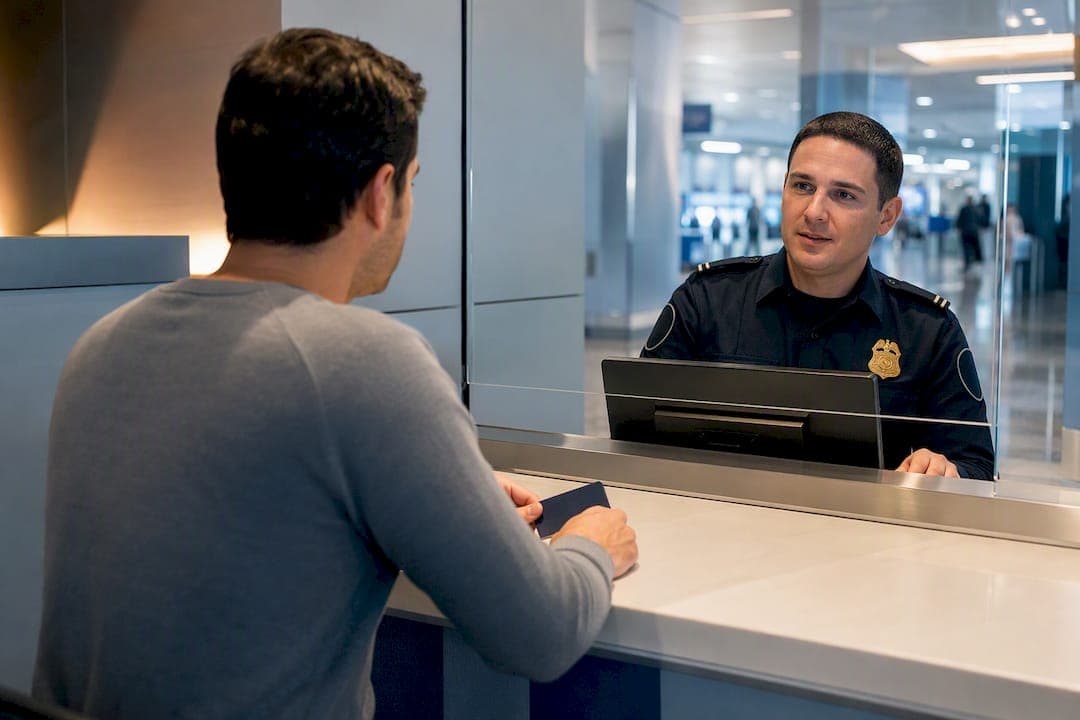
Yes. If you're conditionally approved for Global Entry, you can typically complete your required interview the moment you land at a participating U.S. port of entry, no scheduled appointment needed. The catch: it only works if the port supports Enrollment on Arrival that day. Have your passport, proof of residency, and a printed or saved copy of your conditional approval ready before you step off the plane.
TL;DR:
- Enrollment on Arrival is limited by participating ports, staffing, and time windows, making preparation and early verification essential for success.
- Travelers should carry all passports, proof of residency, and conditional approval evidence, as missing documents are the most common reason for delays or re-routing.
- The interview typically lasts 5 to 15 minutes, but delays may occur due to staffing, document mismatches, or special accommodations.
- For land crossings, minors, or special needs, verifying procedures beforehand helps avoid last-minute surprises or cancellations.
- Treat Enrollment on Arrival as a useful option but not a reliable guarantee, and prepare thoroughly to maximize the chances of completing the interview smoothly.
Table of Contents
- What Is Enrollment on Arrival and Who Can Use It?
- Which Airports and Land Ports Support It?
- How to Complete the Interview on Arrival, Step by Step
- What Documents and Biometrics Should You Bring?
- Special Situations: Land Crossings, Minors, and Accommodations
- How Long Does the Interview Take, and What Causes Delays?
- Traveler-Tested Tips From PassportCenter.ai
- How PassportCenter.ai Helps You Prepare
- Get Interview-Ready Before You Fly
- Why the "Just Show Up" Advice Undersells This Process
- Sources
What Is Enrollment on Arrival and Who Can Use It?
Enrollment on Arrival (EoA) lets conditionally approved Global Entry applicants finish their interview during the standard admissibility inspection instead of booking a separate appointment at an enrollment center. It's built into the same line you'd stand in anyway, which is why it saves so much time compared to the alternative.
To qualify, you need conditional approval already sitting in your TTP profile, and you need to complete the interview within the window CBP and TTP allow after that approval, or your application risks cancellation. There are three versions of the program depending on how you cross the border:
- EoA covers standard air arrivals at participating international airports.
- EoA-Ped applies to pedestrians crossing at participating land ports.
- EoA-Veh applies to travelers arriving by vehicle at those same land ports.
Each version follows the same core idea. You get inspected as a regular international arrival, then request the interview before you leave the checkpoint.
Which Airports and Land Ports Support It?
Not every port of entry offers Enrollment on Arrival, and even ports that do support it don't guarantee it at every terminal or every hour. CBP's official Enrollment on Arrival page lists which airports and preclearance locations currently participate, and that list changes as CBP adjusts staffing.
A few practical checks before you fly:
- Look up your arrival airport on CBP's list a few days before departure, not months in advance.
- If you're arriving by land, confirm the port supports EoA-Ped or EoA-Veh rather than assuming all crossings do.
- If you fly through a preclearance location, verify EoA operates there, since preclearance staffing patterns differ from domestic-arrival airports.
- When in doubt, ask the CBP officer at primary inspection. Staffing that day decides more than any published list.
How to Complete the Interview on Arrival, Step by Step
Walking through this once before you travel removes almost all the guesswork at the booth.
Before you leave home:
- Confirm your conditional approval status in your TTP profile and save a screenshot or printed copy.
- Gather every passport you hold, even ones you don't plan to travel on for this trip.
- Pull together proof of residency and your permanent resident card if you carry one.
- Check TTP for any additional document requests specific to your application.
At the airport or land port:
- Follow standard international arrival signage to primary inspection like any other returning traveler.
- Tell the CBP officer you'd like to complete Enrollment on Arrival, or ask to be directed to the EoA area.
- Hand over your documents when asked. The officer verifies your identity and application details against what you submitted originally.
- Expect fingerprint and photo capture as the final step. This is what activates your enrollment and links it to your identity records.
Most interviews typically run a short duration when your paperwork is in order, according to consistent guidance from CBP and independent travel guides covering the process. A successful interview typically triggers a confirmation message and cancels any enrollment-center appointment still sitting on your TTP account, according to CBP's FAQ page.
Pro Tip: If the officer can't complete your interview that day, whether it's a staffing gap or an accommodation issue, don't panic. Your conditional approval stays valid, and you'll typically need to schedule an enrollment-center appointment instead.
What Documents and Biometrics Should You Bring?
Skipping one document is the single most common reason travelers get bounced from an EoA lane to a scheduled appointment instead.
- Valid passport, and every additional passport you hold if you're a dual citizen.
- Proof of residency, such as a driver's license, a recent utility bill, or a mortgage or rental statement.
- Permanent resident card, if that applies to your status.
- Conditional approval evidence from your TTP portal, either printed or pulled up on your phone.
- Secondary documents TTP specifically requested, including court papers or name-change records if your profile flagged them.
Once your paperwork checks out, the officer captures your fingerprints and a photograph. That biometric data confirms your identity and links your enrollment to law enforcement and travel records, which is why answering verification questions accurately matters more here than it might feel like in the moment.
Special Situations: Land Crossings, Minors, and Accommodations
A few scenarios don't follow the standard airport flow, and it helps to know the differences before you're standing at the booth.
- Pedestrians and vehicles at land ports should ask the primary officer to direct them to the EoA area after standard inspection. No appointment is required for EoA-Ped or EoA-Veh, though daily demand still determines whether it's running.
- Minors need the same proof-of-residency documentation as adults, plus guardian identification when traveling with a parent or guardian who is also enrolling.
- Disability accommodations should be raised with the officer immediately, not after the interview starts. If the resources you need aren't available at that moment, expect your interview to be deferred rather than denied.
- Completion windows matter. TTP sets a deadline for finishing your interview after conditional approval, and missing it can cancel your application entirely.
How Long Does the Interview Take, and What Causes Delays?
Budget 5 to 15 minutes for a straightforward EoA interview, the same range CBP and independent guides consistently cite. Add time if the officer needs to run secondary checks or verify something unusual in your file.
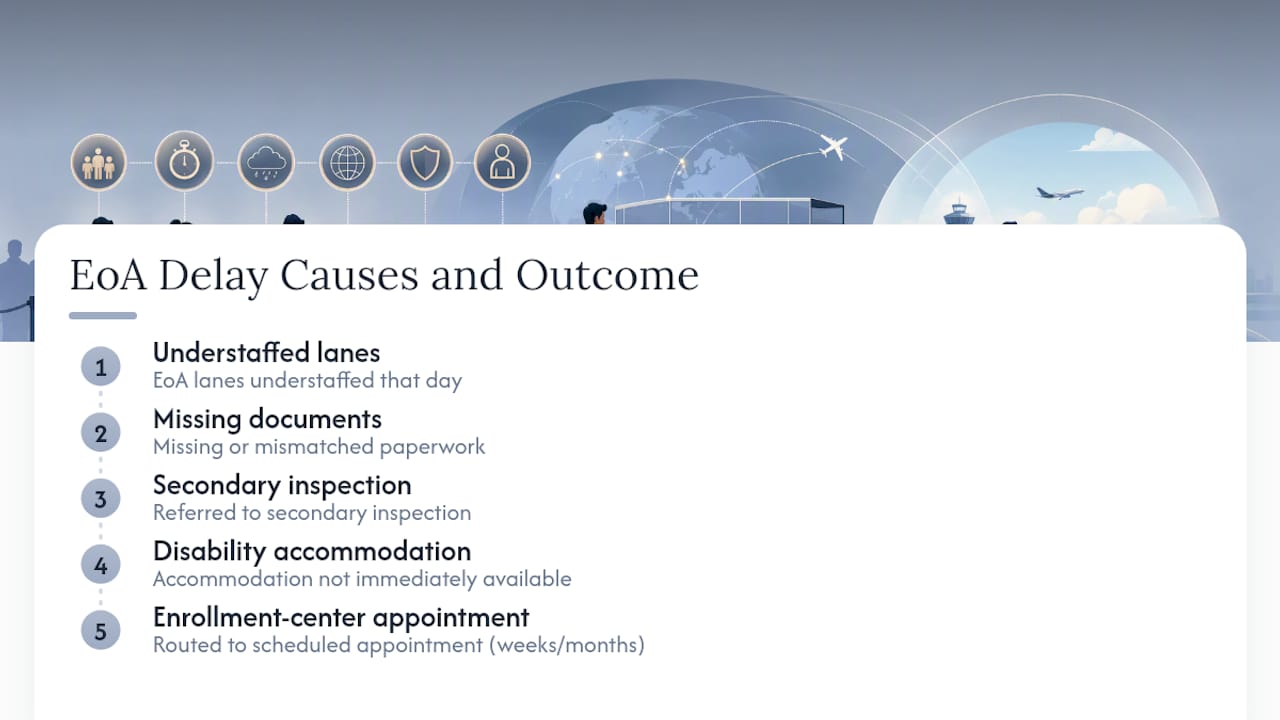
Delays usually trace back to one of four things: understaffed EoA lanes that day, missing or mismatched documents, a referral to secondary inspection, or a disability accommodation that isn't immediately available. None of these mean your application failed. They just mean you're routed toward a scheduled enrollment-center appointment instead, which some travelers already wait weeks or months to book, according to NerdWallet's guide to Global Entry appointments. That gap alone is why EoA is worth attempting first whenever it's available.
A successful interview ends with a confirmation on the officer's screen and, per CBP's FAQ, automatic cancellation of any enrollment-center appointment still on your TTP account. Check your TTP profile after you get home to confirm the appointment cleared and your enrollment shows active.
Traveler-Tested Tips From PassportCenter.ai
A little preparation at home saves a lot of standing around at the booth. Keep both digital and paper copies of your conditional approval and travel documents, since a dead phone battery shouldn't be the reason you miss EoA.
- Don't assume unclear signage means EoA isn't running. Ask the primary officer directly, since lanes get relabeled or shifted without much notice.
- Bring every passport you hold, not just the one you're traveling on.
- Don't leave proof of residency at home. It's one of the most common reasons travelers get pushed to a scheduled appointment.
- If your application involves a complicated record, a name change, or a known accommodation need, a scheduled enrollment-center appointment may serve you better than relying on EoA availability.
Pro Tip: Screenshot your TTP conditional approval page the night before you fly. Airport Wi-Fi is not something you want to depend on at primary inspection.
How PassportCenter.ai Helps You Prepare
PassportCenter.ai builds step-by-step guides and printable checklists specifically for travelers heading into their Global Entry interview, whether that's on arrival or at an enrollment center. Our interview tips guide walks through what officers typically ask and how to organize your documents before you ever reach the booth.
Get Interview-Ready Before You Fly
Most travel guides tell you what Enrollment on Arrival is. PassportCenter.ai focuses on making sure you're not scrambling for a document at the exact moment an officer asks for it. Our free checklist walks through exactly what to have ready, in what order, so the interview itself becomes the fastest part of your trip.
That's the gap PassportCenter.ai fills: CBP runs the interview, we make sure you show up prepared for it. Our Global Entry interview tips article breaks down common officer questions and how to present your conditional approval without fumbling for paperwork. If you're not sure whether you're even ready to enroll, our eligibility resources can help you sort that out before you book a flight.
To be clear, PassportCenter.ai doesn't process your enrollment or speak to CBP on your behalf. We build the preparation materials that make your actual interview faster. Visit Passportcenter now to pull up the full checklist and confirm you have everything covered before your next trip.
Why the "Just Show Up" Advice Undersells This Process
Most guides frame Enrollment on Arrival as a simple hack: skip the appointment, show up, done. That framing sets travelers up to be annoyed when it doesn't work out that way every time.
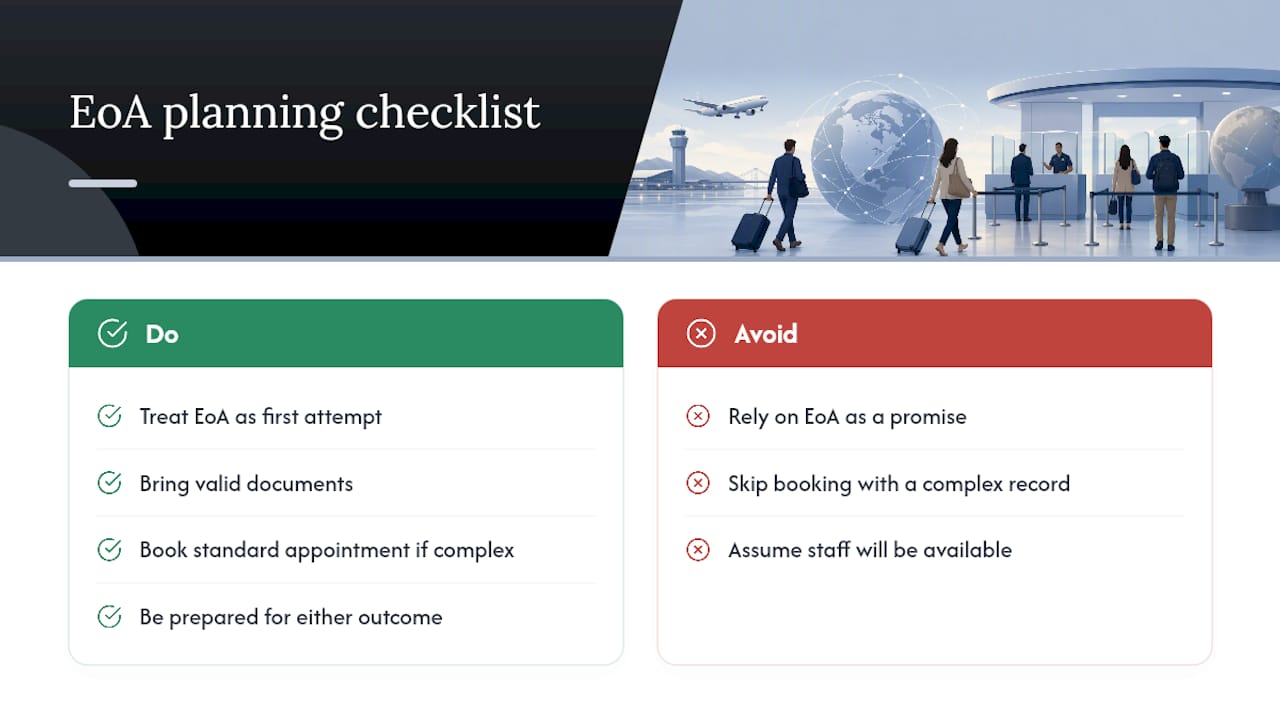
The reality is that EoA is a staffing-dependent courtesy, not a guaranteed alternative to the enrollment center. CBP built it to reduce appointment backlogs, not to replace them entirely, and that distinction shapes how you should actually plan your trip. Treat EoA as your first attempt, not your only plan. If you've got a straightforward file, valid documents, and you're arriving at a participating port, your odds are genuinely good. If your record has any complexity, a name change, a past denial, a permanent resident card that needs extra verification, you're better served booking a standard appointment and treating EoA as a bonus if it happens to work out that day.
The travelers who get frustrated with this system are usually the ones who treated a courtesy as a promise. The travelers who get the most out of it are the ones who showed up prepared for either outcome.
— David
Sources
Confirm current rules directly through CBP's Enrollment on Arrival page and your TTP profile, and check PassportCenter.ai's activation guide for next steps.
- Global Entry Enrollment on Arrival | U.S. Customs and Border Protection
- Trusted Traveler Programs information | TTP