
Yes, Global Entry has a 24-month benefit continuation, but only one thing triggers it: you must submit your renewal application before your current membership expires. Miss that date, and the continuation does not apply.
U.S. Customs and Border Protection (CBP) states it plainly: if you submit a renewal application before your membership expires, "you will be able to continue to use benefits up to 24 months after your membership expiration date" while CBP finishes processing the renewal, according to the Global Entry Frequently Asked Questions. That's the whole rule. No exceptions for travel schedules, no manual workaround if you file late.
Here's what that means in practice:
- Your Global Entry expedited reentry lane keeps working past your printed expiration date.
- Linked TSA PreCheck access continues under the same condition.
- Airport kiosks and Mobile Passport Control-style lanes still recognize your status while renewal is pending.
- The continuation only starts the clock if CBP has your renewal application on file before expiration.
That's CBP's own language, not a travel blogger's interpretation. Treat it as the operating rule for everything that follows.
Key Takeaways
The Global Entry renewal grace period only activates when you submit your renewal application before your membership's official expiration date, and it never guarantees protection against every possible manual-review delay.
| Point | Details |
|---|---|
| File before expiration | Submitting after your membership expires forfeits the 24-month continuation entirely. |
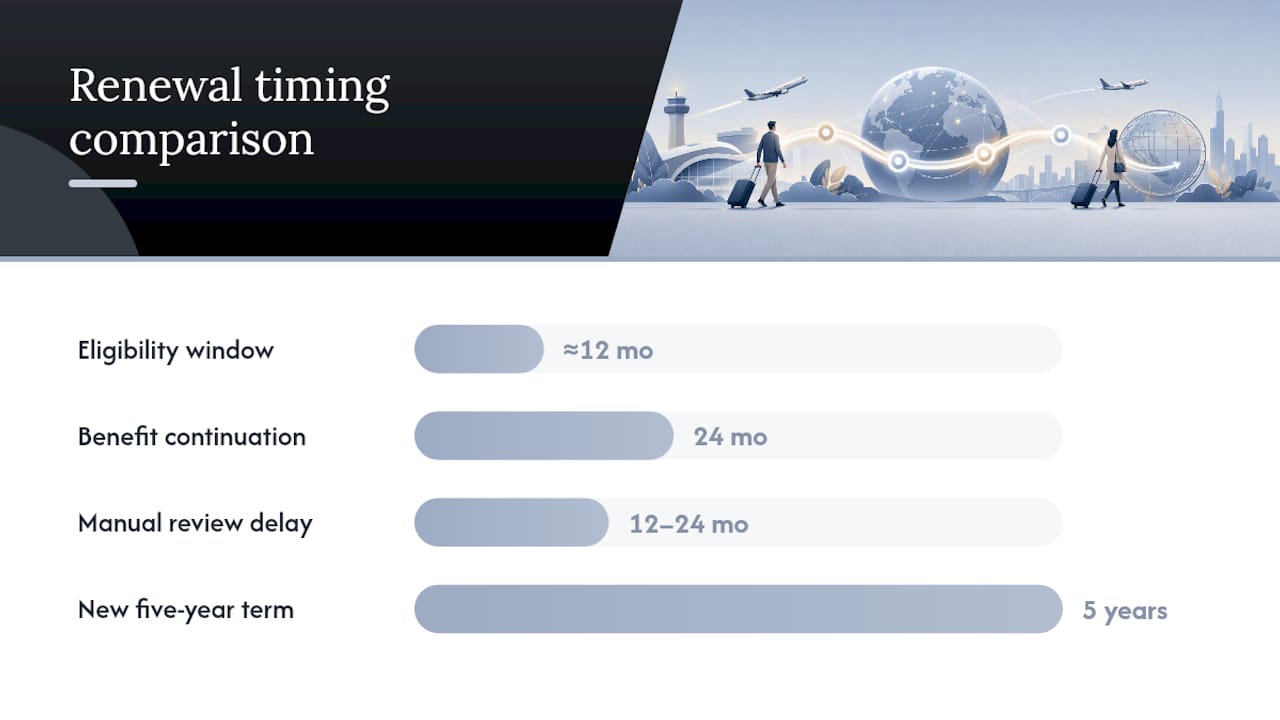
| Renew up to one year early | Eligibility opens 12 months before expiration; earlier submission means more buffer against delays. |
| Manual review can run 12 to 24 months | CBP's own guidance cites this range, which can eat most of your continuation window. |
| Interviews aren't guaranteed | CBP decides case by case; some renewals clear automatically, others require in-person or virtual interviews. |
| Fix passport issues early | Passportcenter's guides and expedited courier referrals help resolve document problems before they trigger a manual review. |
Table of Contents
- What Is the Global Entry Renewal Grace Period, Exactly?
- When Can You Renew, and What's the Deadline That Actually Matters?
- How Do You Renew Global Entry Through the TTP Portal?
- Will CBP Require an Interview for Your Renewal?
- What Do CBP's Processing Times Actually Look Like?
- What Happens If Your Global Entry Membership Actually Expires?
- Protect Your Renewal Timeline: A Quick-Action Checklist
- What Do Travelers Consistently Get Wrong About This Grace Period?
- When Should You Actually Hit Renew?
- Passportcenter Helps You Clear the Obstacles Before They Cost You a Renewal
- Sources
What Is the Global Entry Renewal Grace Period, Exactly?
The phrase "grace period" gets thrown around loosely in travel forums, but it's worth being precise here, because the precision matters for how you plan. The 24-month continuation is not a new membership term. It's an administrative bridge that keeps your existing benefits functional while CBP works through your renewal in the background.
Your membership itself still runs on a five-year cycle. Under 8 CFR 235.12, applicants accepted into Global Entry are approved for five years, and you become eligible to apply for renewal up to one year before that period closes. The 24-month window doesn't reset that clock or grant you a new five-year term. It simply prevents a lapse in usable benefits if your renewal is still sitting in CBP's queue when your old expiration date arrives.
What continues during this window:
- Global Entry expedited reentry at kiosks and airport lanes.
- TSA PreCheck access, since it's linked to your Global Entry status.
- Your existing PASSID and travel history in the system, per Global Entry FAQ guidance confirming your membership number stays constant through renewal.
What does not change or continue automatically:
- The official expiration date shown on your TTP dashboard. It stays fixed even while you're using benefits under the continuation.
- Your need for final approval. The continuation buys you time; it does not substitute for CBP finishing its review.
- Any guarantee that the review will wrap up inside that 24-month window.
There's also a distinction worth understanding between conditional approval, final approval, and the continuation itself. Conditional approval means CBP has cleared your background check pending an interview or final document review. Final approval means you're fully cleared and your new five-year term is active. The continuation of benefits is neither of those. It's a separate, narrower protection that only covers usage of existing benefits while you wait for one of those two outcomes.
Pro Tip: Don't treat the 24-month continuation as a safety net for every kind of delay. It protects you from a routine processing backlog, not from a lapse caused by filing after your expiration date, and not from every possible manual review scenario CBP might open on your file.
When Can You Renew, and What's the Deadline That Actually Matters?
You can start your renewal up to one year before your membership expires. That's the earliest window, confirmed by the FAQ - Trusted Traveler Programs page and echoed in the regulatory text at 8 CFR 235.12. But the date that actually decides whether you get the 24-month continuation isn't your renewal date at all. It's whether that application lands in CBP's system before your membership's official expiration date.
Three scenarios show how much this timing matters:
- Renew 12 months ahead. You get the widest possible cushion. If manual review or an interview request comes up, you have a full year of runway before your old membership even expires, let alone before the continuation window would need to kick in.
- Renew 6 months ahead. Still comfortable for most cases. CBP's typical vetting moves faster than that, but this leaves room for delays without cutting it close.
- Renew the day before expiration. Technically compliant. Submitting one day before your card expires still activates the 24-month continuation, since the rule only requires submission before expiration, not any particular lead time. But you've eliminated your margin for error on document mismatches, missed emails, or a longer review than expected.
Processing itself varies widely. The Official Trusted Traveler Program Website notes that while most applications clear quickly through automated vetting, cases that require manual review can take between 12 and 24 months to complete. That's not a typo. If your file lands in that slower track, you're relying on nearly the entire continuation window just to get to final approval, with almost no buffer left.
The Trusted Traveler Programs FAQ adds another detail travelers often miss: there is no expedited processing option for renewals. Paying an extra fee or calling customer service will not move your file up the queue. Early submission is the only lever you actually control.
How Do You Renew Global Entry Through the TTP Portal?
Renewing happens entirely through the Trusted Traveler Programs (TTP) online portal, and the mechanics are straightforward if you follow them in order.
- Log into your TTP account at the official portal using your existing credentials. Do not create a second account. CBP ties your renewal to your existing PASSID, and duplicate profiles cause processing headaches.
- Locate the Renew option on your dashboard. It typically appears once you're inside your eligibility window, roughly one year before expiration.
- Confirm your citizenship and background information. CBP re-verifies these fields during renewal, so review them carefully rather than clicking through on autopilot.
- Update any changed information. This includes your current address, phone number, employer if applicable, and any travel document changes.
- Verify your passport number matches your TTP profile. This is one of the most common points of failure. If you've renewed your passport since your last Global Entry application, your old passport number may still be on file.
- Submit the application and pay the renewal fee. Submission before your expiration date is what activates the 24-month continuation, so don't delay this step once you've started.
- Watch your dashboard status. After submission, your application will show as pending, then move to conditional approval, and eventually final approval if no interview is required.
A few checks are worth doing before you hit submit. Confirm your PASSID hasn't changed. The Global Entry FAQ confirms this number stays constant through renewal, so if your dashboard shows something unfamiliar, that's a red flag to resolve before submitting. Double check that your legal name matches your current passport exactly, including middle names and any recent legal name changes. If you've moved, update your address in the portal itself rather than assuming CBP will catch it from other records.
Conditional approval means CBP has cleared your background check but may still want an interview or additional document review before granting final approval. Final approval means you're fully cleared, your new five-year term begins, and your dashboard will reflect the new expiration date. The continuation of benefits operates independently of both statuses. It simply lets you keep using your expiring card's privileges while either stage is in progress, as long as you filed before expiration.
Pro Tip: The single most common dashboard mistake is submitting a renewal with an outdated passport number after getting a new passport. If you've renewed your passport since your last Global Entry cycle, update that field first. A mismatch here can trigger unnecessary manual review and push your file into that longer 12 to 24 month track.
If your passport itself is close to expiring or you've recently changed your name, sort that out before touching your Global Entry renewal. Passportcenter's guide to the expired passport renewal process walks through exactly what CBP expects on that front.
Will CBP Require an Interview for Your Renewal?
Not necessarily. CBP decides whether an interview is required on a case-by-case basis, and a growing share of renewals go through without one. There's no guarantee either way when you submit.
Some renewals clear entirely through automated background revetting. If nothing in your file raises a flag, CBP often issues final approval without ever scheduling a sit-down. Others get flagged for additional review, in which case CBP may request an in-person interview at an enrollment center, or in some cases a virtual interview. Industry reporting notes that virtual interviews have become available for some renewal applicants specifically as a way to work through backlog without requiring travel to a physical enrollment site, according to The Points Guy's coverage of the renewal process.
What determines the outcome:
- Changes in your travel history, employment, or background since your last approval.
- Data mismatches between your TTP profile and current passport or personal information.
- Random or routine revetting checks CBP applies across the renewal pool.
- Any prior flags or incidents tied to your PASSID.
You'll typically be notified of an interview requirement through the CBP Help Center notification system, either by email or a status change visible on your TTP dashboard. Check your spam folder periodically during renewal. A missed interview notification because an email landed in a junk folder is an entirely avoidable delay.
The timing here matters against the 24-month continuation. If your file gets flagged early in the review process, you generally have more runway to schedule and complete an interview before your continuation window becomes a concern. If the flag comes late, near the back end of a long manual review, you're working with less margin.
What Do CBP's Processing Times Actually Look Like?
CBP is upfront that most applications clear quickly, but the exception matters more than the rule if it applies to you. The Official Trusted Traveler Program Website states that manual review, when it's triggered, can currently take a lengthy period to complete depending on the program.

Sit with that range for a second. If your renewal gets flagged for manual review shortly after you submit it, you could be looking at a processing timeline that eats most or all of the 24-month continuation before you ever reach final approval. That's the operational risk nobody explains clearly enough: the continuation helps you survive the wait, but it was never designed to guarantee coverage for every possible delay.
Manual review timing varies case by case, and while CBP has cited that 12 to 24 month range in some program contexts, individual outcomes remain unpredictable. There's no dashboard counter that tells you where your specific file sits inside that range.
Ways to reduce your odds of landing in the slow lane:
- Submit your renewal as early as your one-year eligibility window allows, rather than waiting until months before expiration.
- Keep your TTP profile data current year-round, not just at renewal time. Address changes, name changes, and new passport numbers should be updated as they happen.
- Respond immediately to any CBP request for additional information. Delayed responses restart or extend review clocks.
- Check your dashboard status monthly rather than assuming no news means good news.
Pro Tip: If your renewal has been sitting in pending status for more than six months with no update, don't just wait quietly. Document the date you submitted, screenshot your dashboard status periodically, and reach out through the CBP Help Center to create a paper trail. If a delay does stretch toward that 24-month ceiling, you want a record showing you filed on time and followed up appropriately.
For a deeper look at how these timelines have trended, Passportcenter's breakdown of Global Entry application processing times covers what's driving the longer end of that range.
What Happens If Your Global Entry Membership Actually Expires?
If you submit your renewal after your membership expiration date, the 24-month continuation simply does not apply. Your benefits stop immediately at expiration, and you're effectively starting over as if you'd never held the membership, at least from a usage standpoint.
That has real consequences at the airport. You lose access to Global Entry kiosks on reentry, and if your TSA PreCheck was linked through Global Entry rather than a standalone PreCheck enrollment, that access disappears too.
Here's what to do if you're in this position:
- Submit a new renewal application immediately through the TTP portal. You cannot recover the lapsed continuation, but you can start the clock on a new approval as soon as possible.
- Check your dashboard status weekly rather than assuming the application is processing normally in the background.
- Book upcoming international travel with a contingency plan, since you'll be going through standard immigration lanes until you receive final approval.
- Keep your standard passport accessible and current, since you'll need it at every reentry point without expedited processing.
For anyone with imminent travel and no active Global Entry benefits, a short mental checklist helps:
- Confirm your standard passport has enough validity for your trip; if not, prioritize fixing that first.
- Allow extra time at immigration and security, since you'll no longer have expedited access.
- Check whether Mobile Passport Control is available at your entry airport as a partial workaround, covered in Passportcenter's Mobile Passport Control guide.
- Follow up on your pending Global Entry application every few weeks rather than letting it sit silently.
Protect Your Renewal Timeline: A Quick-Action Checklist
Most of the risk in this entire process traces back to timing and data accuracy. Fix those two things and you eliminate the majority of what causes trouble.
- Start your renewal as soon as your one-year eligibility window opens. Don't wait for a reminder email. Mark your calendar the moment your dashboard shows an expiration date.
- Verify every field in your TTP profile before submitting, including passport number, legal name spelling, address, and PASSID.
- Set two calendar reminders, one for the earliest date you can renew and another 90 days before expiration as a hard backstop.
- Check your dashboard monthly after submission rather than waiting for CBP to reach out first.
- Renew family members separately but simultaneously where possible, since children's memberships and adult renewals follow the same submission-before-expiration rule independently.
Pro Tip: If you're renewing for a spouse or child on the same trip cycle, don't assume their expiration dates match yours. Check each family member's individual TTP dashboard, since staggered original approval dates mean staggered renewal deadlines even within the same household.
What Do Travelers Consistently Get Wrong About This Grace Period?
The most persistent misconception is treating the 24-month continuation as an automatic extension you get just for having once been a member. It's not. It only activates if you file before expiration, full stop.
Industry coverage backs this up directly. Reporting from The Points Guy describes the continuation as an operational safety net that helps travelers through CBP backlogs, explicitly cautioning that it's not a guaranteed extension and won't cover every manual-review delay you might encounter. That framing matches CBP's own position: paying attention to your dashboard and filing early does more for your outcome than any assumption about how the continuation is supposed to work.
The second misconception is assuming a fee payment or a customer service call can speed things along. CBP officials are explicit that no expedited processing option exists for TTP renewals. The only real lever is submitting early enough that a manual review, if it happens, has room to run its course before your continuation window closes.
Pro Tip: Treat the 24-month window as insurance against a normal processing backlog, not as extra time you're free to use before starting your renewal. The safest strategy is still filing as early in your one-year eligibility window as your schedule allows.
When Should You Actually Hit Renew?
My honest read on this, after seeing how the timeline plays out across different traveler situations, is that six to twelve months before expiration is the sweet spot for anyone who travels internationally more than a couple of times a year. Waiting until the final weeks before your card expires isn't reckless exactly, but it removes almost all your margin if CBP flags your file for a closer look.
The mistake I see most often isn't procrastination. It's travelers treating the continuation as a reason to relax about renewal timing altogether, as if the 24 months were extra time to use before starting the process rather than a buffer for after. That's backward. The buffer exists to protect you from CBP's processing queue, not from your own delay.
The second mistake is smaller but just as costly: letting a passport renewal or name change sit unresolved on your TTP profile. A mismatched passport number is one of the easiest, most preventable ways to trigger a manual review you didn't need.
Pro Tip: If anything about your identity documents has changed since your last approval, whether that's a new passport, a legal name change, or a different address, update your TTP profile before you touch the renewal button, not after.
Passportcenter Helps You Clear the Obstacles Before They Cost You a Renewal
A lot of Global Entry renewal delays don't actually start with CBP. They start with a passport problem sitting quietly on your TTP profile: an expired passport, a legal name change never updated, or a lost passport you haven't replaced yet. Any of those can trigger the exact manual review scenario that eats into your 24-month continuation window.

Passportcenter.ai exists to help you clear those obstacles before they become renewal roadblocks. The site's free guides walk you through fixing the passport-side issues that commonly interfere with a clean Global Entry renewal, from a full passport renewal process breakdown to current passport processing time expectations so you know how far in advance to act. If you need your passport turned around quickly to hit your Global Entry renewal window, Passportcenter can also connect you with registered expedited courier services built for exactly that kind of deadline pressure. Start by checking your passport renewal checklist at Passportcenter before you touch your TTP renewal, so nothing on the document side slows you down.
Sources
- Global Entry Frequently Asked Questions
- FAQ - Trusted Traveler Programs
- Official Trusted Traveler Program Website | Department of Homeland Security
- What to do if your Global Entry expires - The Points Guy
- 8 CFR 235.12