
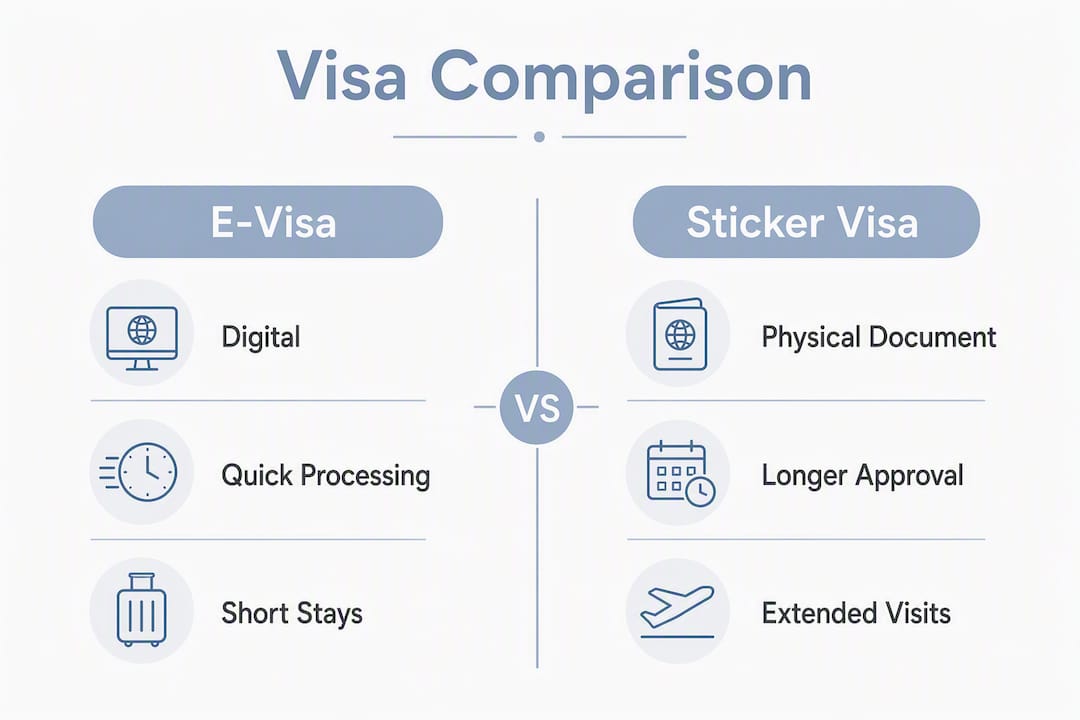
An e-visa is a digital travel permit issued entirely online; a regular visa is a physical document affixed to your passport through in-person consular processing. For short tourist or business trips, e-visas and electronic travel authorizations are faster and easier to obtain. For longer stays, work, study, or complex immigration situations, a traditional sticker visa remains the required route.
Pro Tip: Always verify requirements on the destination country's official government portal before booking, and print a copy of any digital approval. Border officers often expect a paper copy, and a dead phone battery at immigration is a problem you can avoid.
Table of Contents
- How does an e-visa compare to a regular visa?
- How do you apply for an e-visa or a sticker visa?
- What are the real advantages and limitations of each visa type?
- Which countries use e-visas, and when do you still need a sticker visa?
- ESTA, e-visas, and when U.S.-bound travelers actually need a visa
- How do you decide between an e-visa and a sticker visa for your trip?
- Key Takeaways
- Why the e-visa vs. sticker visa debate is more nuanced than most guides admit
- Passportcenter makes checking your visa requirements straightforward
- Authoritative sources for checking official visa rules
How does an e-visa compare to a regular visa?
The practical differences between these two document types come down to where you apply, how long you wait, and what you're allowed to do once you arrive.

| Dimension | E-Visa | Regular (Sticker) Visa |
|---|---|---|
| Application channel | Online portal, no embassy visit | Embassy, consulate, or visa application center |
| Processing time | 1–7 days; some near-instant | Commonly 5–15 days; longer for complex categories |
| Typical cost shape | Lower fees, paid online | Higher fees; additional service/biometric charges possible |
| Documentation | Passport scan, digital photo, online form | Full document packet; certified translations often required |
| Interview required | No | Usually yes for U.S. nonimmigrant visas and many countries |
| Validity/entries | Short-term; often single or double entry | Longer validity; multiple-entry options more common |
| Eligible activities | Tourism, transit, simple business | Tourism, business, work, study, long-term residence |
| Security/fraud risk | Scam sites mimic official portals | Consular process harder to fake; in-person identity check |
The most decisive differences at a glance:
- Speed: e-visas can arrive in under 24 hours; consular visas require scheduling, attending an appointment, and waiting for passport return.
- Convenience: the entire e-visa process happens from your laptop or phone, with no travel to an embassy.
- Scope limits: e-visas are intentionally restricted to short-term, low-complexity categories. They do not authorize work or study.
- Evidence trail: a sticker visa in your passport is a physical record that border officers can verify instantly, even without internet connectivity.
Country examples:
- E-visa countries: Turkey (official e-visa portal), India (official e-visa portal), and Rwanda (official e-visa portal) all operate established e-visa systems for eligible nationalities.
- Sticker/consular visa countries: China, Russia, and Brazil still require in-person consular processing for most U.S. travelers. Many countries use a hybrid: e-visas for tourism, consular visas for work and study.
The Visa Waiver Program (VWP) lets eligible nationals visit the U.S. for tourism or business for up to 90 days without a visa, provided they hold an approved ESTA. ESTA approvals are generally valid for a period up to two years.
How do you apply for an e-visa or a sticker visa?
The two pathways are genuinely different in effort, time, and what you need to prepare.
Applying for an e-visa
- Prepare your documents — You'll need a valid passport with at least six months of remaining validity, a digital passport photo meeting the portal's specs, and your travel itinerary.
Pro Tip: Before you travel, confirm your passport is valid for the full duration of your trip plus the required buffer. Check the U.S. passport renewal process guide if your passport is expiring soon.
Applying for a traditional sticker visa
- Identify the correct visa category. Tourism, business, student, and work visas each have different forms and requirements. For the U.S., most nonimmigrant applicants complete Form DS-160 online.
- Gather your document packet. Typical requirements include your passport, a recent photo, proof of financial means, travel itinerary, and supporting documents specific to your visa category.
- Schedule your biometrics and interview appointment. Wait times at U.S. embassies and consulates vary significantly by location and season. Book as early as possible.
- Attend the appointment. Bring originals of all documents. Consular officers evaluate immigration intent in person, which is a deliberate security measure that digital systems cannot fully replicate for complex cases.
- Wait for processing. Standard tourist visa processing commonly runs 5–15 days after the interview, though complex categories take longer.
- Collect your passport. Your visa is either affixed as a sticker or you receive a return-by-mail notification. Verify all details before leaving the consulate.
Documents to have ready for either route:
- Valid passport (check current processing times if yours needs renewal)
- Compliant passport photo
- Proof of onward travel and accommodation
- Financial evidence (bank statements, sponsorship letters)
- For sticker visas: employment letters, enrollment records, or other category-specific support documents
What are the real advantages and limitations of each visa type?
E-visa advantages
- Lower overall cost in most cases, since there are no travel or service-center fees
Sticker visa advantages
- Broader activity eligibility: work, study, long-term residence, and multiple-entry travel are all possible.
- Longer validity periods. Some U.S. nonimmigrant visas are valid for up to 10 years.
- Physical evidence in your passport that border officers can verify without connectivity.
- The in-person interview gives applicants a chance to clarify their situation directly with a consular officer.
E-visa limitations
- Restricted by design: short stays, limited entries, and narrow permitted activities. Using an e-visa for unauthorized purposes such as work or study risks denial at the border and potential consequences for future travel.
- Not available to all nationalities for all destinations.
- Scam risk is real. Unofficial sites mimic government portals and charge inflated fees or harvest your data. Always verify the URL belongs to an official government domain.
Sticker visa limitations
- Requires scheduling and attending an in-person appointment, which can mean significant travel time and cost
Fraud warning: A quick search for "India e-visa" or "Turkey e-visa" returns dozens of unofficial sites that look official. Before entering any personal or payment information, confirm the URL ends in a government domain (.gov.in, .gov.tr, or the country's official equivalent).
Which countries use e-visas, and when do you still need a sticker visa?
The global rollout of e-visas has been uneven. Here's how the split typically plays out for common travel scenarios:
- Short-term tourism (under 30 days): — Turkey, India, Rwanda, Kenya, Sri Lanka, and Australia (ETA) all issue e-visas or electronic travel authorizations for eligible nationalities. For many of these destinations, the e-visa is now the standard route.
For travelers planning extended stays or remote work abroad, the digital nomad visa guide covers online-application options that go beyond standard tourist e-visas.
Countries where in-person consular processing remains standard for U.S. travelers include China (China Visa Application Service Center), Russia, and Brazil, among others. Always check the destination embassy's official site for the most current requirements.

ESTA, e-visas, and when U.S.-bound travelers actually need a visa
This is one of the most common points of confusion, and it's worth being direct: ESTA is not a visa.
The Electronic System for Travel Authorization is a pre-travel screening tool for the Visa Waiver Program. It determines whether a traveler from a VWP-eligible country poses a security or law enforcement risk before they board a flight to the United States. Approval does not grant a visa; it grants permission to travel to a U.S. port of entry and request admission.
What ESTA covers:
- Citizens of VWP-designated countries traveling for tourism or business
- Stays of up to 90 days
- ESTA approvals are generally valid for two years or until your passport expires, whichever comes first
Who must apply for a U.S. visa instead:
- Travelers from countries not in the VWP
- Anyone planning to stay longer than 90 days
- Students, workers, exchange visitors, and anyone with a purpose beyond tourism or simple business
- Travelers who have been denied ESTA or who have prior visa violations
The standard U.S. nonimmigrant visa process involves completing Form DS-160 online, scheduling an interview at a U.S. embassy or consulate, attending the interview with a full document packet, and waiting for processing. Some visa categories, such as the B1/B2 tourist/business visa, can be valid for up to 10 years with multiple entries, which makes the upfront investment worthwhile for frequent travelers.
If your ESTA is denied: apply for a consular visa rather than attempting to travel on a different authorization. A denial does not automatically bar you from the consular route, but it will be part of your record and may affect the review. Trying to enter on an alternative authorization after a denial is a serious mistake.
If you're a U.S. citizen traveling abroad and you're weighing entry programs, the Global Entry enrollment process is a separate trusted-traveler program that speeds up your return to the U.S., not a visa substitute.
How do you decide between an e-visa and a sticker visa for your trip?
Run through this checklist before you book:
- Is your stay within the e-visa's allowed duration? Most e-visas cap stays at 30–90 days. If you need longer, you need a consular visa.
- Is your purpose tourism, transit, or simple business? E-visas cover these. Work, study, or long-term residence require a consular visa, full stop.
- Do you need multiple entries? E-visas often allow only single or double entry. Frequent border crossings during a trip require a multiple-entry consular visa.
- Are you eligible for a travel authorization waiver? VWP travelers to the U.S. use ESTA, not a visa. Some countries have similar bilateral waiver programs.
- Do you have prior visa refusals or immigration complications? If yes, consular processing gives you the opportunity to address those issues directly with an officer.
- How much time do you have? If your trip is in two weeks and the destination offers an e-visa, that's your fastest route. If you need a consular visa, start the appointment-booking process immediately.
Next steps based on your answers:
- E-visa eligible: go directly to the destination's official government immigration portal and apply. Do not use third-party sites.
- Consular visa required: check the destination embassy's website for the correct form, required documents, and current appointment availability. For U.S.-bound travel, start at travel.state.gov.
- Unsure of your eligibility: use the official portal's eligibility checker or contact the destination's embassy directly.
For travelers curious about how long they can stay in certain countries without any visa at all, the countries where U.S. citizens can stay six months or longer guide is a useful reference.
Key Takeaways
E-visas work for short, simple trips; traditional sticker visas are required for work, study, longer stays, and any situation where in-person consular review is mandatory.
| Point | Details |
|---|---|
| E-visa vs sticker visa | E-visas are digital and online; sticker visas are physical, consular-issued documents requiring an in-person appointment. |
| Processing time difference | E-visas generally process faster; traditional consular visas usually take longer. |
| ESTA is not a visa | ESTA is a VWP travel authorization for eligible nationals visiting the U.S. for up to 90 days; it does not replace a visa for longer stays or other purposes. |
| Activity restrictions | E-visas cover tourism, transit, and simple business only; work, study, and long-term residence always require a consular visa. |
| Passportcenter | Passportcenter provides free guides on visa requirements, passport validity, and entry rules to help you confirm the right document before you travel. |
Why the e-visa vs. sticker visa debate is more nuanced than most guides admit
Most travel articles frame this as a simple speed comparison: e-visas are fast, sticker visas are slow, therefore e-visas are better. That framing misses the point.
The real issue is scope. E-visas are deliberately narrow instruments. Governments designed them to handle high-volume, low-risk, short-term travel efficiently, while preserving in-person consular review for anything that carries more complexity or risk. That's not a flaw in the system; it's the system working as intended.
Where travelers get into trouble is treating an e-visa as a flexible substitute for a proper consular visa. Using a tourist e-visa to work remotely, for example, is a visa violation in most jurisdictions, regardless of whether anyone at the border asks about it. The consequences, ranging from deportation to multi-year entry bans, are disproportionate to what feels like a minor technicality.
The other underappreciated point is the fraud risk on the e-visa side. The simplicity of online applications has created a cottage industry of scam portals that look nearly identical to official government sites. A traveler who pays $80 to a fake "India e-visa" site doesn't just lose money; they may arrive at the border with a document that doesn't exist in any official system.
The honest verdict: for short tourism and business trips to countries with established e-visa programs, the electronic route is faster, cheaper, and genuinely convenient. For anything more complex, the consular process exists for good reasons, and trying to work around it creates more risk than it saves in time.
Passportcenter makes checking your visa requirements straightforward
Figuring out whether you need an e-visa, a consular visa, or just a valid passport for your next trip shouldn't require hours of cross-referencing embassy websites. Passportcenter gives you free, plain-language guides covering entry requirements by country, passport validity rules, and step-by-step application guidance for U.S. travelers.
The site also covers ESTA eligibility, Global Entry enrollment, and new European entry rules like ETIAS and the UK ETA, so you're not caught off guard by requirements that changed since your last trip. When you need expedited passport processing, Passportcenter connects you to registered courier services that can move faster than standard government timelines.
Visit Passportcenter to check the entry requirements for your destination and confirm you have the right documents before you book.
Passportcenter may earn a referral fee from partner courier services linked on the site. All information is provided for general guidance only; confirm current visa and entry rules with the official embassy or consulate of your destination country before travel.
Authoritative sources for checking official visa rules
- U.S. Customs and Border Protection — ESTA and the Visa Waiver Program: official ESTA eligibility, application, and VWP rules for travel to the United States.
- U.S. Department of State — Visa Waiver Program: VWP country list, ESTA validity, and when a U.S. visa is required.
- Department of Homeland Security — Visa Waiver Program: DHS overview of VWP administration and participating countries.
- U.S. Embassy — Consular visa information and interview guidance: explains the DS-160 process, interview requirements, and why in-person review matters.
- Passportcenter — passport and visa guides for U.S. travelers: free guides on passport requirements, processing times, and country entry rules.