U.S. citizens need a visa to enter Egypt, no exceptions. The good news: two routes handle the vast majority of tourist trips without a consulate appointment. You can apply online through the official Egypt e-Visa portal before you leave home, or purchase a visa on arrival at major Egyptian airports and seaports. For most tourists with a confirmed itinerary, the e-Visa is the smarter call.
Three sources you should bookmark right now:
- U.S. Department of State — Egypt page: Official travel advisories, entry rules, and security alerts for U.S. citizens
- Egypt e-Visa Portal (visa2egypt.gov.eg): The only government-authorized site for online visa applications
- Egyptian Embassy and Consulates in the U.S.: For non-tourist visas, work, study, or complex travel situations
Table of Contents
- Egypt visa options for U.S. citizens: which route fits your trip?
- e-Visa vs. visa on arrival vs. embassy: a quick comparison
- How to apply for an Egypt e-Visa step by step
- What to expect with visa on arrival at Egyptian airports
- When and how to apply at an Egyptian embassy or consulate
- Passport validity, health notes, and what to carry at arrival
- Fees, payment methods, and how to avoid unofficial sites
- What to do if your visa is denied or you hit problems in Egypt
- Key takeaways: your pre-travel checklist
- Official links to verify before you travel
- One thing most travelers overlook
- Sources
Egypt visa options for U.S. citizens: which route fits your trip?
The e-Visa FAQ on the official portal confirms that U.S. passports are among the nationalities eligible to apply. That covers the standard tourist visa, but Egypt offers several distinct categories depending on your purpose of travel.
Tourist e-Visa and visa on arrival are the two paths most U.S. travelers use. Both grant a 30-day stay, and both are available as single-entry or multiple-entry. The e-Visa is processed before you board; the visa on arrival is purchased at the airport or seaport after you land.
Sinai-only entry stamp is a limited option available at certain Red Sea resort entry points, notably Sharm El Sheikh. It lets you stay within a defined zone of South Sinai without a full Egyptian visa. The catch: you cannot leave that zone to visit Cairo, Luxor, or anywhere else in Egypt. Confirm the exact boundaries before you rely on this for itinerary planning, because the restrictions are real.
Transit visas apply if you are passing through Egypt without entering the country proper. These are handled separately and are not the same as a tourist visa.
Non-tourist visas (work, study, media, diplomatic, official) require a consular application at an Egyptian embassy or consulate before you travel. You cannot convert a tourist visa to a work or study visa once you are in-country. If your trip involves any professional activity, paid or unpaid, apply at the consulate.
When a consular visa is the right call: prior entry refusals anywhere, a complicated travel history, a passport with stamps from certain countries, or any purpose beyond tourism. Airlines can also deny boarding if they believe you lack the right documentation, so a pre-approved consular visa removes that risk entirely.
e-Visa vs. visa on arrival vs. embassy: a quick comparison
| e-Visa | Visa on Arrival | Embassy/Consulate | |
|---|---|---|---|
| Where to apply | Online at visa2egypt.gov.eg | Airport or seaport on arrival | Egyptian Embassy or consulate in the U.S. |
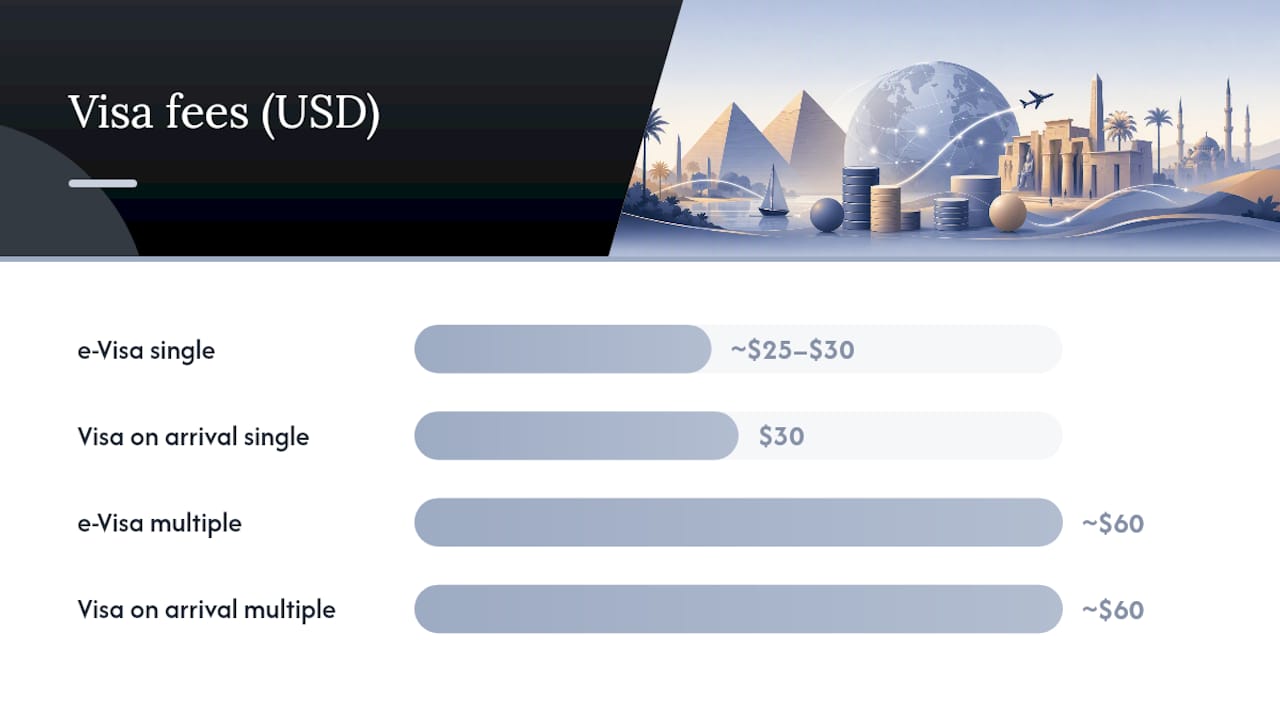
| Cost (single entry) | ~$25–$30 | $30 USD (as of March 1, 2026) | Varies by visa type |
| Cost (multiple entry) | ~$60 | ~$60 | Varies by visa type |
| Validity/duration | 30 days, extendable | 30 days, extendable | Depends on visa category |
| Processing time | Typically a few business days | Immediate on arrival | Days to weeks |
| Payment method | Credit/debit card online | Exact USD cash at most ports | Check or money order (varies by consulate) |
| Best for | Most tourists with confirmed travel dates | Last-minute travelers or backup option | Work, study, long stays, complex travel history |
Pro Tip: If you have ever been denied a visa to any country, or if your passport contains stamps that could raise questions at immigration, apply through an Egyptian consulate before you travel. Arriving with a pre-approved consular visa is far safer than testing your luck at the immigration counter.
How to apply for an Egypt e-Visa step by step
The official portal is visa2egypt.gov.eg. Do not use any other site. Third-party services that appear in search results often charge significantly more and collect your personal data without the same authorization. The portal itself notes in its terms that it may share information with affiliates and service providers, so read the privacy terms before registering.
Here is the exact process:
- Go to visa2egypt.gov.eg and create an account using a valid email address. You will receive a confirmation email to verify your account.
- Sign in and select your visa type. For most U.S. tourists, that is the single-entry or multiple-entry tourist e-Visa.
- Enter your passport details exactly as they appear on the biographical data page. Any mismatch between your application and your passport at immigration can cause delays or denial.
- Upload required documents. Have your passport ready (biographical page), a recent passport-style photo if prompted, and your travel details including arrival date and accommodation.
- Pay the fee online using a credit or debit card. The portal accepts card payments; keep the transaction confirmation.
- Download and print your approved e-Visa. Save a PDF copy to your phone as a backup. You will present this document at Egyptian immigration on arrival.
- Check your application status by logging back into your portal account. Approved applications show a clear status indicator. Do not travel until the status reads approved.
Timing matters. The Egypt e-Visa portal advises applicants to submit at least 7 days before departure. Treat that as the absolute floor, not the target. Apply as soon as your travel dates are confirmed, ideally 2–3 weeks out. That buffer gives you time to correct any errors, resubmit if needed, or pivot to a consulate if something goes wrong.
Pro Tip: Screenshot your confirmation email and save the approved e-Visa PDF in at least two places: your phone's camera roll and a cloud folder you can access offline. Egyptian immigration officers will want to see the document, and a dead phone battery is not an excuse they accept.
Your passport must be valid for the duration of your stay. The standard recommendation is at least six months of validity beyond your arrival date. If your passport is expiring soon, check current U.S. passport processing times before you apply for any visa.
What to expect with visa on arrival at Egyptian airports
Visa on arrival is straightforward, but the process has a specific order and a cash requirement that catches travelers off guard.
The typical airport flow at Cairo International and other major ports:
First, before you reach passport control, look for the bank or payment counters in the arrivals hall. These are usually staffed by Banque Misr or National Bank of Egypt representatives. You pay here, receive a visa sticker, and then proceed to the immigration officer who stamps your passport.

Payment is the critical detail. As of March 1, 2026, the single-entry visa on arrival fee rose to $30 USD, and the multiple-entry option is commonly reported at about sixty US dollars. Many arrival points require exact U.S. dollar cash. Egyptian pounds are not always accepted at these counters, and card terminals are not reliably available. Bring crisp, undamaged bills in small denominations. A $50 bill when the fee is $30 can create a real problem if the counter has no change.
Sinai-only arrivals at Sharm El Sheikh sometimes operate under a separate stamp system that restricts movement to South Sinai resort areas. If your entire trip is Sharm El Sheikh and you have no plans to visit the rest of Egypt, this can work. If there is any chance you want to travel beyond that zone, get a full tourist visa instead.
Wait times at the visa counter vary. During peak season, the line can add 30–45 minutes to your arrival process. The e-Visa skips that line entirely, which is one of the practical reasons most frequent travelers to Egypt prefer it.
When and how to apply at an Egyptian embassy or consulate
Some trips simply require a consular visa, and trying to manage them on arrival is a gamble not worth taking. Here is when to go the consular route:
- You are traveling for work, study, journalism, research, or any professional purpose
- You have a prior visa refusal from Egypt or another country
- You plan to stay longer than 30 days or need a visa category the e-Visa portal does not offer
- An airline or tour operator has told you a pre-approved visa is required before boarding
- Your travel history is complicated and you want certainty before you fly
How the consular application works:
The Egyptian Embassy in Washington, D.C. handles applications from some states, while Egyptian consulates in New York, Houston, Chicago, and Los Angeles serve others. Jurisdiction depends on your state of residence, so check the embassy or consulate website first to confirm which office serves you.
Typical steps: download the visa application form from the relevant consulate's website, gather a passport-style photo, prepare supporting documents (invitation letter, enrollment letter, or employer letter depending on visa type), pay the consular fee, and submit by mail or in-person appointment depending on that consulate's current instructions.
Processing times vary by visa type and consulate workload. Plan for at least 1–2 weeks, and longer for complex applications. Do not book non-refundable travel until you have the visa in hand.
The Egyptian Embassy website lists jurisdiction, required documents, and current fees for each visa category. That is your authoritative source for non-tourist applications.
Passport validity, health notes, and what to carry at arrival
Passport requirements: Carry a passport valid for at least six months beyond your planned arrival date in Egypt. Immigration officers can deny entry if your passport expires too soon, regardless of your visa status. You also need at least one or two blank pages for the visa stamp. If your passport is nearly full or close to expiring, renew it before you travel.
Documents to have ready at immigration:
- Printed or digital copy of your approved e-Visa (or visa receipt if paying on arrival)
- Return or onward ticket showing you plan to leave Egypt
- Hotel reservation or accommodation details
- Local contact information if you have one
Health and vaccination guidance: The CDC travel health page for Egypt lists current vaccine recommendations and any active health notices. Routine vaccines should be up to date. The CDC also recommends hepatitis A and typhoid vaccines for most travelers to Egypt, and additional vaccines depending on your itinerary and health history. Check the CDC page close to your departure date, as recommendations can change.
Egypt does not currently require proof of COVID-19 vaccination for entry, but health requirements can shift. Verify current rules with the U.S. Department of State Egypt page and the Egyptian Embassy within a few weeks of travel.
Fees, payment methods, and how to avoid unofficial sites
Here is what you should expect to pay and where:
- e-Visa (single entry): approximately $25–$30, paid by card on the official portal
- e-Visa (multiple entry): approximately $60, paid by card on the official portal
- Visa on arrival (single entry): $30 USD cash, effective March 1, 2026
- Visa on arrival (multiple entry): approximately $60 USD cash
Fee update: Egypt raised the visa-on-arrival single-entry fee to $30 USD on March 1, 2026. If you read older guides quoting $25, that figure is outdated for arrival processing.
Third-party sites are a real problem. Search for "Egypt e-Visa" and you will find dozens of sites that look official but are not. They charge service fees on top of the actual visa cost, sometimes doubling or tripling what you would pay on the government portal. Some collect your passport data without clear authorization.
The only legitimate online application channel is visa2egypt.gov.eg. Before entering any personal information, check that the URL matches exactly. The portal's own terms note that your data may be shared with affiliates and service providers, so read those terms before you register.
Practical steps:
- Pay for your e-Visa by credit or debit card on the official portal only
- Bring exact USD cash for arrival processing if you plan to pay on arrival
- Keep all receipts, whether digital or paper, until you are back home
- Never pay a third-party site to "expedite" an Egyptian e-Visa
What to do if your visa is denied or you hit problems in Egypt
A valid visa or approved e-Visa does not guarantee entry. Egyptian immigration officers retain final authority to deny admission without explanation, as the U.S. Department of State makes clear. If that happens, stay calm and do not argue with the officer.
If you are denied boarding before you leave the U.S.: Contact your airline immediately to understand the specific reason. Then call the Egyptian consulate that issued or would have issued your visa. If the issue is documentation, it may be fixable before your next attempt.
If you are denied entry at an Egyptian port: Ask to speak with a supervisor, show your return ticket and hotel reservation, and contact the U.S. Embassy in Cairo for consular assistance. The Embassy can help U.S. citizens navigate in-country issues, connect you with legal resources, and contact family on your behalf if needed.
If you lose your passport or visa documents while in Egypt: Go to the nearest police station to file a report, then contact the U.S. Embassy in Cairo. Keep digital and printed copies of your passport biographical page and your visa in a separate bag from your actual documents.
Enroll in STEP before you leave. The Smart Traveler Enrollment Program is free and takes five minutes. It registers your trip with the nearest U.S. Embassy, so the government can reach you during a security incident, natural disaster, or family emergency. It also makes it easier for the Embassy to assist you if something goes wrong.
Key takeaways: your pre-travel checklist
Most U.S. tourists should apply for an Egypt e-Visa on the official portal as soon as travel dates are confirmed, carry exact USD cash as a backup, and verify passport validity and health requirements before departure.
| Point | Details |
|---|---|
| Visa is required | U.S. citizens must have a visa; choose e-Visa online or visa on arrival at the airport. |
| Apply early | Submit your e-Visa at least 7 days before departure, and earlier when possible. |
| Fee update (2026) | Visa-on-arrival single-entry costs $30 USD cash as of March 1, 2026; multiple-entry is ~$60. |
| Use only the official portal | Apply at visa2egypt.gov.eg only; third-party sites overcharge and collect unnecessary data. |
| Passport validity | Carry a passport valid for at least six months beyond your arrival date in Egypt. |
Official links to verify before you travel
Bookmark these before your departure date and check them within two weeks of flying:
- Visa2egypt: Apply online, check application status, and review current fees and eligibility
- U.S. Department of State — Egypt Travel Page: Current travel advisory level, entry requirements, and security alerts for U.S. citizens
- Egyptian Embassy in Washington, D.C.: Jurisdiction, consular fees, required documents, and appointment or mailing instructions for non-tourist visas
- Eg: In-country consular assistance, security alerts, and emergency contact for U.S. citizens already in Egypt
- CDC Travel Health — Egypt: Vaccine recommendations, health notices, and destination-specific health guidance
- STEP Enrollment: Register your trip so the U.S. government can reach you in an emergency abroad
One thing most travelers overlook
The e-Visa is the right call for almost every U.S. tourist with confirmed travel dates. Apply the moment your flights are booked, not the week before departure. That is the obvious advice. Here is what most guides skip: save your approved e-Visa as a PDF and screenshot the approval screen separately. If the portal goes down or your email is inaccessible at Cairo airport, that screenshot on your camera roll is your backup. Egyptian immigration officers want to see the document, not hear a story about a slow internet connection.
Also carry $30 in small USD bills regardless of whether you have an e-Visa. If your e-Visa has a technical issue at the counter, the visa-on-arrival option is your safety net, and you will need exact cash to use it.
For passport questions before you apply for any visa, Passportcenter covers renewal timelines, processing speeds, photo requirements, and everything else you need to make sure your travel document is ready before you start the visa process.