
U.S. citizens need a visa to enter mainland China. There is no general visa-free entry for American passport holders, so you must have a valid Chinese visa in hand before you board your flight. The most common solution is the 10-year multiple-entry L tourist visa, which most U.S. travelers qualify for. The 240-hour visa-free transit is a narrow exception covered later in this guide, but it does not replace a visa for standard travel.
Do these three things in the next 24–72 hours:
- Check your passport. You need at least six months of validity beyond your travel dates and at least two blank visa pages. If your passport falls short, renew it before starting your China visa application.
- Start a COVA application. The China Online Visa Application (COVA) system, launched for U.S. applicants on September 30, 2025, is now the required first step. Create an account, fill out the form, and upload your documents for preliminary review.
- Confirm your consular jurisdiction and book your in-person window. Once COVA shows "Passport to be submitted," you have a limited window to bring your originals to the correct Embassy, Consulate, or China Visa Application Service Center (CVASC).
End-to-end, a straightforward application typically takes a few weeks from starting COVA to receiving your passport back. Express processing is available for an additional fee, and private visa agencies can handle logistics if you are pressed for time or live far from a consular office.
Key Takeaways
U.S. citizens must obtain a Chinese visa before arrival, and the COVA online system is now the required first step for all U.S. applicants.
| Point | Details |
|---|---|
| Visa required for U.S. citizens | No general visa-free entry exists for American passport holders traveling to mainland China. |
| COVA is the starting point | Complete the online form and upload documents first; only bring your passport in person after COVA shows "Passport to be submitted." |
| 10-year L visa is most common | Most U.S. travelers qualify for a 10-year multiple-entry tourist visa; total processing typically takes 1–3 weeks. |
| Name matching is critical | Your name in COVA and on the visa sticker must match your passport bio-page exactly, including all punctuation. |
| Passportcenter for passport prep | Use Passportcenter to check renewal timelines and connect with trusted courier services before starting your China visa application. |
Table of Contents
- Which visa type do U.S. travelers actually need?
- How to apply for a China visa from the U.S. under COVA
- What documents do you need to upload and bring?
- Fees, processing times, and expedite options
- Which U.S. consulate or CVASC should you submit to?
- Does the 240-hour transit policy apply to U.S. citizens?
- Common reasons China visa applications get rejected (and how to fix them)
- Why COVA was introduced and what the official sources say now
- What I'd tell a U.S. traveler before they start the China visa process
- How Passportcenter can help you prepare
- Sources
Which visa type do U.S. travelers actually need?
The Ministry of Foreign Affairs Consular Service lists more than a dozen visa categories. For most U.S. travelers, the choice comes down to a handful of classes.
L (Tourist/Leisure): The go-to for vacation, sightseeing, and visiting friends or family informally. Most U.S. passport holders qualify for a 10-year multiple-entry L visa, though each individual stay is typically capped at 30, 60, or 90 days depending on the specific endorsement. This is the visa the vast majority of American travelers apply for.
M (Business/Trade): For attending trade fairs, business meetings, or commercial negotiations. You will need an invitation letter from a Chinese business entity. Do not use an L visa for business activities; Chinese immigration takes the distinction seriously.
Z (Work): Required if you have a job offer from a Chinese employer. The process involves additional steps, including a work permit issued by Chinese labor authorities before the visa is granted. Plan several months ahead.
X1 / X2 (Student): X1 is for programs longer than 180 days; X2 covers shorter study periods. Both require a JW201 or JW202 form issued by your school.
Q1 / Q2 (Family Reunion): Q1 is for family members of Chinese citizens or permanent residents who plan to settle or stay long-term. Q2 covers short family visits (under 180 days). An invitation letter from the Chinese family member is required.
S1 / S2 (Private Affairs): For family members of foreigners working or studying in China. S1 is for long-term stays; S2 for short visits. Similar to Q visas but tied to a foreign resident rather than a Chinese national.
G (Transit): For passing through China en route to a third country. If you do not qualify for the 240-hour visa-free transit policy, you need a G visa. See Section 7 for the transit policy details.
One important caveat: certain areas of China require additional permits even when you hold a valid visa. Tibet is the clearest example. The U.S. State Department's China Travel Advisory specifically notes that special permits are required for Tibet and some other restricted zones. Apply for those permits well in advance through an authorized travel agency, as individual applications are not accepted.
How to apply for a China visa from the U.S. under COVA
The COVA system replaced the older paper-form process for U.S. applicants starting September 30, 2025. Every application now begins online. Here is the full sequence.
-
Create your COVA account. Go to the official China Online Visa Application portal. Use an email address you check regularly; all status notifications go there. Set a strong password and save your login credentials somewhere secure.
-
Fill out the application form. Work through each section carefully. Your name must match your passport exactly, including punctuation and middle names. If your passport shows "JOHN A SMITH," do not enter "John Smith" or "John Adam Smith." Even minor discrepancies are a leading cause of delay under COVA's preliminary review.
-
Upload required documents. At this stage you upload digital copies, not originals. The core uploads are your passport bio-page, proof of U.S. residence, and any previous Chinese visa or residence permit. For an L visa, you also upload a travel itinerary or hotel bookings. File format requirements are strict: JPEG or PDF, within the specified file-size limits, and clear enough that text is legible. Blurry scans are rejected.
-
Submit the online form and wait for preliminary review. After submission, COVA reviews your uploaded documents. This is not the final approval; it is a completeness and consistency check. Turnaround varies, but most applicants see a status update within a few business days.
-
Watch for "Passport to be submitted" status. This is the green light to move to the in-person stage. Once this status appears, you typically have 30 days to bring your physical passport and original documents to the correct consular office or CVASC. Do not miss this window; letting it lapse means restarting the process.
-
Schedule your in-person appointment. Book through the Embassy, Consulate, or CVASC website for your jurisdiction. Appointments fill up, especially at busy periods. Book as soon as COVA shows the "Passport to be submitted" status.
-
Submit your passport and originals in person. Bring your passport, the printed COVA barcode/information page, and all required original documents. The officer will verify everything against your COVA submission. Inconsistencies at this stage can still cause rejection.
-
Track your application status. Use the COVA portal or the consular office's tracking tool to monitor progress. Standard processing typically takes 4 business days; express service is faster for an additional fee.
-
Collect your passport. Pick it up in person or arrange mail-back if the office offers that option. Bring your receipt. Before you leave the counter, check that the visa sticker matches your passport name exactly, including every punctuation mark. Errors on the sticker itself must be corrected before you travel.
Where to submit: CVASC vs. direct consular submission
China Visa Application Service Centers operate in several major U.S. cities and handle most routine submissions. They offer extended hours, mail-back service, and a slightly smoother experience for straightforward cases. Direct consular submission is required for certain visa types or complex cases. Both options require an appointment. CVASC charges a service fee on top of the official consular fee; factor that into your budget.
Pro Tip: Start your COVA application before you book non-refundable flights or hotels. Processing delays are real, and having flexible travel dates gives you room to fix document issues without losing money.
What documents do you need to upload and bring?
Getting the document split right saves you a second trip to the consular office. Here is exactly what goes where.
What to upload in COVA
- Passport bio-page scan: Clear JPEG or PDF, all four corners visible, no glare, text fully legible.
- Proof of U.S. residence: A valid U.S. driver's license, a recent utility bill (within 3 months), or a bank statement showing your current address. Non-citizen residents should include their Green Card or valid visa.
- Previous Chinese visa or residence permit: If you have held a Chinese visa before, upload a scan of that page. This helps the system match your history.
- Name-change documents: If your current passport name differs from a previous Chinese visa due to marriage or legal name change, upload the supporting legal document (marriage certificate, court order).
- Visa-specific supporting documents: For an L visa, a travel itinerary or hotel bookings. For an M visa, an invitation letter from the Chinese company. For X visas, the JW form from your school.
What to bring as originals
- Your passport: Valid for at least 6 months beyond your intended stay, with at least two blank visa pages. Emergency passports (12-page limited validity) may not be accepted.
- Printed COVA barcode/information page: Print this directly from the portal after your application reaches "Passport to be submitted" status.
- Previous passports containing Chinese visas: Bring any older passports that show prior Chinese visas or residence permits.
- Original supporting documents: Bring originals of whatever you uploaded, including your proof of residence and any invitation letters.
Passport photo specifications
China's photo requirements differ from U.S. passport standards. The required size is 33mm x 48mm, with a white background, no glasses, and the face occupying 70–80% of the frame. The photo must be recent (taken within the last 6 months). Common mistakes U.S. applicants make: submitting a standard 2"x2" U.S. passport photo (wrong dimensions), using a light-gray background instead of white, or submitting a photo with visible shadows.
For precise specs and where to get a compliant photo in the U.S., the U.S. passport photo size guide at Passportcenter covers the technical requirements in detail and lists acceptable vendors.
Special cases: Minors need a parent or legal guardian to sign the application. Naturalized U.S. citizens should bring their naturalization certificate if their country of birth differs from their citizenship on the passport, as consular officers sometimes request it.
Fees, processing times, and expedite options
The official consular fee for U.S. applicants is $140 for most visa categories. This is the base fee paid directly to the consulate. CVASC locations add a service fee on top of that; the exact amount varies by location, so confirm current pricing with your specific CVASC before your appointment.
| Service | Typical Cost | Processing Time |
|---|---|---|
| Standard consular processing | $140 (official fee) | 4 business days |
| Express consular processing | $140 + express surcharge | 2–3 business days |
| CVASC service fee (added to above) | Varies by location | Same as consular |
| Private visa agency (full service) | $140 plus additional fees | Varies; often 1–2 weeks end-to-end |
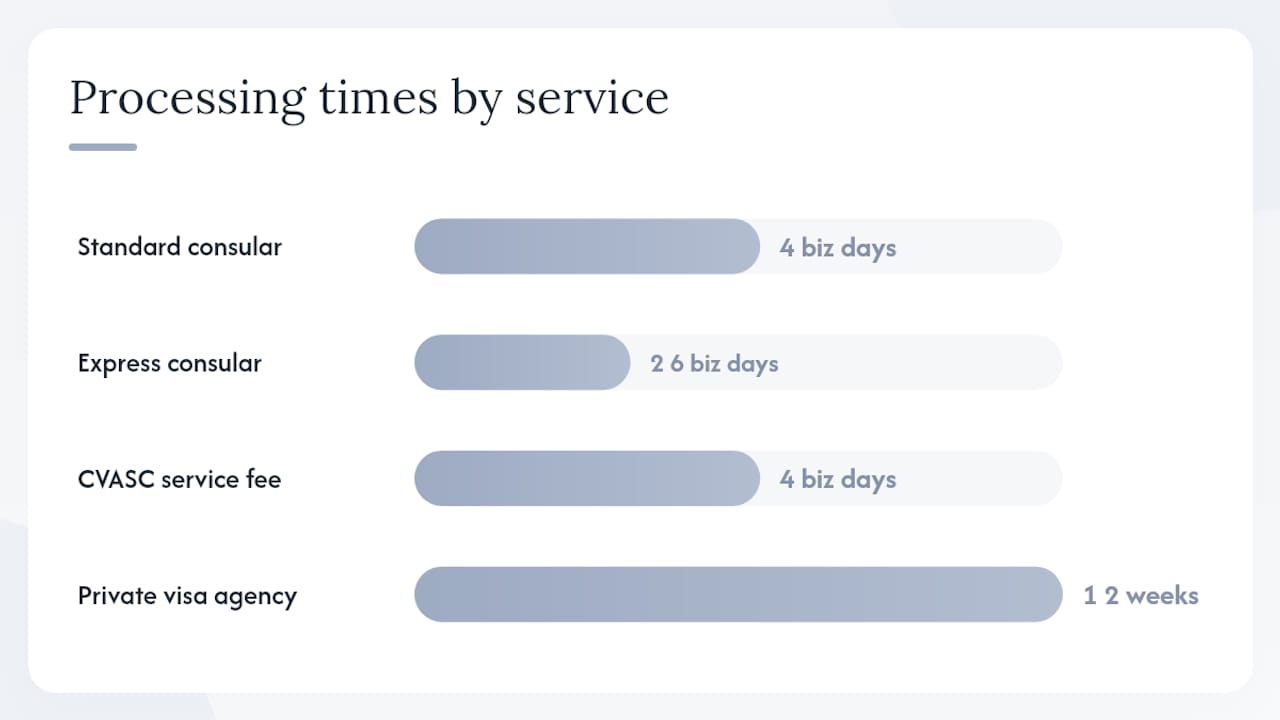
Standard consular processing typically takes a few business days after passport submission, with express service available for faster turnaround at an additional fee. The total end-to-end timeline, including COVA preliminary review and scheduling, is usually several weeks for a straightforward case.
Private agencies like CIBT Visas and MyChinaVisa handle the COVA submission, appointment scheduling, and document preparation on your behalf. They charge a service fee above the official consular fee, but they are worth considering if you live far from a consular office, have a complex case (name changes, prior visa issues), or simply want someone to manage the logistics. Always verify current pricing directly with the agency before paying, as fees change.
Pro Tip: Build in at least two extra weeks beyond the official processing time if your travel dates are firm. Appointment availability, document corrections, and mail-back logistics all add time that the official processing window does not account for.
Which U.S. consulate or CVASC should you submit to?
Submitting to the wrong consular office is one of the fastest ways to get your application rejected outright. China's consular system assigns jurisdiction by your state of residence, not by where you happen to be traveling from.
The Embassy's September 2025 Requirements and Procedures notice lists which U.S. states fall under each consular jurisdiction. The main offices serving U.S. applicants are:
- Embassy of the People's Republic of China, Washington, D.C.: Covers residents of Washington, D.C., Maryland, Virginia, and several other states in the mid-Atlantic and Southeast.
- Consulate General in New York: Covers New York, New Jersey, Connecticut, Pennsylvania, and other Northeastern states.
- Consulate General in Chicago: Covers Illinois, Indiana, Ohio, Michigan, Wisconsin, Minnesota, and surrounding Midwest states.
- Consulate General in San Francisco: Covers California (Northern), Nevada, Oregon, Washington State, and other Western states.
- Consulate General in Los Angeles: Covers California (Southern), Arizona, New Mexico, Hawaii, and nearby states.
- Consulate General in Houston: Covers Texas, Louisiana, Oklahoma, Arkansas, and neighboring Southern states.
Each consulate has an associated CVASC that handles routine submissions. Check the official Embassy website or the specific Consulate's page to confirm which states fall under each jurisdiction before you book your appointment.
Agent and third-party submission: Private agencies are generally permitted to submit on your behalf, but they must present the printed COVA barcode page, your original passport, and a signed authorization letter. Confirm the specific requirements with your chosen agency and the consular office before your appointment date, as rules can vary.
Does the 240-hour transit policy apply to U.S. citizens?
It can, but the conditions are strict. The National Immigration Administration administers the 240-hour (10-day) visa-free transit policy, which allows eligible travelers to stay in designated areas of China for up to 240 hours without a visa, provided they are transiting to a third country or region.
To qualify, you must meet all of the following:
- Hold a valid passport and a confirmed onward ticket to a third country or region (not back to the U.S. or to Hong Kong/Macau as the final destination).
- Enter and exit through designated ports. Not all airports qualify; check the NIA's current list of approved ports before relying on this policy.
- Stay within the designated geographic area. The policy restricts movement to specific cities or provinces; crossing into other regions without a visa is not permitted.
- Have no intention of settling or working during the transit period.
What the 240-hour policy does NOT do: it does not replace a standard tourist visa for a planned trip to China. It is designed for genuine transit passengers, not for travelers who want to visit China as their primary destination.
The Embassy's FAQ on visa-free entry is direct on this point: U.S. citizens are not on the ordinary 30-day visa-free entry list. The unilateral visa-free arrangements China has extended to certain countries do not include the United States. If you are planning a trip to mainland China, you need a visa.
One practical caveat: immigration officers have full discretion at the port of entry. Even when you believe you qualify for transit, carry proof of your onward ticket, your hotel booking for the transit period, and any other supporting documents. A transit policy on paper does not guarantee entry if an officer has questions you cannot answer.
Common reasons China visa applications get rejected (and how to fix them)
Most rejections and delays under COVA trace back to a short list of preventable errors.
Name mismatch or punctuation errors. Your name in COVA must match your passport bio-page character for character, including hyphens, apostrophes, and middle names. If your passport shows "MARY O'BRIEN," entering "Mary Obrien" or "Mary O Brien" will trigger a mismatch. Fix: copy your name directly from your passport bio-page, character by character, before typing it into COVA. The State Department's advisory specifically flags name matching as a source of entry problems.
Wrong photo format or dimensions. Submitting a standard 2"x2" U.S. passport photo instead of the required 33mm x 48mm China-spec photo is a common mistake. Fix: get a photo taken specifically for the Chinese visa application, not a generic passport photo.
Insufficient passport validity or blank pages. If your passport expires within 6 months of your travel dates or has fewer than two blank pages, your application will be rejected. Fix: renew your passport before applying. The passport renewal checklist at Passportcenter walks you through the full process.
Submitting to the wrong consulate. Jurisdiction is determined by your state of residence. Fix: verify your jurisdiction on the Embassy website before booking any appointment.
Poor image quality in COVA uploads. Blurry scans, cut-off corners, or low-resolution files fail the preliminary review. Fix: scan at 300 DPI minimum, check that all text is legible, and verify file size is within the portal's limits before uploading.
Incomplete or missing supporting documents. For visa types that require an invitation letter (M, Q, S), submitting without one or with an improperly formatted letter causes rejection. Fix: confirm the exact format requirements for your visa category on the Embassy's official page before uploading.
Pre-submission checklist
Run through this before you book your in-person appointment:
- Passport valid for 6+ months beyond travel dates
- At least two blank visa pages in passport
- Name in COVA matches passport bio-page exactly (punctuation included)
- Photo meets 33mm x 48mm, white background, no glasses spec
- All COVA uploads are clear, within file-size limits, and show all four corners
- Proof of U.S. residence is current (within 3 months for utility bills/bank statements)
- Supporting documents match your visa type (itinerary for L, invitation for M, etc.)
- Previous Chinese visas or permits uploaded if applicable
- Correct consular jurisdiction confirmed for your state of residence
- COVA status shows "Passport to be submitted" before booking appointment
Why COVA was introduced and what the official sources say now
Before September 2025, U.S. applicants filled out paper forms and submitted everything in person from the start. The COVA system centralized preliminary document review online, which means consular staff now see a pre-screened application before your passport arrives. The practical effect: mismatches in uploaded data (names, punctuation, inconsistent documents) surface earlier in the process, giving applicants a chance to correct errors before the in-person stage rather than discovering problems at the counter.
The Embassy's COVA announcement describes the workflow clearly: complete the online form, upload required documents, wait for preliminary review, then bring originals once the portal shows "Passport to be submitted." That status message is the official signal that your digital submission passed the first check.
Common COVA technical errors and fixes:
- Upload fails or times out: Use a stable connection, reduce file size if above the portal limit, and try a different browser (Chrome and Firefox tend to work more reliably than Safari for government portals).
- "Application not found" after submission: Save your application number immediately after submitting. If the portal loses your session, log back in and search by application number rather than starting over.
- Status stuck on "Under review" for more than 10 business days: Contact the relevant consular office directly by email or phone with your application number. Do not submit a duplicate application.
- "Passport to be submitted" window expiring: If you cannot schedule an appointment within the 30-day window due to availability, contact the consular office before the window closes to request guidance. Do not simply let it lapse.
For the most current policy changes, fee schedules, and jurisdiction updates, check the Embassy's official visa page and the National Immigration Administration directly. Policy details change, and a third-party summary (including this one) can lag behind official updates.
What I'd tell a U.S. traveler before they start the China visa process
The single biggest mistake I see is people starting COVA after they've already booked non-refundable flights. The online preliminary review, appointment scheduling, and consular processing together take longer than most travelers expect, and a single document error resets the clock. Start COVA first. Book flexible travel dates until you have the visa in hand.
The second thing worth saying plainly: COVA's name-matching requirement is not bureaucratic nitpicking. The State Department's advisory warns that even an approved visa can cause problems at the port of entry if the sticker does not match the passport bio-page exactly. Middle names, hyphens, apostrophes — all of it matters. Spend five minutes comparing your passport to your COVA form before you submit.
On the DIY vs. agency question: most straightforward L visa applications are manageable without a service. If you live within driving distance of a CVASC, have a clean passport history, and your name has never changed, do it yourself and save the agency fee. Pay for a service like CIBT Visas or MyChinaVisa when you have a complex case (name change, prior visa complications, a tight timeline, or you live in a state far from any consular office). The fee is worth it when the alternative is a rejected application two weeks before your trip.
One more thing: keep a digital copy of your COVA barcode page and all uploaded documents in cloud storage. If your printed copy gets damaged or lost on the way to the appointment, you need a backup you can pull up on your phone.
How Passportcenter can help you prepare
Getting your passport in order is the prerequisite for everything else in this guide. If your passport is expiring, has too few blank pages, or needs a name correction before you can start COVA, Passportcenter gives you the clear, step-by-step guidance to fix it fast.
Passportcenter is a free resource built specifically for U.S. travelers. The site covers passport renewal timelines, photo specifications, name-change procedures, and country-specific entry requirements in plain language. When you need more than information, Passportcenter connects you directly to trusted, registered passport courier services that can expedite your renewal so your passport is ready before your China visa application window opens. No guesswork about which courier to trust, no searching through government pages for processing times.
Check your passport validity right now at Passportcenter and get the renewal process started if you need it. A delayed passport is the most common reason U.S. travelers miss their China visa window.
Sources
Use these official and authoritative sources to verify current requirements before you submit anything.
Embassy of the People's Republic of China in the United States — COVA guidance: The primary source for COVA workflow, document requirements, and consular jurisdiction rules. Check here for any updates to the online application process.
Embassy FAQ on Visa-Free Entry (Updated February 2026): Confirms which countries qualify for visa-free entry and clarifies that U.S. citizens are not on the exemption list for ordinary entry.
National Immigration Administration of China: The authoritative source for transit policies, including the 240-hour visa-free transit rules, approved ports, and visa-exemption lists. Check here before relying on any transit policy.
Ministry of Foreign Affairs — Guidance on Visa Application: Official visa category descriptions and application rules. Useful for confirming which visa class fits your travel purpose.
U.S. State Department China Travel Advisory: Covers entry requirements, name-matching warnings, special permit requirements (Tibet), and current safety advisories. Read this before you travel, not just before you apply.
CDC Travel Health — China: Current vaccination recommendations and health notices for travelers to China. Check this 4–6 weeks before departure to allow time for any required immunizations.
MyChina.Guide — China Visa for U.S. Citizens: A practical, regularly updated summary of fees, timelines, and common applicant experiences. Useful as a cross-reference, but always verify figures against official Embassy sources before paying.
This article provides general information only. Visa policies, fees, and processing requirements change. Verify all details with the official Embassy, Consulate, or National Immigration Administration pages before submitting your application or making travel arrangements.
This article is general information, not a substitute for advice from a qualified lawyer. Consult a qualified legal professional about your own circumstances before acting on anything here.
- The application process for U.S. citizens utilizes the China Online Visa Application (COVA) system
- China Visa for US Citizens: Step-by-Step (2026)
- National Immigration Administration of China (visa-exemption and transit policy)