
U.S. citizens must obtain a Kenya Electronic Travel Authorization (eTA) before boarding a flight to Kenya, and there's no way around it. Apply through the official portal at etakenya.go.ke before you travel. Your passport needs validity extending well beyond your arrival date, so check that first. Skip the eTA and you risk denied boarding or turned away at the border.
TL;DR:
- U.S. citizens must apply for a Kenya eTA before travel; approval is not guaranteed entry and is checked at the border.
- Application requires a valid passport with over six months' validity, a recent photo, travel details, and proof of accommodation, all matching exactly.
- Processing generally takes around three days but is recommended at least two weeks before departure to accommodate delays or manual reviews.
- Exempt travelers include East African Community citizens, Kenyan residents, and flight crew, while others face rejection if they lack a pre-approved eTA.
- Travelers should verify health requirements like yellow fever vaccination and stay updated on evolving entry protocols beyond the eTA process.
Table of Contents
- What Is the Kenya eTA for U.S. Citizens?
- Do U.S. Citizens Need a Kenya eTA?
- What Documents Do You Need Before You Apply?
- How to Apply for a Kenya eTA
- How Long Does Kenya eTA Processing Take?
- Who's Exempt, and What Happens at the Border?
- Common Kenya eTA Mistakes and a Pre-Departure Checklist
- Multiple Entry vs. Single Entry: Which Do You Need?
- What Else Do You Need Beyond the eTA to Enter Kenya?
- What to Do If Your eTA Application Runs Into Trouble
- A Practical Note on Preparation
- Need Your Passport Sorted Before You Apply for Your eTA?
- Sources
What Is the Kenya eTA for U.S. Citizens?
The Kenya eTA is the electronic travel authorization that replaced the country's older e-visa system on January 5, 2024. If you've traveled to Kenya before and remember applying for an "e-visa," that platform is gone. The current system runs through etakenya.go.ke and is managed by Kenya's Directorate of Immigration Services.
Here's the distinction that trips people up: an approved eTA is not a guarantee of entry. It's pre-travel clearance that lets you board your flight. The actual admission decision happens at the port of entry, where an immigration officer reviews your documents and makes the final call.
Kenya shifted to this system as part of a broader Visa Free Regime, an administrative change designed to screen travelers before they leave home rather than at the airport. The [Kenya Embassy in Washington, D.C.] confirms the eTA is now mandatory for most foreign visitors](https://kenyaembassydc.org/eta/), and that includes people who've breezed through Kenyan immigration on old-style visas in the past.
Do U.S. Citizens Need a Kenya eTA?
Yes, and this applies to every U.S. passport holder regardless of age. Infants and children need their own approved eTA before the family boards a flight. There's no minor exemption, no "add the baby to mom's application," and no way to travel as a family unit under one authorization.
A small set of travelers don't need to apply:
- Citizens of East African Community (EAC) member states, who move under separate regional agreements.
- Kenya permanent residents and valid work-permit holders, who already carry documentation that covers entry.
- Flight crew traveling on official duty.
- Passengers in true airside transit who never leave the airport and continue on a connecting flight within a short window.
If you don't fall into one of those categories, plan to apply. And don't count on a walk-up visa at the airport counter as a backup plan. There is no reliable visa-on-arrival option for most travelers anymore, and showing up without a pre-approved eTA can mean the airline denies boarding before you even leave the U.S.
What Documents Do You Need Before You Apply?
Gather everything before you sit down at the computer. The application moves faster when you're not scrambling for a scan halfway through.
- Valid U.S. passport with at least six months of validity remaining past your arrival date, plus one completely blank page for entry stamps.
- Digital passport-style photo, recent and meeting standard photo specifications (plain background, no glasses glare, forward-facing).
- Contact information, including a working email address and phone number, since confirmation and status updates go there.
- Travel itinerary, with your arrival and departure dates locked in.
- Proof of accommodation, either a hotel booking confirmation or a formal invitation letter if you're staying with someone in Kenya.
- Payment method, since the portal requires online payment by card to process your application.
One detail that causes more rejections than it should: make sure every name you enter matches your passport exactly, down to middle names and suffixes. A typo or a shortened nickname can flag your application for manual review.
How to Apply for a Kenya eTA
Start at etakenya.go.ke and confirm you're on the official government site before typing in any personal information. Kenya's immigration authority has flagged look-alike sites in the past, so check the URL carefully.
- Create an account or continue as a guest applicant, depending on the portal's current flow.
- Enter your biographic details exactly as they appear on your passport.
- Upload your passport photo page and your digital passport-style photo.
- Answer the eligibility and background questions honestly. Rushing or guessing here is a common cause of delays.
- Enter your travel itinerary, including arrival and departure dates and your accommodation details.
- Review every field for typos, especially your name and passport number.
- Complete payment through the portal's accepted card options.
- Save or print your confirmation page and note your reference number.
Pro Tip: Fill out the application on a desktop or laptop rather than a phone. Uploading clear document scans is far easier with a full-size screen, and you're less likely to submit a blurry photo that triggers a manual review.
Keep screenshots of every screen you complete, not just the final confirmation. If a payment glitches or your session times out, those screenshots save you from re-entering everything from scratch.
How Long Does Kenya eTA Processing Take?
Standard processing typically wraps up within a few working days, which sounds comfortable until you consider how often that baseline gets stretched.
Immigration authorities have noted that automated checks can flag applications for manual review, and manual review adds time you can't predict. That's why the official guidance recommends applying at least two weeks before your travel date, not three days out. Building in that buffer protects you from a last-minute scramble.
If your trip is close and you're out of runway, an urgent or expedited processing option exists for an additional fee. It's worth the cost when your departure is inside that two-week window and you have no flexibility left.
- Standard processing: around 3 working days, longer if flagged for review.
- Recommended lead time: at least 2 weeks before departure.
- Expedited option: available for an extra fee when time is short.
If your eTA still hasn't come through and your flight is close, contact your airline directly and keep proof of your submitted application handy. Airlines sometimes accept a confirmation screenshot with your reference number while the approval finishes processing.
Who's Exempt, and What Happens at the Border?
The exemption list is narrow by design: EAC citizens, Kenya permanent residents, valid work-permit holders, and passengers in true airside transit who never clear immigration. Everyone else applies through the standard eTA process, no exceptions carved out for short trips or return visitors.
Even with an approved eTA in hand, understand that it authorizes travel, not automatic admission. The immigration officer at your port of entry still reviews your passport, your stated purpose of travel, and your documentation before waving you through. This isn't unique to Kenya, but it's worth internalizing: an eTA approval email is a green light to board, not a guarantee stamped at the gate.
These exemption categories and entry rules come directly from Kenya's immigration regulations, and they can shift. Verify current rules through the official portal or the Kenya Embassy before you finalize travel plans, especially if your situation falls into a gray area like dual citizenship or a layover with a hotel stay.
Common Kenya eTA Mistakes and a Pre-Departure Checklist
Most rejected or delayed applications trace back to a handful of avoidable errors. Passport validity under six months is the most common one. A name that doesn't match exactly between your passport and application form is a close second. Beyond that:
- Low-quality or improperly cropped photos that fail the portal's automated check.
- Incomplete itinerary details, especially a missing return or onward flight date.
- Payment failures from using a card not enabled for international transactions.
If your application gets flagged, don't panic and resubmit blindly. Check your confirmation email for specific feedback first, and if it's unclear, reach out to Kenyan immigration support through the contact channels listed on the portal.
Pro Tip: Before you leave for the airport, confirm you have a printed or phone-saved copy of your eTA approval, your physical passport, proof of accommodation, and your return ticket. Airlines check all four before they'll issue a boarding pass for Kenya.
Passport problems catch travelers off guard more often than eTA issues do. If your passport is close to that six-month cutoff, our guide to common passport application mistakes walks through what causes renewal delays before they become a travel emergency.
Multiple Entry vs. Single Entry: Which Do You Need?
Most U.S. leisure travelers heading to Kenya for a single trip apply for a single-entry authorization, which covers one arrival and one departure within your approved travel window. If your itinerary is straightforward, like a safari trip or a beach stay in Mombasa followed by a direct flight home, single entry covers you completely.
Multiple entry becomes relevant if your trip involves leaving Kenya and coming back within the same visit, a pattern common among travelers combining Kenya with a side trip to Tanzania, Uganda, or Rwanda. Crossing overland into a neighboring country for a few days and returning to Kenya afterward means you need an authorization that permits more than one entry, or you'll be stopped trying to re-enter.

This is easy to overlook when you're planning a multi-country East Africa itinerary and assume one authorization covers the whole region. It doesn't. Each country runs its own entry system, and Kenya's eTA only governs your entries into Kenya specifically. When you fill out your application, pay close attention to the entry type field and match it to your actual itinerary, not just your first arrival date. Guessing wrong here either wastes money on an entry type you don't need or leaves you stuck at a land border without proper documentation to get back in.
What Else Do You Need Beyond the eTA to Enter Kenya?
An approved eTA gets you to the airport, but it isn't the only box to check before landing in Nairobi or Mombasa. Health documentation matters just as much, and it's easy to assume the eTA process covers everything when it doesn't.
The CDC maintains updated travel health guidance for Kenya, covering vaccination recommendations and health precautions specific to the region. Depending on your itinerary and any recent travel history, you may need to show proof of yellow fever vaccination, particularly if you're arriving from or have recently transited through a country with yellow fever risk. Check the CDC's country-specific page well before your trip, since some vaccines need weeks to become effective.
COVID-19 entry protocols have relaxed significantly since the height of the pandemic, but requirements can still shift with little notice depending on global health conditions. Don't rely on what a friend experienced last year. Check current conditions close to your departure date.
The U.S. State Department's Kenya country page is worth bookmarking too. It covers safety advisories, local laws, and updates that go beyond entry paperwork, the kind of practical, on-the-ground information that helps you travel smart once you've cleared immigration.
What to Do If Your eTA Application Runs Into Trouble
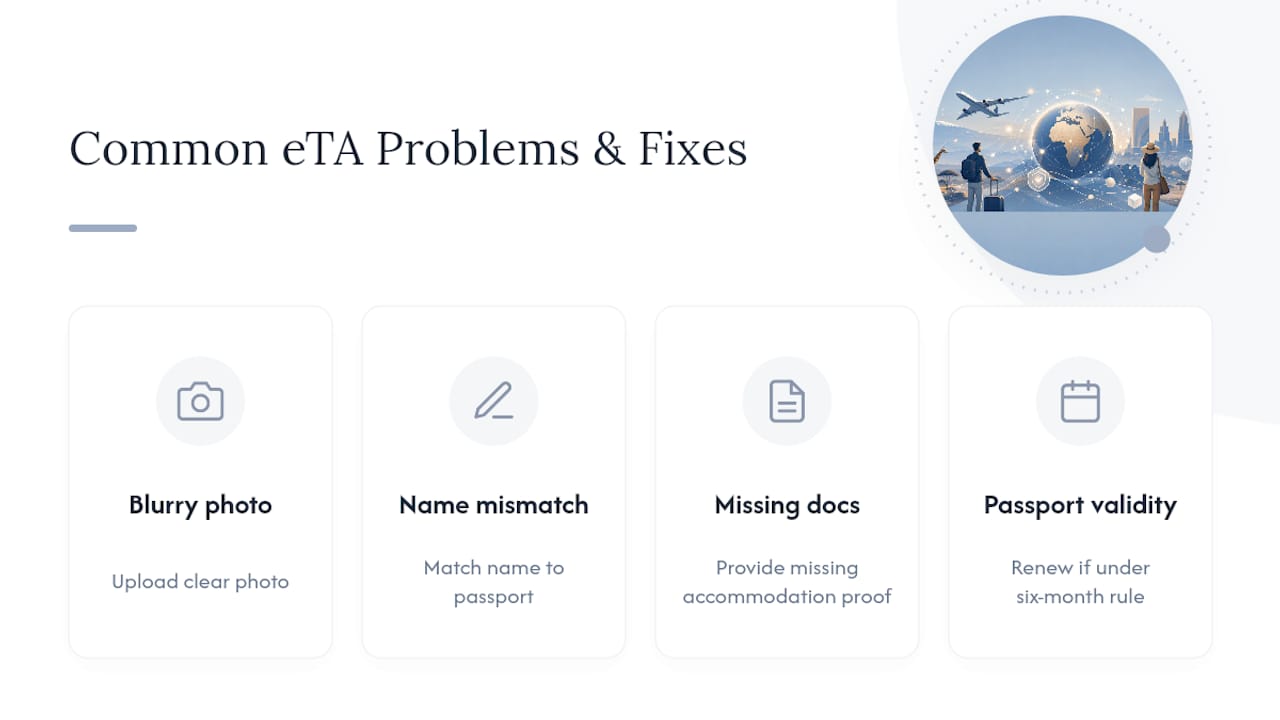
Applications get delayed or denied for specific, fixable reasons more often than random bad luck. If your status shows "pending" past the standard three-day window, resist the urge to submit a second application. Duplicate submissions tend to confuse the review process further rather than speed it up.
Start by checking your confirmation email closely. Kenyan immigration often flags the specific issue: a blurry photo, a mismatched name, or an itinerary detail that didn't line up. Fixing that specific problem and following the portal's resubmission instructions is faster than starting over blind.
If you're denied outright, look for the stated reason before deciding your next move. A passport validity issue means renewing your passport, not resubmitting the same application. A documentation gap, like a missing accommodation proof, is something you can correct and resubmit fairly quickly.
If your travel date is close and you haven't heard back, contact both your airline and Kenyan immigration support directly. Airlines have some flexibility for passengers who can show proof of a submitted application, especially when an urgent processing request is already in the pipeline. Keep every screenshot and reference number from your original submission. They become your proof of good-faith effort if you need to explain a delay at check-in.
For travelers whose real problem is a passport that won't meet the six-month validity rule in time, that's a different fix entirely, and one worth solving before you even start the eTA form.
A Practical Note on Preparation
The eTA process trips people up far less often than their passport does. If your passport is close to expiring or doesn't meet that six-month buffer, that's the real blocker, and it's worth fixing weeks before you touch the eTA application. Always apply through the official portal directly. When time is tight, expedited passport help can be the difference between making your flight and rebooking it.
— David
Need Your Passport Sorted Before You Apply for Your eTA?
If your passport is expiring soon, missing that six-month cushion, or you're staring down a Kenya trip with no time to spare, the eTA application is the least of your problems until you understand Canada’s revised visitor visa guidelines that similarly highlight the importance of timely documentation. Passportcenter.ai gives you plain-language guidance on renewal timelines, expedited processing options, and how to avoid the passport mistakes that stall international trips.
This isn't a visa service. Passportcenter.ai is a free resource for understanding your passport situation, and it connects you to vetted expedited courier partners when your timeline is genuinely tight. If you're not sure whether your passport will clear that six-month rule for Kenya, check our current passport processing time guide and see where you stand before you start the eTA form. Visit Passportcenter to check your renewal timeline now.
Sources
- General Information · Kenya Electronic Travel Authorization (eTA)
- Kenya travel information – U.S. Department of State
- Kenya travel health – Centers for Disease Control and Prevention (CDC)