
Routine passports currently take about 4 to 10 weeks door to door once you factor in mailing, and expedited orders run roughly 2 to 7 weeks. If your status has read "Mailed" for more than two weeks and nothing has shown up, your next move is simple: call the National Passport Information Center at 877-487-2778. Don't pay for anything else first.
TL;DR:
- Processing times can extend up to 10 weeks for routine and 7 weeks for expedited services due to mail delays and high demand, especially in peak seasons.
- Checking your application status with the provided tools and waiting two weeks after the "mailed" status before escalating is crucial to avoid unnecessary calls.
- Applying during peak seasons, missing or incorrect supporting documents, or living in regions with staffing issues can further delay delivery beyond official estimates.
- Booking expedited processing and faster shipping options can reduce total wait time approximately to 3-4 weeks in worst cases, but private couriers do not shorten government review time.
- For minors or special cases, extra documents and careful preparation at acceptance facilities can prevent manual holds that add further weeks to delivery.
Table of Contents
- Passport Delivery Delays: How Long Is Total Delivery Really Taking?
- How Do You Check Your Application Status?
- Why Do Passport Delivery Delays Happen in the First Place?
- What to Do if Your Passport Hasn't Arrived
- What Are Your Legitimate Options for Faster Delivery?
- PassportCenter.ai's Checklist to Avoid Delays
- Are Delays Different for First-Time Applicants Versus Renewals?
- Do Delivery Times Vary by Region?
- What About Delays for Minors or Special Cases?
- Why Do Acceptance Facility Locations Matter for Delays?
- Planning Your Trip Around Passport Delivery Delays
- Where PassportCenter.ai Fits Into Your Timeline
- Sources
Passport Delivery Delays: How Long Is Total Delivery Really Taking?
The State Department's official processing time is 4 to 6 weeks for routine service and 2 to 3 weeks for expedited service. That number only covers the government's internal review, not the trip through the mail. If you're applying for the first time or renewing by mail, USPS transit can tack on up to two weeks getting your application to the processing center, and up to two more weeks getting your finished passport back to you.
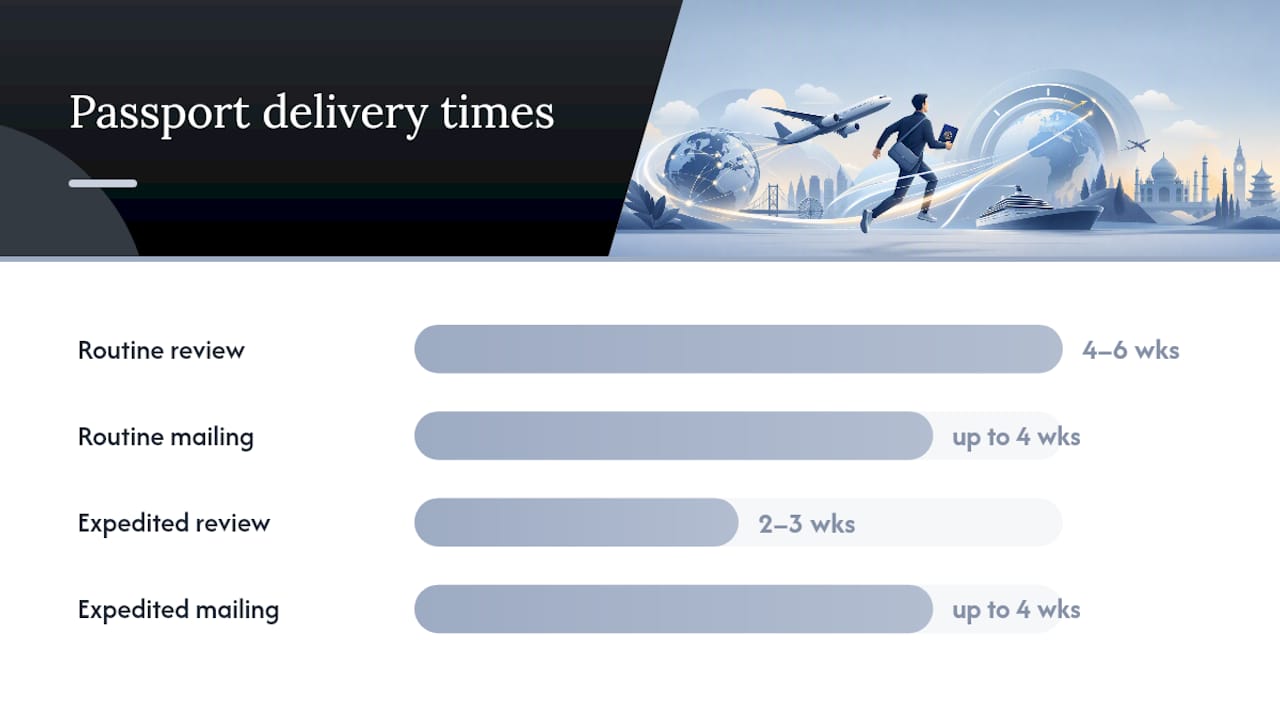
Run the worst case math and routine service can realistically stretch to 10 weeks, while expedited can hit 7 weeks in a bad stretch. That's not a glitch. It's just processing time plus two mailing legs.
Statistic Callout: During the 2023 backlog, routine processing averaged 10.5 weeks at its worst, according to GAO's review of what went wrong. Current windows are shorter, but the lesson stands: build in a buffer.
A few things that stretch your timeline further:
- Applying between late winter and summer, when demand spikes hardest.
- Missing or mismatched supporting documents that trigger a hold.
- Living in a region where regional processing centers are running behind.
If you're booking travel, use the outer edge of the range as your target date, not the inner one. Passportcenter's breakdown of current processing time walks through how to calculate your personal buffer based on when you applied.
How Do You Check Your Application Status?
Two tools matter here: the status checker on Travel.State.Gov, and your USPS or courier tracking number if you mailed your application. You'll need your application locator number, last name, and date of birth to look anything up.
Here's what each status actually tells you:
- In Process — your application is being reviewed. It can take up to two weeks after mailing before this even appears, so don't panic in week one.
- Approved — your passport has been printed and is queued for shipment.
- Mailed — your passport has left the facility. Start your two-week clock here.
- Supporting Documents Mailed — your old passport or birth certificate is on its way back separately, often 1 to 4 weeks after your new passport arrives.
One quirk trips up a lot of applicants: your tracking number might show "delivered" at a regional mail facility before the agency's own system reflects intake. That's a sorting-to-intake lag, not evidence your passport vanished. If your tracking shows delivered but your government status hasn't moved, wait a few business days before assuming a problem.
Why Do Passport Delivery Delays Happen in the First Place?
Most delays trace back to a handful of predictable causes, and knowing which one applies to you tells you whether to relax or escalate.
- Seasonal demand — application volume climbs from late winter through summer, straining capacity across every processing center.
- USPS transit and sorting — mail routing anomalies and regional sorting backlogs can add days without anyone doing anything wrong.
- Missing or mismatched documents — an unsigned form, a photo that doesn't meet spec, or a name that doesn't match your ID puts your file on hold until someone catches it.
- System outages — periodic IT issues at processing centers create short but real slowdowns.
- Structural staffing gaps — GAO's analysis of the 2023 backlog found that staffing and IT capacity, not just demand, drove extended waits, and some of that capacity strain persists even in calmer years.
If your delay lines up with one of these, it's probably not unique to you. If it doesn't, that's your signal to call.
What to Do if Your Passport Hasn't Arrived
Work through this in order rather than jumping straight to the phone.
- Recheck your status at passportstatus.state.gov and confirm the date it last changed.
- Wait out the two-week window from the date your status flipped to "Mailed" before assuming something's wrong, since carrier scans can lag agency updates.
- Call NPIC at 877-487-2778 (TTY: 888-874-7793) once that window passes. Have your application number, full legal name, and date of birth ready before you dial.
- Ask about your supporting documents separately if only those are missing. They travel on their own timeline and can take up to four weeks longer than the passport itself. Reimbursement claims for lost original documents typically need to be filed within 120 days.
- File a USPS mail loss claim if NPIC confirms your passport was mailed but tracking data suggests it never reached you.
Pro Tip: Write your application number down somewhere other than your email inbox. NPIC agents move faster when you can rattle off your details instead of hunting for a confirmation message while on hold.
What Are Your Legitimate Options for Faster Delivery?
You have real, government-sanctioned ways to speed things up, but each one has a ceiling on what it actually fixes.
- Expedited processing costs an additional $60 and shortens the review window from 4 to 6 weeks down to 2 to 3 weeks. It does nothing for mailing time.
- 1 to 3 day return delivery costs $23.36 for passport books and gets your finished passport to you faster once it ships. It's not available for passport cards, and you pay it separately from the expedited fee.
- Urgent travel appointments are available if you're flying internationally within 14 days or need a visa within 28 days, but you'll need to show proof of that travel when you book.
Statistic Callout: Combined, expedited processing plus 1 to 3 day return delivery runs $83.36 above your standard passport fee, and can cut a 10 week worst case down closer to 3 to 4 weeks.
One clarification worth repeating: private courier services don't speed up government review. They handle secure pickup and delivery to acceptance facilities, which helps with logistics, but the internal processing clock runs at the same pace regardless of who drops off your paperwork.
PassportCenter.ai's Checklist to Avoid Delays
A surprising share of "delays" are actually self-inflicted holds. Before you mail anything, run through this:
- Sign every form where a signature line exists. Unsigned applications get returned, not held. Passportcenter's list of common application mistakes covers the ones that trip up applicants most.
- Double check your photo meets the size and background specs. Rejected photos are one of the top causes of processing holds.
- Mail with tracking, always. First-class mail with no tracking number leaves you guessing if something goes missing.
- Use a rigid envelope for passport books and documents to avoid damage that triggers a manual review.
- Bookmark your status page and check it weekly rather than daily. Status updates don't move faster because you refresh more often.
Are Delays Different for First-Time Applicants Versus Renewals?
First-time applicants face a structurally slower path than renewers, and it has nothing to do with luck. A first-time application requires an in-person visit to an acceptance facility, identity and citizenship document review, and often a longer verification step if your birth certificate or ID raises any question. Renewals by mail skip the in-person appointment entirely for most adults, which removes one whole layer of scheduling friction.
Renewals also tend to move faster through document review because the government already has a record of your prior passport. First-time applicants without a clean paper trail, such as those relying on older birth certificates or unusual name histories, are more likely to trigger a hold for supporting document verification.
That said, first-timers aren't necessarily slower once their file reaches processing. The gap is mostly front-loaded: getting the application accepted takes longer, but once it's In Process, both groups move through the same 4 to 6 week routine window or 2 to 3 week expedited window. If you're applying for the first time, budget extra time before you even mail anything, not just after.
Do Delivery Times Vary by Region?
Yes, and it's not random. Passport applications get routed to one of several regional processing centers, and each center's workload shifts with local demand, seasonal travel patterns, and staffing levels at that specific site. An application processed at a center handling a spring travel surge can run behind one in a quieter region during the same calendar week.
Mailing time compounds this. USPS transit speeds vary by state and even by zip code, so two applicants who submit on the same day can see their passports arrive days apart purely based on geography. Rural addresses served by longer rural delivery routes sometimes see slightly longer outbound transit than dense urban zip codes with more frequent delivery cycles.
There's no published breakdown of exact wait times by state, so you can't look up your specific region's current speed. The practical takeaway: treat the official processing time estimates as a national average, and lean toward the longer end of any range if you live somewhere with historically slower mail service or you're applying during a regional demand spike.
What About Delays for Minors or Special Cases?
Passports for children under 16 come with extra document requirements, and every added document is another place a delay can start. Both parents typically need to provide consent, either by appearing together or by submitting notarized authorization if one parent can't attend. A missing signature, an expired notarization, or a custody document that doesn't match the child's legal name is enough to put the file on hold.
Special cases carry their own friction. A recent legal name change, a court-ordered guardianship, or an application filed on behalf of someone with power of attorney all require supporting paperwork that a standard adult renewal doesn't need. Each of those documents gets reviewed individually, and any inconsistency, like a name that doesn't exactly match across documents, triggers a manual check rather than an automatic pass.
If you're applying for a minor or handling a special circumstance, gather every required document before you go to the acceptance facility rather than after. It's far faster to fix a missing form on the front end than to wait for a hold notice weeks into processing. When in doubt about which documents your situation needs, check the specifics before mailing anything.
Why Do Acceptance Facility Locations Matter for Delays?
Every passport application that isn't a mail-in renewal starts at an acceptance facility, whether that's a post office, a clerk's office, or a public library with passport services. These facilities don't process your passport. They verify your identity, check your documents, and forward your application into the government pipeline.
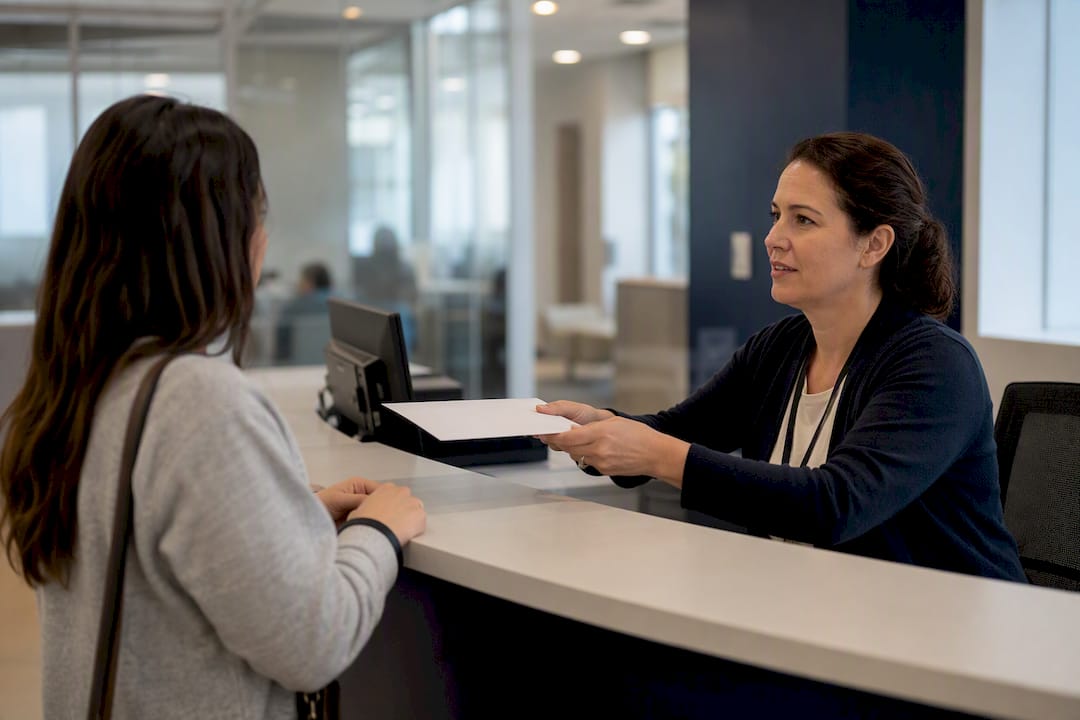
That intake step is where a surprising number of delays begin. A facility clerk who misses an incomplete signature, a facility with a backlog of its own appointments, or a rural location with limited weekly hours can all add days before your application even reaches a processing center. Urban facilities in high-demand areas sometimes book out appointment slots weeks in advance, which pushes your entire timeline back before processing has even started.
Choosing a facility with same-week availability, and confirming your documents are complete before your appointment, removes one of the few delay sources you actually have control over. Once your application leaves the acceptance facility, the rest is governed by processing capacity and the mail. But that first step is yours to manage.
Planning Your Trip Around Passport Delivery Delays
If your travel date is more than two months out, routine service with a normal buffer is fine. Inside eight weeks, pay for expedited and 1 to 3 day return delivery rather than gambling on standard mail. Inside two weeks, book an urgent appointment instead of hoping expedited processing catches up in time.
The math favors paying $83.36 for expedited plus faster shipping over rebooking a flight or losing a deposit. But don't pay for anything before checking your actual status. Half the "delays" applicants report are still sitting comfortably inside the normal window.
— David
Where PassportCenter.ai Fits Into Your Timeline
Once you know your realistic delivery window, the harder part is knowing what to do if you're inside it, outside it, or somewhere in the gray zone. That's the gap Passportcenter fills. Rather than guessing whether your wait is normal, you get plain-language guides built around the same official timelines covered here, plus checklists that catch the application mistakes most likely to trigger a hold before you ever mail anything.
If you're staring down a tight travel date, Passportcenter also connects you to registered expedited courier services for the cases where professional handling genuinely helps with logistics. Start at Passportcenter to check your specific timeline, run through the mistake checklist before you mail your application, and find a vetted courier option if your trip can't wait.
Sources
- Get Your Processing Time - Travel - State Department
- Renew your passport by mail - Travel - State Department
- Check your application status - Travel - State Department
- What’s Being Done to Prevent Future Passport Processing Backlogs? - GAO