
Passport expeditor scams are real, and they're targeting U.S. applicants right now through copycat websites, fake seals, and ads that promise faster passports than the government can deliver. The only official source for passport forms and appointments is Travel — no other site can renew your passport or guarantee expedited processing.
If you're worried you've already interacted with a scam site, act now:
- Stop any pending payment and call your bank or card issuer to block or dispute the charge.
- Report it immediately to the Diplomatic Security Service at Dsscrimetips and to the FTC at Reportfraud. If you shared personal information, start a recovery plan at IdentityTheft.gov.
The scope of this problem is bigger than most people realize. FinCEN has documented counterfeit passport card fraud rings using stolen identities to impersonate victims at banks, and the FTC has issued a direct consumer alert warning against websites charging for services the government provides free.
Key Takeaways
Passport expeditor scams succeed by mimicking government authority and charging for services travel.state.gov provides free, so verification before payment is the single most effective defense.
| Point | Details |
|---|---|
| Use one official site | Travel.state.gov is the only source for passport forms, appointments, and online renewals. |
| Watch for fake urgency | Countdown timers, gift-card demands, and same-day promises signal a scam site. |
| Verify courier registration | Ask which specific passport agency a courier is registered with before paying. |
| Report fraud fast | Use dsscrimetips.state.gov and ReportFraud.ftc.gov the moment you suspect a scam. |
| Protect your identity | Freeze your credit and start a recovery plan at IdentityTheft.gov if PII was exposed. |
Table of Contents
- Common Passport Expeditor Scams and Red Flags
- How Registered Couriers Work and What They Can't Promise
- Checklist: How to Verify a Passport Expeditor Before You Pay
- What to Do If You Already Paid or Shared Personal Information
- Protecting Your Identity After a Passport Scam
- How Passportcenter Helps You Verify Before You Commit
- Why the Real Risk Isn't the Money You Lose
- Frequently Asked Questions
- Sources
Common Passport Expeditor Scams and Red Flags
Scammers rely on a small set of tricks that repeat across nearly every fake passport site. Recognizing the pattern matters more than memorizing any single example.
- Copycat websites with misleading domain names — sites like "USPassportHelp-Gov.com" or similar variations that mimic official language but aren't affiliated with the State Department.
- Fake seals or government-style logos slapped onto a private business's homepage to imply federal authority it doesn't have.
- Charging for free forms. The FTC warns that some sites charge $60 to a few hundred dollars for downloadable forms the government hands out at no cost.
- Impossible speed promises, like same-day passports with no agency appointment.
- Pressure tactics, urgency countdowns, requests for gift cards or wire transfers, and vague or nonexistent refund policies.
A local news investigation in Orlando found travelers paying fees for completed forms available free from the government, with the Better Business Bureau tracking many complaints tied to specific repeat offenders.
Pro Tip: Sponsored ads at the top of your search results are a common scam vector. Scroll past them and click only on results showing the actual travel.state.gov domain.
How Registered Couriers Work and What They Can't Promise
A registered courier or expeditor is a private business, not a government agency. Some couriers register with individual passport agencies to hand-deliver applications and pick up finished passports on a traveler's behalf, but that registration is granted agency by agency, never as a blanket credential.
Here's what a legitimate courier can and cannot do:
- Can: physically deliver a signed, printed application to a regional passport agency and retrieve the completed passport.
- Can: charge a service fee for this hand-delivery work.
- Cannot: submit your application online in place of you.
- Cannot: promise faster processing than the agency itself controls.
- Cannot: act as a government representative or speak for the State Department in any dispute.
Travel.State.Gov's own guidance is blunt about the limits here: courier fees are non-refundable, and the department takes no responsibility for disputes with private courier companies. That's a risk you accept the moment you pay one.
Checklist: How to Verify a Passport Expeditor Before You Pay
Run through this before handing over any payment information.
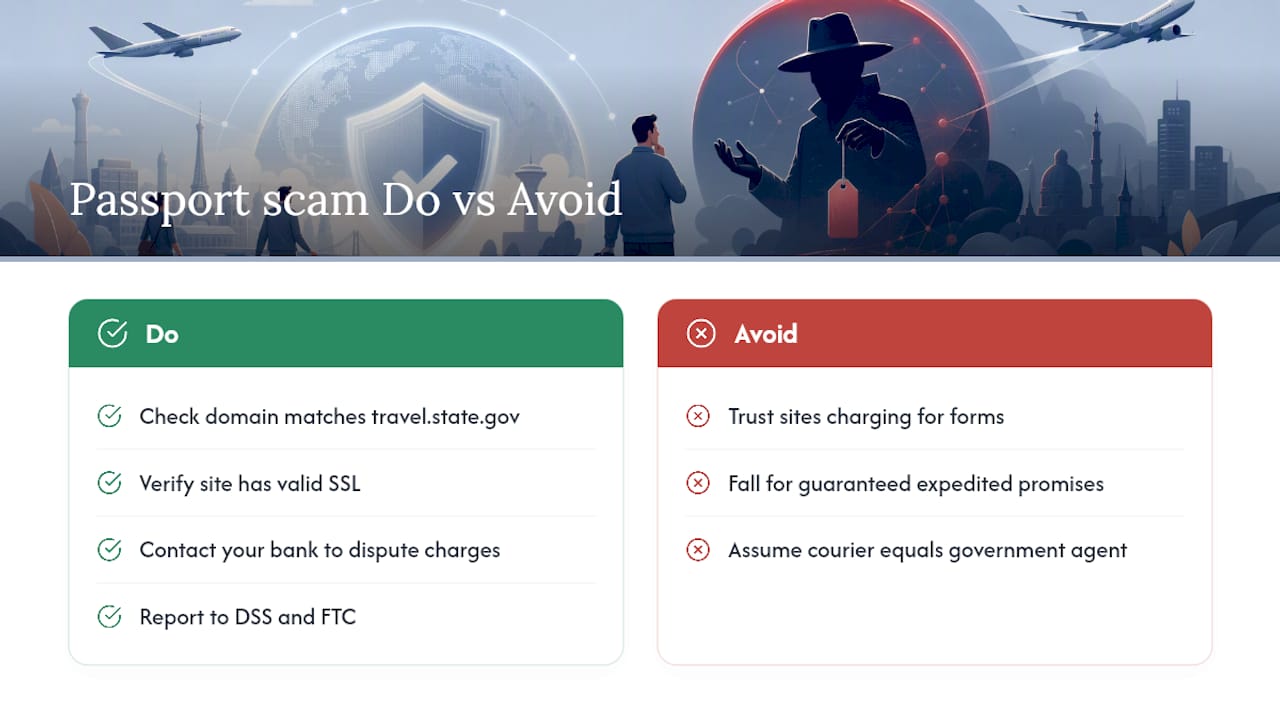
- Start at travel.state.gov. Never trust a site claiming government affiliation unless the URL is exactly that.
- Check the courier registration list against the specific passport agency you'd be using. Registration is per agency, not universal, so ask which locations the company actually serves.
- Inspect the domain. Look for a valid SSL certificate, an exact domain match, and run a WHOIS lookup if you can. Newly registered domains are a red flag.
- Search for complaints. Check the Better Business Bureau and recent news coverage for the company's name.
- Call using a verifiable phone number, not one only listed on the site itself. Ask for registration documentation and a written fee breakdown, including the refund policy.
- Avoid irreversible payment methods like wire transfers, gift cards, or cryptocurrency. Save every receipt, confirmation email, and screenshot.
Resources like Scruteon's scam prevention guide walk through similar red-flag checklists that apply broadly to online fraud, not just passport services.
Pro Tip: If a company won't tell you exactly which passport agency it's registered with, that's your answer. Hang up and go straight to travel.state.gov.
What to Do If You Already Paid or Shared Personal Information
If you've already sent money or personal details to a site you now suspect is fraudulent, move through these steps in order and document everything as you go.
- Call your bank or card issuer first. Ask specifically about chargeback or dispute options for the transaction.
- Report the fraud to the Diplomatic Security Service at dsscrimetips.state.gov and to the FTC at ReportFraud.ftc.gov.
- If personal information was exposed, start a recovery plan at IdentityTheft.gov and notify your state's consumer protection office.
- File a Better Business Bureau complaint and contact local police if you suspect organized criminal activity.
- Preserve evidence: screenshots, emails, receipts, and domain records with dates and dollar amounts attached.
| Action | Where to Go |
|---|---|
| Dispute a charge | Your bank or card issuer |
| Report passport fraud | dsscrimetips.state.gov |
| Report a scam site | ReportFraud.ftc.gov |
| Recover from identity theft | IdentityTheft.gov |
| File a consumer complaint | Better Business Bureau |
DSS maintains offices in 29 U.S. cities, making it the largest-reach federal law enforcement presence tied to a single agency's mission, according to DSS's own crime tips resource. That infrastructure exists specifically to handle reports like yours.

Protecting Your Identity After a Passport Scam
Exposure to a scam site doesn't stop at the money you lost. If you typed in your name, date of birth, Social Security number, or passport number, treat it as an identity theft event, not just a financial one.
- Place a fraud alert or credit freeze. A freeze locks your credit file entirely and is stronger protection; a fraud alert is faster to set up but weaker. Choose a freeze if you have time to manage it.
- Use IdentityTheft.gov's recovery plan. It generates a personalized checklist and pre-filled letters for creditors and agencies.
- Monitor bank statements and credit reports closely for at least several months. Watch official mail for unfamiliar account notices.
- Watch for the specific fraud pattern FinCEN has flagged: counterfeit passport cards used to impersonate victims in person at banks, often followed by rapid withdrawal attempts.
That last pattern matters because it moves beyond online fraud into physical impersonation, which is harder to reverse once it starts.
How Passportcenter Helps You Verify Before You Commit
Passportcenter built its guidance around one goal: helping you handle your passport application correctly the first time, so you never feel pressured into a risky third-party shortcut. The site's regional passport agency guide lists official agency locations and appointment rules you can cross-check against any courier's registration claims. The processing time guide shows you what realistic government timelines actually look like, so you can spot an expeditor's inflated speed promise instantly.
Passportcenter's content is written under David's editorial direction, with a focus on plain-language accuracy over sales pressure.
Pro Tip: Before clicking any expedited-service link, check it against a legitimate government timeline first. If the promised speed sounds too good against the official processing windows, it probably is.
When you do need expedited help, Passportcenter connects you only with vetted courier referrals, not random search-result ads. Start at Passportcenter to compare your legitimate options before you pay anyone.
Why the Real Risk Isn't the Money You Lose
Most coverage of passport expeditor scams focuses on the dollar amount victims lose to fake fee pages, and that framing undersells the actual danger. The FinCEN notice on counterfeit passport cards shows the bigger threat: once a scam site has your name, birth date, and passport number, that data can resurface months later in an in-person bank impersonation, not just a one-time charge on your card.
Conventional advice tells people to "check for HTTPS" and call it a day. That's necessary but nowhere near sufficient. The courier registration requirement is the detail almost nobody checks, and it's the fastest way to unmask a scam, because legitimate companies can name their exact agency affiliations without hesitation. A company that gets vague when you ask "which agency are you registered with?" has told you everything you need to know.
If you take one thing from this guide, prioritize the domain and registration checks before you ever reach for your wallet. Recovery after the fact through IdentityTheft.gov and DSS works, but it's always slower and messier than prevention.
Frequently Asked Questions
Are passport expeditors legit? Some are. Registered couriers can legally hand-deliver applications and pick up passports at specific agencies, but they're private businesses, not government agents, and their fees are non-refundable.
How can I tell if a passport service website is fake? Check the exact domain against travel.state.gov, look for a valid SSL certificate, and be suspicious of any site charging for forms or promising guaranteed expedited turnaround.
What should I do if I already paid a fake passport site? Contact your bank immediately to dispute the charge, then report the incident to DSS and the FTC, and start a recovery plan at IdentityTheft.gov if you shared personal details.
Can a passport courier make my application process faster than the government agency? No. Couriers can only speed up the physical delivery and pickup steps; the government agency itself controls actual processing time.
Where do I report passport-related identity theft? File with IdentityTheft.gov for a personalized recovery plan, and report the fraud separately to DSS and the FTC so investigators can track the scam network.
Sources
- DSS Crime Tips — passport-fraud-tip
- Avoid scam websites that offer to help you get or renew your passport — FTC
- ReportFraud — Federal Trade Commission
- FinCEN notice: Counterfeit U.S. passport card fraud
Bookmark these before you need them. Scam response works best when you don't have to search for the right link mid-crisis.