Proof of travel is required only if you need an in-person appointment at a passport agency because you're leaving within 14 days, or you need a foreign visa within 28 days, or you're facing a life-or-death emergency. Standard expedited processing by mail, the $60 option most applicants use, does not require any proof of travel. Acceptable proof includes a flight itinerary, hotel or cruise reservation, or an employer letter.
TL;DR:
- Proof of travel is only necessary for in-person passport agency appointments, not for routine or expedited mail processing, which only costs $60.
- Acceptable proof includes a flight itinerary, hotel reservation, cruise or ferry ticket, employer letter, or international car insurance documentation, all with clear names, dates, and destinations.
- Printed documents are required; digital copies or screenshots typically won't suffice, and highlighting or highlighting the travel date can speed up check-in.
- Emergency appointments demand proof of travel and evidence of a life-or-death situation, such as a death certificate or hospital letter, verified during check-in.
- If travel plans are not finalized, refundable hotel bookings, cruise reservations, or employer letters are valid substitutes, but fake or expired documents won't pass verification.
Table of Contents
- Which Passport Services Actually Require Proof of Travel
- What Counts as Acceptable Proof of International Travel
- How to Prepare Your Proof for the Appointment
- Documenting a Life-or-Death Emergency
- What If You Haven't Booked Travel Yet?
- Scheduling an Urgent Appointment: Fees and Timelines
- Why So Many Applicants Get This Wrong
- Get Your Free Checklist Before Your Appointment
- Sources
- FAQ
Which Passport Services Actually Require Proof of Travel
Not every fast passport request needs paperwork proving you're actually going somewhere. The State Department splits processing into distinct tiers, and only two of them ask you to show proof.
- Routine processing: No proof needed. Standard 4 to 6 week wait.
- Expedited by mail or acceptance facility: No proof needed. Costs $60 extra and typically runs 2 to 3 weeks, not counting mail transit.
- Urgent in-person agency appointment: Proof required. Reserved for travel within 14 days or a foreign visa appointment within 28 days.
- Life-or-death emergency: Proof required, plus documentation of the emergency itself.
Here's where people trip up. If you're flying out in 10 days, you qualify for an agency appointment and must bring proof. If you're flying out in 20 days, you likely have time to just pay the $60 expedite fee and mail your application, no proof required at all. The 14-day and 28-day windows aren't suggestions. They're the hard cutoffs agencies use to decide who gets a seat.
One more wrinkle: even after your passport is issued, you still have to get it back. Factor in return shipping time when you're calculating how close to your departure date you can safely cut it.
What Counts as Acceptable Proof of International Travel
The National Passport Center accepts a short, specific list of documents, and vague printouts don't make the cut. Here's what actually works:
- Flight itinerary or e-ticket. Must show your name, the departure date, and an international destination. A boarding pass alone usually won't do; the reservation confirmation with full trip details is what agency staff want to see.
- Hotel reservation. Common for land or sea trips to Canada, Mexico, Bermuda, or the Caribbean. It needs your name and the travel dates clearly printed.
- Cruise ticket. Same rules apply: name, sailing date, and destination need to be visible on the confirmation.
- Bus or ferry ticket. Accepted for regional travel where flying isn't part of the plan.
- International car insurance documentation. Useful if you're driving across a border and don't have a hotel booking yet.
- Employer letter on company letterhead. Needed for business travel where a personal itinerary doesn't exist. It should state the destination, the dates, and the business purpose, and it should be signed by someone at the company, not just typed and left unsigned.
Anything without a name, a date, and a destination is a candidate for rejection. A screenshot with no confirmation number attached rarely satisfies an agency reviewer, so treat "does this look official" as your filter before you walk in.
How to Prepare Your Proof for the Appointment
Bring paper, not pixels; for travelers, having English emergency phrases handy can also be invaluable during urgent situations requiring proof of travel. Agencies generally require printed proof of travel, and a document sitting only in your email inbox or phone screen may get turned away at the counter.
- Print your itinerary, reservation, or employer letter before you leave the house.
- Bring at least one extra copy of every document in case staff need to keep one.
- Translate any foreign-language paperwork professionally, and bring the original alongside the translation.
- Print your appointment confirmation too. Staff check for it at the door.
- Highlight or circle your travel date so it's impossible to miss during check-in.
Pro Tip: Staff will often mark up your paperwork with your departure date the moment they see it, so making that date obvious with a highlighter or a sticky note shaves real time off your check-in and cuts down on back-and-forth questions.
Digital-only documents create friction you don't need on appointment day. Print everything, even if it feels redundant.
Documenting a Life-or-Death Emergency
Emergency appointments come with a stricter bar. You need proof of international travel plus proof the emergency is real, and the State Department defines the qualifying relationships narrowly: parents, children, spouses, siblings, and grandparents count as immediate family for this purpose.
Acceptable emergency documentation includes:
- A death certificate.
- A signed mortuary statement.
- A hospital letter on official letterhead, signed by medical staff.
Foreign-language versions of any of these need a professional translation attached, not a rough personal translation. Agency staff verify emergency claims during check-in, so bring the original documents, not just copies. Passportcenter's guide to life-or-death emergency passports walks through what to expect at the counter step by step.
What If You Haven't Booked Travel Yet?
You don't need a purchased plane ticket to get an agency appointment, but you do need something concrete. A refundable hotel booking, a cruise reservation, or an employer letter on letterhead all work as substitutes for a flight itinerary.
- Use a real, cancellable reservation rather than a free "hold" generator; agencies may verify the booking, and a fake or expired hold won't survive that check.
- Business travelers should lean on the employer letter route instead of scrambling for a personal itinerary.
- If you genuinely can't produce anything that qualifies, don't risk showing up empty handed. Pay the $60 expedite fee for mail processing instead, or push your travel date out far enough for routine service.
Passportcenter's breakdown of expedited passport options is worth a look if you're still deciding which route fits your timeline.
Scheduling an Urgent Appointment: Fees and Timelines
Call the National Passport Information Center at 877-487-2778 to request an urgent appointment. Be ready to state your travel date and describe your proof when you call.
- Making the appointment itself is free. There's no charge to book the slot.
- The $60 expedite fee applies to the processing itself, whether you go through the mail option or an acceptance facility.
- Routine processing runs several weeks. Expedited processing runs roughly a few weeks, and that clock doesn't include however long the mail takes to reach you.
- The State Department warns applicants directly to avoid third-party booking services that charge for appointments; book through official channels only.
Passportcenter's guide on regional passport agencies lists what each location expects at the door, which can save you a wasted trip.
Why So Many Applicants Get This Wrong
Most people assume "expedited" and "urgent" mean the same thing. They don't, and that confusion sends a lot of travelers into an agency lobby with paperwork they didn't need, or without paperwork they should have brought. The distinction is simple once you see it: paying $60 for expedited mail service skips the proof requirement entirely, while walking into a physical agency because your flight is in nine days does not.
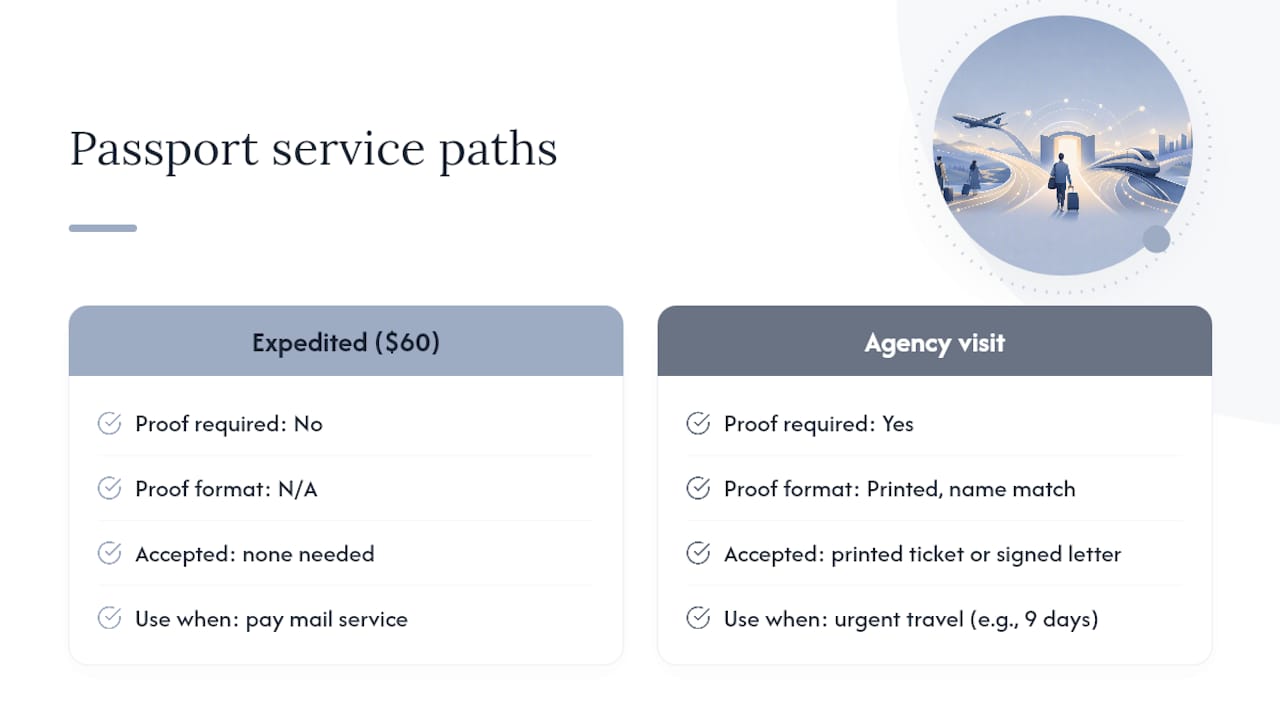
What surprises people more is how strict agencies are about the format of proof, not just its existence. A perfectly legitimate flight booking gets rejected constantly because it's sitting on a phone screen instead of a printed page, or because the traveler's name doesn't match what's on the ID they're presenting. The rule isn't really about whether you're traveling. It's about whether you can prove it in a way a stranger behind a counter can verify in under a minute.
The employer letter route also gets underused. Business travelers often assume they need a plane ticket in hand, when a signed letter on letterhead stating the trip's purpose and dates does the same job. If your itinerary isn't locked yet, that's often the cleaner path than gambling on a refundable hotel booking you might have to cancel anyway.
— David
Get Your Free Checklist Before Your Appointment
Passportcenter built its checklist for one reason: agency rejections almost always come down to a missing signature, a missing date, or a document that never got printed. That's a fixable problem, not a lucky-or-unlucky one.
A free proof-of-travel checklist and employer-letter template can walk you through exactly what to print and how to format it before your appointment. If your timeline is tighter than an agency slot allows, or you'd rather hand the whole process to a professional, some services can also connect you with verified courier partners for paid expedited handling, entirely optional and disclosed upfront. Head to Passportcenter to pull your checklist and see which path actually fits your departure date.
FAQ
What qualifies as proof of travel for a passport?
A printed flight itinerary showing your name, departure date, and destination qualifies for air travel. Hotel reservations, cruise tickets, and employer letters on letterhead qualify for other travel types, according to the National Passport Center.
Can I fly domestically with just my Social Security card?
No. A Social Security card is not accepted as identification for domestic air travel; you need a REAL ID compliant driver's license, passport, or another TSA-approved photo ID.
How do I get proof of travel if I haven't booked a flight yet?
Use a refundable hotel booking, a cruise reservation, or a signed employer letter stating your business travel dates and destination instead of a flight ticket.
Do I need 6 months of validity on my passport to travel?
That requirement depends on the destination country, not the U.S. Some countries require six months of remaining validity beyond your travel dates, so check the entry requirements for your specific destination before you go.
Does standard expedited passport service require proof of travel?
No. Standard expedited-by-mail service, which carries a $60 fee, does not require any proof of travel at all. Proof is only required for in-person agency appointments and life-or-death emergencies.