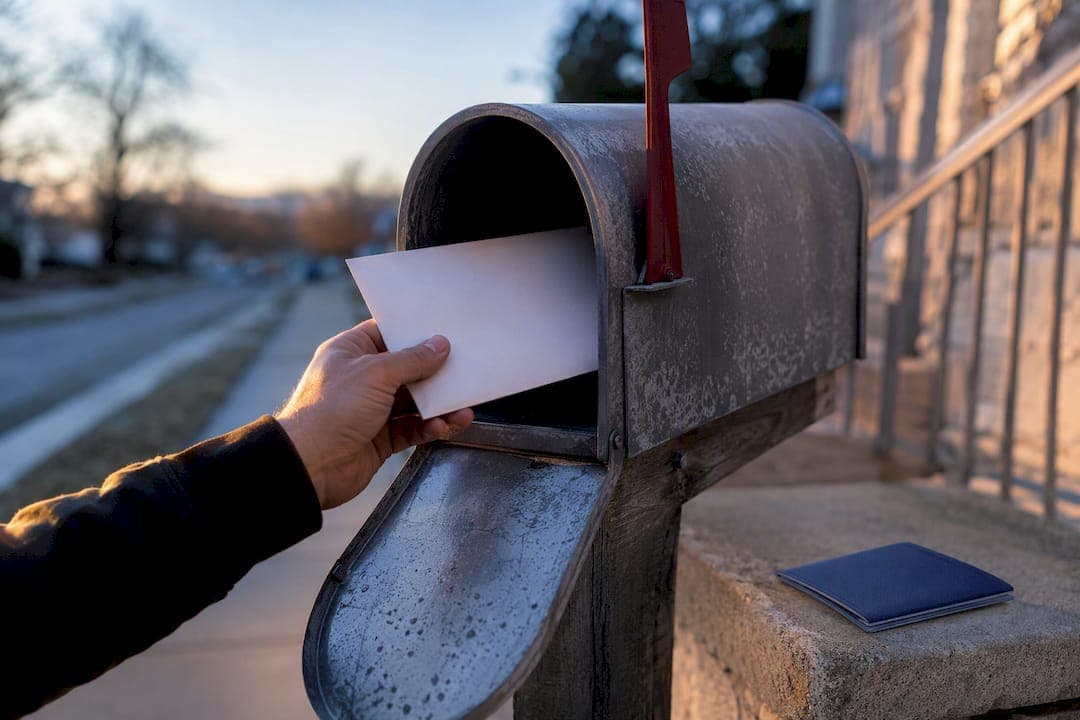
Mail a routine application and the realistic total wait runs 6 to 8 weeks, sometimes closer to 10 once mailing delays stack up. Expedited service cuts that to roughly 4 to 5 weeks, mailing included. The catch: State Department processing windows do not include mail transit, so if your trip is inside 6 weeks, expedited plus a paid return-shipping upgrade is your safest move.
TL;DR:
- Mailing delays can add up to two weeks before processing begins and after completion, making planning more complex than official timelines suggest.
- Expedited processing speeds workflow review to two to three weeks, but does not reduce mailing times or guarantee delivery dates.
- Using trackable mailing methods and adding return-shipping upgrades can significantly improve predictability and reduce total delivery time.
- For trips within 14 days, an urgent agency appointment with proof of travel is the only guaranteed fast option; otherwise, choose expedited processing if traveling within six weeks.
- Planning for at least 10 to 12 weeks for routine applications or four weeks for expedited ones ensures you account for worst-case delays and avoid costly last-minute fixes.
Table of Contents
- What Are the Current State Department Processing Windows?
- How Does Mailing Time Change Your Total Wait?
- What Options Speed Up Passport Delivery?
- Agency Appointment or Expedited Mail: Which Do You Need?
- How Do You Mail Your Application and Read Status Updates?
- Does the Season You Apply In Matter?
- How Passportcenter Helps You Plan Around These Windows
- A Realistic Buffer Beats Optimism Every Time
- Get Straightforward Passport Guidance Without the Agency Runaround
- Sources
What Are the Current State Department Processing Windows?
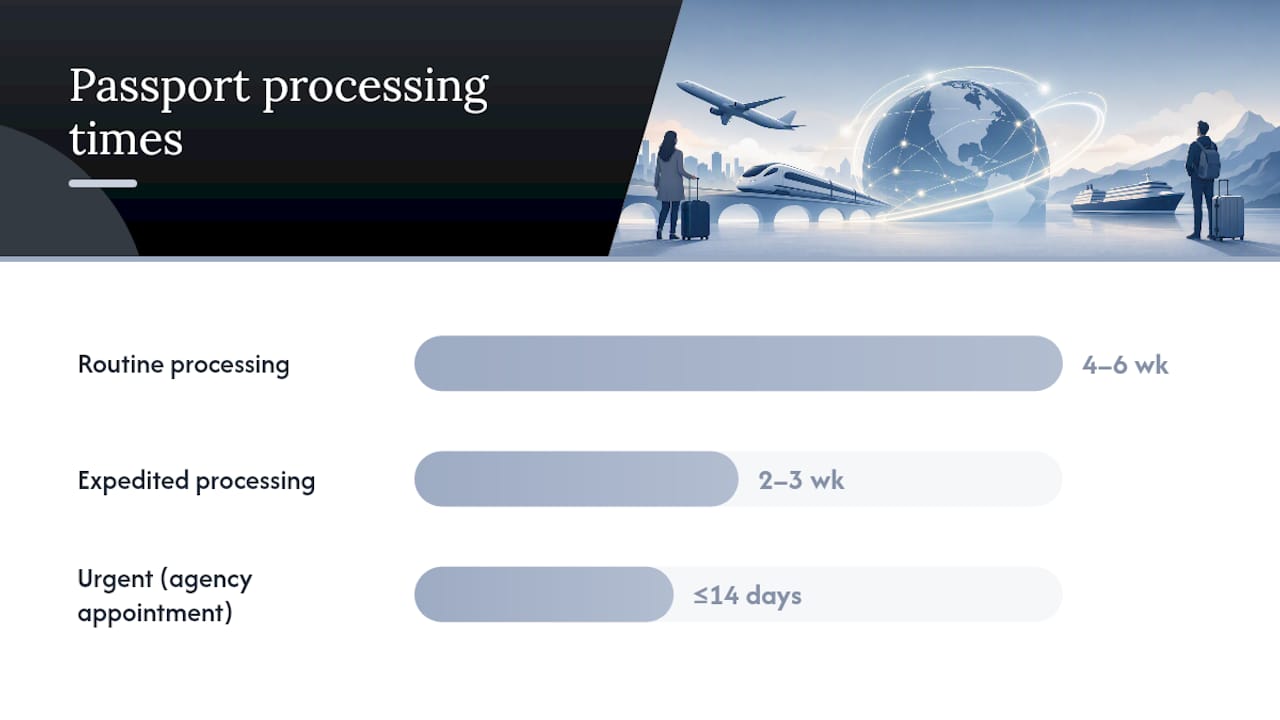
The State Department publishes two official timelines, and both refer only to internal processing, not the time your envelope spends in transit. Routine service takes 4 to 6 weeks. Expedited service takes 2 to 3 weeks. Neither figure starts counting until your application physically reaches a passport agency.
Expedited processing costs an additional $60 on top of your regular application fee. That fee buys speed inside the agency's workflow, nothing else. It does not include faster mailing, and it does not guarantee a specific delivery date.
- Routine processing: 4 to 6 weeks, standard fee only
- Expedited processing: 2 to 3 weeks, plus $60
- Urgent/agency appointment: available if you're traveling within 14 days, or facing a documented life-or-death emergency
Fee snapshot: Expedited service adds $60 to your application cost, and it only speeds up processing time, not mailing.
Agency appointments are reserved for genuine urgency. You will need proof of travel, typically a dated flight itinerary or confirmed travel document, and for emergencies, documentation such as a letter from a hospital or funeral home. Walking in without proof usually gets you turned away.
How Does Mailing Time Change Your Total Wait?
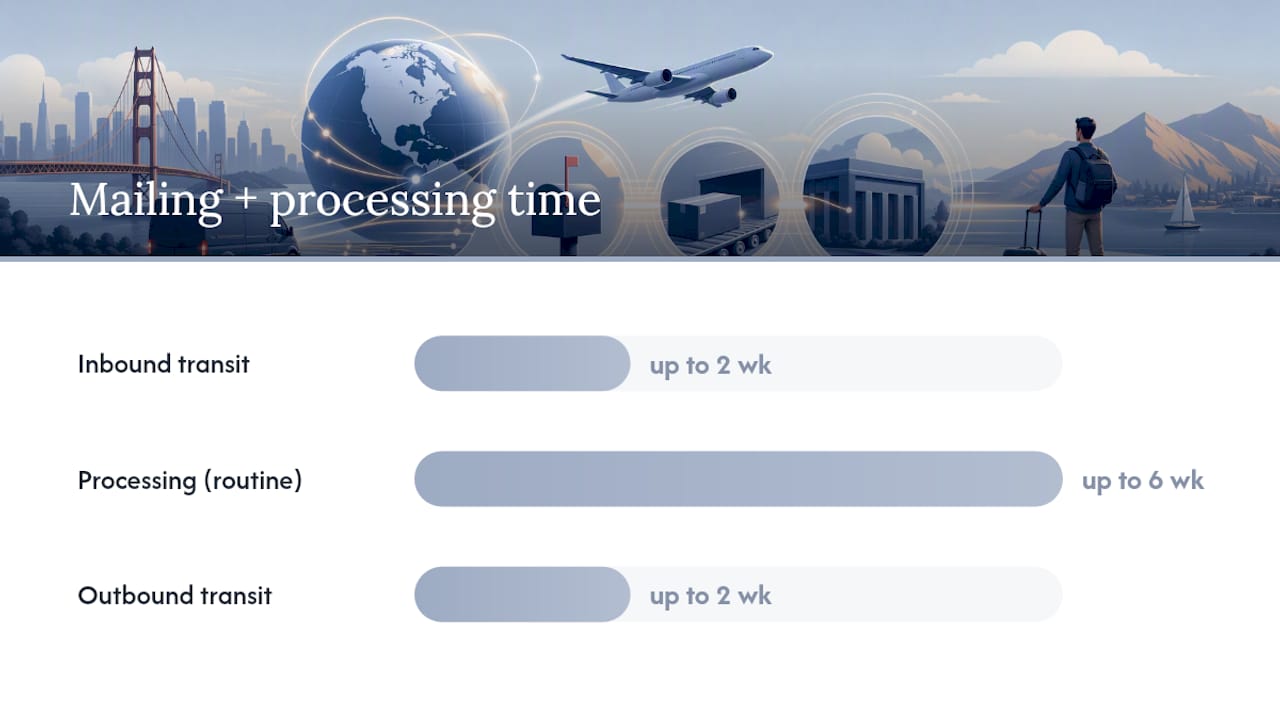
Processing windows and mailing windows are two separate clocks, and confusing them is the single biggest reason travelers cut things too close. Your application can take up to 2 weeks just to reach the State Department after you drop it in the mail. That clock has to finish before processing even begins.
The same lag applies on the way back. Once your passport is printed and mailed, it can take up to another 2 weeks to land in your mailbox.
- Inbound transit: up to 2 weeks before your application starts processing
- Outbound transit: up to 2 weeks after your passport is printed
Worst-case math: 2 weeks inbound mailing, plus 6 weeks routine processing, plus 2 weeks outbound mailing equals a 10-week planning horizon in the worst case.
Two example timelines make this concrete. Routine, worst case: about 2 weeks inbound mailing, up to 6 weeks processing, about 2 weeks outbound mailing, roughly 10 weeks total. Expedited, typical case: shorter inbound mailing, 2 to 3 weeks processing, shorter outbound mailing, roughly 3 to 4 weeks total.
What Options Speed Up Passport Delivery?
You have three real levers, and stacking them is how experienced travelers beat the clock. None of them are free, but each buys certainty you don't get from routine mail.
- Pay for expedited processing ($60). This shortens the internal review from 4-6 weeks down to 2-3 weeks. It changes nothing about how long your envelope spends in the mail.
- Add the return-shipping upgrade (about $23.36). This buys 1 to 3 day delivery once your passport is printed, replacing an unpredictable outbound wait with a tracked, dated delivery. It is the single cheapest way to remove uncertainty from your timeline.
- Choose a trackable mailing method for your outgoing application. USPS Priority Mail or Priority Mail Express gives you a tracking number and a delivery estimate, so you know exactly when your paperwork arrives.
Pro Tip: If your travel date is inside six weeks, the return-shipping upgrade is worth every penny. It's the only piece of the process you can actually lock down to a specific delivery window.
If your timeline is tighter still, a registered passport courier can hand-carry your application to an agency in person, skipping mail transit entirely. That costs more than USPS, but it removes both transit windows from your calculation.
Agency Appointment or Expedited Mail: Which Do You Need?
Your travel date decides this for you. There's no gray area here, so match your timeline to one of these three lanes.
- Traveling in under 14 days: Book an urgent agency appointment with proof of travel or emergency documentation. This is the fastest option.
- Traveling in under 6 weeks: Choose expedited processing and pay for the return-shipping upgrade for the most predictable timeline without an in-person appointment.
- Traveling in more than 6 weeks: Routine service is normally sufficient. Adding buffer time is wise especially during busy seasons.
Cutting it closer than these windows almost always means paying more later to fix a problem that was avoidable earlier.
How Do You Mail Your Application and Read Status Updates?
Address your envelope exactly as instructed on your application form, since agencies sort by location and a wrong address adds delay. Use a tracked mailing service, ideally USPS, so you have proof of when it arrived.
Expect a quiet period after mailing. It typically takes up to 2 weeks before your status shows "In Process", since intake and scanning take time before anything appears online.
- Application received: your envelope has arrived but hasn't been logged into the system yet
- In Process: your application is actively being reviewed
- Approved: your passport has been cleared for printing
- Passport mailed: your book is in transit back to you
Pro Tip: Checking your status daily during that first two-week window won't speed anything up. Check weekly instead, and save yourself the stress.
If your status hasn't updated after the full expected window, that's when it's worth calling the National Passport Information Center rather than continuing to refresh the page.
Does the Season You Apply In Matter?
Timing your application around demand cycles can shave real time off your wait. Passport offices see the heaviest volume from late winter through summer, when spring break and summer vacation applications flood in together. October through December tends to run lighter, which usually means smoother, more predictable processing.
- For a 95% confidence buffer: apply 10 to 12 weeks before travel if going routine
- For an 80% confidence buffer: apply 6 to 8 weeks before travel if going routine
- Holiday surges: major holiday travel windows can create short-term spikes even during traditionally slower months
If your trip lands during peak season, treat the worst-case 10-week estimate as your real planning number, not the optimistic one.
How Passportcenter Helps You Plan Around These Windows
This resource breaks these timelines down further in dedicated guides, including a full processing-time comparison and a mailing checklist that flags common paperwork mistakes before they cost you a week. For travelers on a real deadline, it also connects users to vetted courier services built for last-minute cases.
A Realistic Buffer Beats Optimism Every Time
Three things matter more than anything else here: track your mailing both directions, don't panic during the two-week status silence, and always plan against the worst case, not the best one. My honest recommendation is 10 to 12 weeks of buffer for routine applications and at least 4 weeks for expedited ones. That buffer has saved more trips than any expedite fee ever will.
— David
Get Straightforward Passport Guidance Without the Agency Runaround
This site provides plain-language breakdowns of fees, processing windows, and mailing checklists built specifically for U.S. applicants trying to hit a travel date.
Instead of guessing whether your timeline works, pull up the site's expedite options guide or its worst-case delay breakdown to see exactly where your application stands. If your trip is close enough that mail transit is the risk, Passportcenter.ai also connects you directly to vetted courier services that can walk your application through in person. Start at Passportcenter and find the guide that matches your travel date.
Sources
- Get Your Passport Fast - Travel - State Department
- Passport Appointments, Renewals, & Photo Services | USPS