
Schengen visa insurance is travel medical coverage of at least €30,000, including repatriation, valid across every Schengen state for the exact length of your trip. That's the legal bar, not a suggestion. Your next move is to buy a Schengen-compliant policy that lists all Schengen states by name and matches your travel dates exactly. Providers such as AXA Schengen, Swisscare, WorldTrips/Atlas, Insubuy, and SafeTrip offer policies designed to meet these Schengen visa insurance requirements.
TL;DR:
- Policies must explicitly state coverage for all Schengen member states, not just Europe or individual countries outside the zone.
- Repatriation limits must match or exceed the overall coverage amount of €30,000 to avoid rejection.
- Purchase your insurance early, confirm all certificate details match your travel dates, and print copies to prevent last-minute rejections.
- U.S. residents should buy insurance from providers with local or Schengen-based claims offices to ensure smooth recoverability.
- Exclusions such as high deductibles or pandemic restrictions do not automatically disqualify a policy but may require explanation or alternative choices.
Table of Contents
- What Counts as Schengen Visa Insurance?
- Vetted Shortlist: Schengen-Compliant Insurance Options
- How These Policies Differ (and What Actually Gets Checked)
- How to Buy a Compliant Policy and Get Your Certificate Right
- Why the €30,000 Rule Exists and How Consulates Check It
- Why You Should Buy Insurance in Your Own Country of Residence
- Recommended Providers for Schengen Visa Applicants
- What Drives the Cost of Schengen Visa Insurance
- How to Compare Policies Beyond the Sticker Price
- Common Reasons Embassies Reject Insurance Documents
- How to Verify Your Policy Meets Your Specific Embassy's Requirements
- What I've Seen Trip Up Applicants Most Often
- How PassportCenter.ai Fits Into Your Travel Prep
- Where to Verify These Rules Yourself
- Sources
- FAQ
What Counts as Schengen Visa Insurance?
Consulates check five things on your policy certificate, and they check them fast. If any one is missing or vague, expect a request for corrected documents, or an outright denial.
Under Article 15 of the Visa Code, your travel medical insurance must cover repatriation, urgent medical attention, emergency hospital treatment, and death, with a minimum of €30,000 in coverage. It must be valid throughout the Member States, not just the one country where you're applying. That's the standard piece of "schengen travel insurance requirements" that trips people up: a policy that only covers France won't get you a visa for a trip that also includes Italy and Germany.
Pro Tip: Don't assume "Europe" and "Schengen" mean the same thing on an insurance certificate. Some European countries, like the United Kingdom or Croatia's neighbors, aren't in the Schengen area at all, while non-EU members like Norway, Iceland, Switzerland, and Liechtenstein are. As of 2025, 29 countries belong to the zone, including Bulgaria and Romania, which joined that January. Your certificate needs to say "Schengen states," not just "Europe."
For U.S. residents specifically, the answer to "do US citizens need Schengen visa" coverage depends on trip length and purpose. Tourists staying under 90 days for short visits typically don't need a visa at all, but anyone applying for a long-stay or work visa does need to show proof of this insurance regardless of citizenship. If you're researching Schengen visa insurance USA options, the five providers below all sell to American buyers directly.
Vetted Shortlist: Schengen-Compliant Insurance Options
Here's a quick compare of the five providers most travelers land on when shopping for compliant coverage, and what each is actually built for.
- AXA Schengen Travel Insurance: A large international insurer with dedicated Schengen policy pages and single-trip or annual plans. Best for travelers who want a widely recognized name and a certificate that's easy to download the moment you pay.
- Swisscare Low Cost Schengen Visa Insurance: Budget-focused, Schengen-specific policies with fast electronic certificate issuance. Best for travelers on a tight budget who need a basic, embassy-ready document without extras.
- WorldTrips / Atlas Travel Insurance: International medical plans offering both single-trip and multi-trip structures. Best for frequent flyers who'd rather buy one annual policy than a new one for every trip.
- Insubuy Schengen Travel Insurance: A U.S.-based broker built around Schengen visa shoppers, with a purchase workflow designed for American applicants. Best for U.S. residents who want a domestic buying experience and immediate certificate issuance.
- SafeTrip (UnitedHealthcare Global): A global-assistance insurer with strong worldwide support networks and brand recognition. Best for travelers who value having a large assistance network behind their policy.
All five, when purchased correctly, should confirm the €30,000 minimum, spell out repatriation coverage, and issue a downloadable certificate at checkout. Annual multi-trip policies from providers like WorldTrips/Atlas are acceptable for multiple-entry visas as long as the plan covers your first intended stay with per-trip coverage of at least €30,000. That detail matters if you're comparing plan types instead of just price. Typical entry-level policies for short trips run cheap through Swisscare, while annual and multi-trip plans through WorldTrips or SafeTrip cost more upfront but save money if you're crossing Schengen borders multiple times a year.
How These Policies Differ (and What Actually Gets Checked)
Every compliant policy has to clear five checkpoints: the €30,000 minimum, an explicit repatriation clause, dates that match your itinerary, geographic scope covering all Schengen states, and recoverability, meaning claims can actually be paid out from within a Schengen country.
The wording on your certificate matters more than most applicants realize. A certificate that says "valid in Europe" is ambiguous and can trigger a rejection, because Europe includes plenty of non-Schengen countries. You want language that explicitly says "valid in all Schengen member states" or lists them. Similarly, watch for repatriation language buried in fine print with a separate, lower limit than your overall coverage.
- Confirm the certificate names "Schengen states" explicitly, not just "Europe" or "worldwide."
- Check that the repatriation clause isn't capped below your overall coverage limit.
- Verify your policy dates cover the full stay, including buffer days for early arrival or delayed departure.
- Look for a named insurer contact or claims office based in a Schengen country.
Pro Tip: Repatriation sub-limits are the single most common reason compliant-looking policies still get flagged. A policy can meet the €30,000 headline number while burying a repatriation cap of €5,000 or less deep in the policy wording, which contradicts what consulates are actually checking for. Read the full policy schedule, not just the summary certificate.
Deductibles, pandemic exclusions, and pre-existing condition riders don't automatically disqualify a policy, but they're common triggers for a consular officer to ask follow-up questions. If your policy has a high deductible or excludes conditions you actually have, be ready to explain it or choose a different plan.
How to Buy a Compliant Policy and Get Your Certificate Right
Getting Schengen visa medical insurance coverage sorted correctly is mostly a matter of sequence. Do these steps in order and you avoid almost every common rejection reason.
- Choose your plan and confirm the certificate fields before paying. Check that the quote screen or sample certificate shows your name, exact travel dates, €30,000 coverage, a repatriation clause, and the insurer's contact details.
- Buy before your visa appointment, not after. Most consulates want the certificate submitted with your application, and some embassies won't accept an appointment slip in place of a purchased policy.
- Download both the certificate and the full policy wording, not just the one-page summary. Some consulates ask to see the underlying terms if anything on the certificate looks unclear.
- Print everything. Bring the certificate and policy schedule to your appointment, and keep copies in your carry-on for border control, since digital-only proof isn't always accepted at the border.
Watch for these red flags before you submit: a repatriation sub-limit lower than your main coverage, geographic wording that says "Europe" instead of "Schengen states," and an insurer with no stated Schengen-based correspondent or claims office. Any one of these can turn a seemingly fine policy into a rejected application.
Why the €30,000 Rule Exists and How Consulates Check It
The €30,000 figure isn't arbitrary. It comes directly from Article 15 of the Visa Code, which sets it as the minimum needed to cover repatriation, urgent medical attention, emergency hospital treatment, or death while you're in the Schengen area. The number reflects the estimated cost of a serious medical emergency followed by an evacuation flight home, not routine care.
The EEAS's MTI guidance goes beyond the regulation's headline number. It specifies:
- No pre-existing condition exclusions that undercut the basic required coverage
- A minimum grace period built into the policy
- Recoverability, meaning claims must be payable through a Schengen-based entity, not just a foreign insurer with no local presence
That recoverability requirement is why consulates favor insurers with an international footprint or a Schengen correspondent. An obscure insurer with no way to pay claims inside the Schengen area raises red flags even if the paperwork looks fine on paper. At the practical level, this is also why border officials still ask to see a printed certificate. Digital verification systems exist, but a paper copy remains the most reliable way to satisfy a border check when a system is down or an officer wants to see the document directly.
Why You Should Buy Insurance in Your Own Country of Residence
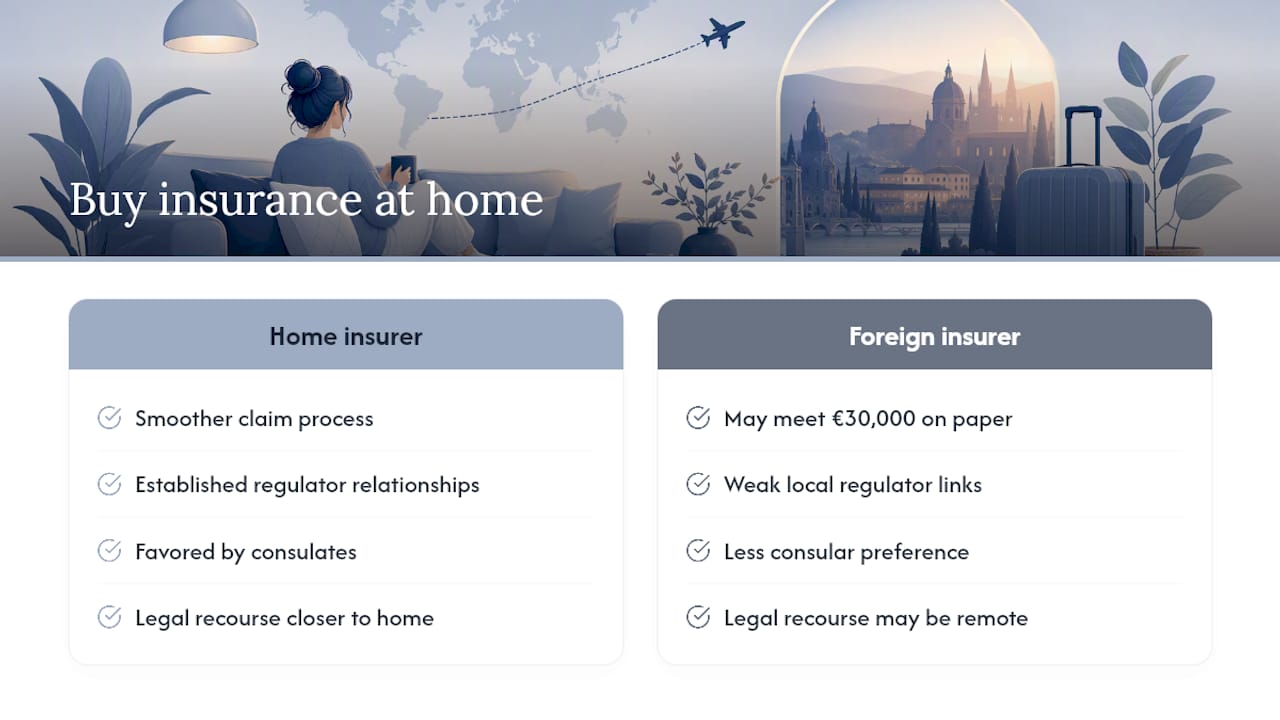
Consular guidance and embassy notes generally recommend buying your policy in your country of residence rather than shopping for the cheapest plan from an insurer based somewhere else entirely. This isn't a hard legal rule the way the €30,000 minimum is, but it's a practical standard tied directly to recoverability.
Here's the logic: if something goes wrong overseas and you need to file a claim, the process works more smoothly when your insurer has an established relationship with regulators and correspondents in your home market. A U.S. resident buying through Insubuy, a broker built specifically around Schengen visa shoppers in the U.S., gets a policy structured around exactly this expectation. Consulates lean toward insurers with a track record in the applicant's home country because it reduces the odds of a claim getting stuck in a dispute between jurisdictions.
This matters more than it sounds. An insurer registered somewhere with no consumer protection framework relevant to you can technically meet the €30,000 and repatriation requirements on paper while still leaving you exposed if a claim gets contested. Buying domestically, through a provider like Insubuy or a U.S.-facing branch of a larger insurer like AXA Schengen or SafeTrip, keeps your legal recourse closer to home if a dispute happens.
It also simplifies the paperwork trail. Your home-country insurer typically issues documentation, invoices, and correspondence in a format your bank or credit card dispute process already recognizes, which matters if you ever need to contest a charge or a denied claim after the fact.
Recommended Providers for Schengen Visa Applicants
Beyond the five providers profiled above, the best insurance for Schengen visa purposes usually comes down to matching the provider to your travel pattern rather than chasing the lowest price. A single two-week vacation calls for a different plan than a job that has you crossing borders monthly.
For a first-time applicant taking one trip, a single-trip policy from Swisscare or AXA Schengen covers the requirement cleanly without paying for coverage you won't use. For someone who travels to Europe several times a year, an annual multi-trip plan through WorldTrips/Atlas or SafeTrip often costs less over twelve months than buying five or six separate single-trip policies.
Some providers offer a buying experience tailored to specific countries. Certain brokers have certificate formats, payment processes, and customer support designed to accommodate applicants from particular regions rather than adapted from products for other markets.
Whichever provider you choose, verify independently that the certificate names all Schengen states, states the €30,000 figure explicitly, and spells out repatriation coverage without a hidden sub-limit. A provider's reputation doesn't substitute for reading your own certificate line by line.
What Drives the Cost of Schengen Visa Insurance
Schengen visa insurance amount and cost depend on a small set of factors: your age, trip length, coverage type, and whether you're buying single-trip or annual coverage.
Age is one of the biggest swing factors. Older travelers, particularly those over 65 or 70, typically pay noticeably more because medical risk and claim likelihood rise with age. Trip length matters too. A two-week policy costs less than a three-month one, simply because the insurer is on the hook for a longer window.
Plan type changes the math further. A single-trip policy from a budget provider like Swisscare is the cheapest way to meet the requirement for one short trip. An annual multi-trip policy through WorldTrips/Atlas or SafeTrip costs more per year but becomes the better value once you're taking three or more trips to Europe annually.
Add-ons push the price up too. Higher coverage limits above the €30,000 floor, lower deductibles, or riders covering hazardous activities like skiing or scuba diving all add to the premium. None of these extras are required for visa compliance, but some travelers choose them for real-world protection beyond what the embassy asks for.
How to Compare Policies Beyond the Sticker Price
Comparing Schengen visa medical insurance coverage effectively means reading past the marketing page and into the actual policy schedule, not just the summary certificate insurers show you at checkout.
Start with the coverage ceiling and confirm it's at least €30,000 with no confusing sub-caps. Then check the repatriation clause specifically, since that's the line item most likely to have a hidden lower limit. From there, compare deductibles side by side. A policy with a €0 deductible costs more upfront but pays out from the first euro of a claim, while a higher deductible lowers your premium but increases what you'd owe out of pocket if something happens.
Exclusions deserve equal attention. Pre-existing condition riders, pandemic-related exclusions, and hazardous-activity carve-outs vary a lot between insurers even when the headline coverage numbers look identical. Two policies that both say "€50,000 coverage" can have very different real-world value depending on what's excluded underneath that number.
Finally, compare how each insurer handles claims processing and recoverability. A policy from an insurer with a Schengen-based correspondent or claims office tends to move faster and draws less scrutiny from consular officers reviewing your application.
Common Reasons Embassies Reject Insurance Documents
Most rejections trace back to a handful of repeatable mistakes, and nearly all of them are avoidable with a careful read of your certificate before you submit it.
Coverage below €30,000 is the most obvious disqualifier, but it's rarer than you'd think since most compliant products advertise the figure clearly. The more common issue is a policy that hits €30,000 overall while capping repatriation separately at a much lower amount, which technically fails the requirement even though the headline number looks fine.
Date mismatches cause a lot of denials too. If your policy starts a day after your flight lands or ends before your planned departure, that gap is enough for a consular officer to send the application back. Geographic wording is another repeat offender: certificates that say "Europe" or "worldwide" without specifically naming the Schengen states create ambiguity that consulates aren't required to resolve in your favor.
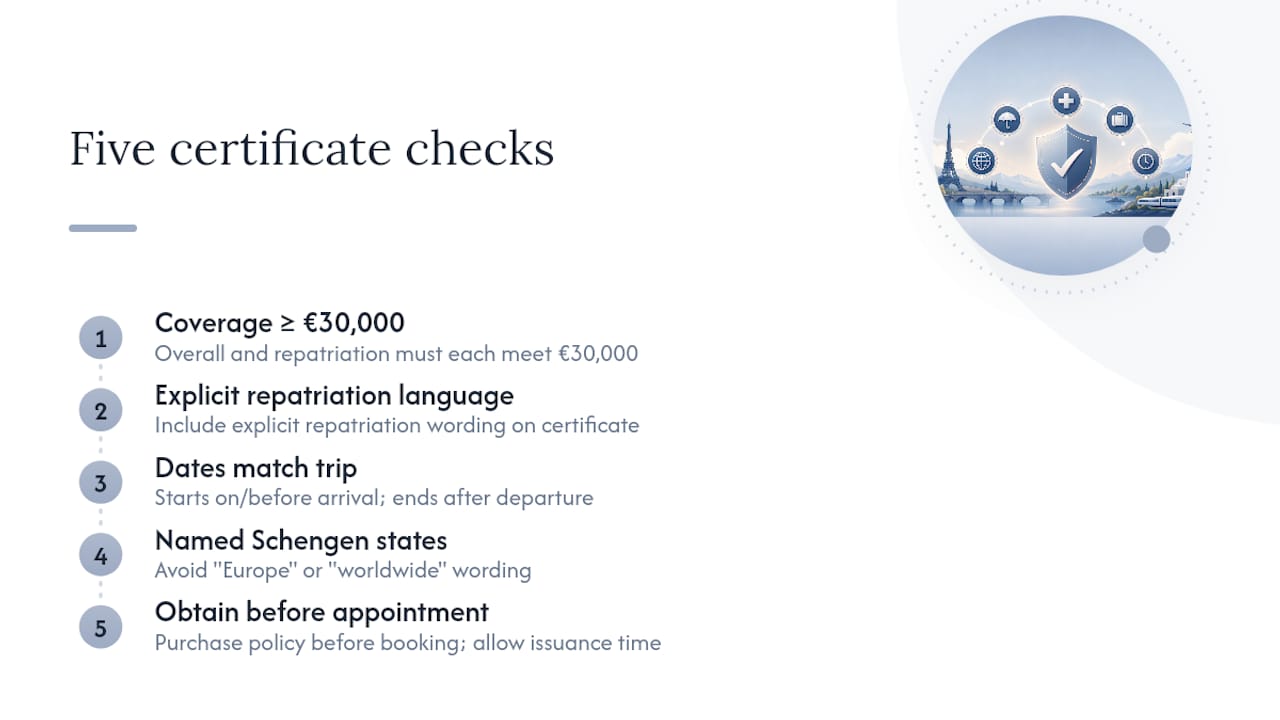
Buying insurance too late in the process is a self-inflicted problem. Some applicants book a visa appointment, then scramble for a policy the night before, only to discover their preferred provider needs a day or two to issue a certificate. Buy your policy first, then schedule around it. Finally, missing repatriation language entirely, even when the overall coverage number is high, remains one of the more common and entirely preventable causes of rejection.
How to Verify Your Policy Meets Your Specific Embassy's Requirements
Requirements are set at the EU level through the Visa Code, but individual consulates sometimes add their own preferred format or additional documentation requests. Verifying compliance for your specific embassy takes a few extra minutes and can save you a return trip.
Start with the consulate's own visa application checklist, usually published on the embassy or visa center's website for the specific country you're applying to. Cross-reference the insurance line item there against your certificate. Most consulates simply restate the Visa Code's €30,000 and repatriation language, but some add specifics, like requiring the certificate in a particular language or format.
Next, confirm your certificate matches the EEAS MTI form structure where applicable, since several consulates use that template as their reference point for what a compliant certificate should contain. If your insurer's certificate is missing fields the MTI form expects, like an insurer contact or explicit Schengen-state coverage, ask for a revised certificate before your appointment.
If you're applying for a multiple-entry visa, be aware that you're only required to show proof covering your first planned trip, though you'll sign an acknowledgment that you understand ongoing coverage is needed for later trips, and some consulates ask for that proof anyway.
What I've Seen Trip Up Applicants Most Often
The single most avoidable mistake I keep seeing isn't a coverage gap. It's applicants buying the right policy at the wrong time, then showing up to their appointment with a certificate that doesn't match their actual travel dates because their itinerary shifted after purchase.
The workflow that works: buy your policy as soon as your travel dates are locked, download the certificate immediately, print both the certificate and the full policy wording, and staple them together before you leave for your appointment. Don't rely on a phone screenshot. Consular staff and border officers both still expect paper.
While you're sorting insurance, it's worth double-checking your passport validity and, if you're a visa-exempt traveler, whether ETIAS applies to your trip. Insurance is one piece of a document stack that has to line up together.
— David
How PassportCenter.ai Fits Into Your Travel Prep
Insurance is one line item on a longer checklist, and getting the rest of your travel documents in order is where PassportCenter.ai actually helps. We don't sell insurance policies. What we do is help you get the surrounding paperwork right: passport validity windows, renewal timelines, and country-specific entry rules that trip up travelers just as often as insurance gaps do.
If you're prepping for a Schengen application, our guide to the €30,000 rule for U.S. travelers walks through the insurance side in more depth, while our passport and entry-requirement checklists cover everything else on your document list. When your passport needs expediting to make an appointment deadline, you may be able to find courier partners who handle that process. Start at Passportcenter and work through your document checklist before your visa appointment, not the week of it.
Where to Verify These Rules Yourself
- Visa Code Article 15: the legal text setting the €30,000 minimum and repatriation requirement.
- EEAS MTI form: the certificate template consulates reference for required fields.
- Consilium's Schengen area page: the current, official list of member states.
- EntryPolicies' coverage analysis: a practical breakdown of repatriation sub-limits and common rejection triggers.
- For questions on multiple-entry visa distinctions, MNS Solicitors' overview covers the documentation implications in more detail.
This article is general information, not a substitute for advice from a qualified lawyer. Consult a qualified legal professional about your own circumstances before acting on anything here.
Sources
- REGULATION (EC) No 810/2009 (Visa Code) — Article 15
- INTERNATIONAL MEDICAL TRAVEL INSURANCE (MTI) — EEAS
- Schengen Visa Insurance Requirements: Coverage Limits & Repatriation Rules | EntryPolicies
- The Schengen area explained - Consilium
FAQ
Do US Citizens Need Schengen Visa Insurance?
U.S. citizens taking short tourist trips under 90 days generally don't need a Schengen visa at all, but anyone applying for a long-stay or work visa must show proof of compliant travel medical insurance regardless of citizenship.
What Is the Minimum Coverage Amount for Schengen Visa Insurance?
The minimum is €30,000, covering repatriation, urgent medical attention, emergency hospital treatment, and death, as required under Article 15 of the Visa Code.
Can I Buy Schengen Visa Insurance From a US-Based Provider?
Yes. Providers like Insubuy operate specifically as U.S.-based brokers for Schengen visa insurance, and AXA Schengen and SafeTrip also sell to U.S. residents directly.
Does an Annual Multi-Trip Policy Meet Schengen Visa Requirements?
Yes, as long as it covers your first planned stay with per-trip coverage of at least €30,000, an annual multi-trip policy from providers like WorldTrips/Atlas satisfies the requirement for multiple-entry visas.
What's the Most Common Reason Schengen Insurance Gets Rejected?
A repatriation sub-limit set lower than the policy's overall coverage is one of the most frequent causes of rejection, even when the headline coverage figure meets the €30,000 minimum.