
Travel insurance is not legally required for most U.S. travelers visiting Europe on a short tourist stay, but it becomes mandatory the moment you need a Schengen visa. Either way, the honest recommendation is the same: buy a plan with at least $100,000 in emergency medical coverage and evacuation benefits, and if you're applying for a Schengen visa, keep a printed insurance certificate showing at least €30,000 in coverage. Specialist Schengen insurers, major global travel insurers, and comparison marketplaces all sell policies that meet this bar.
TL;DR:
- Travel insurance for Schengen visa applicants must meet a minimum of €30,000 in medical coverage with explicit repatriation benefits and cover the full trip duration.
- Most U.S. travelers staying under 90 days in Western Europe do not need insurance for entry, but skipping it risks significant out-of-pocket expenses in emergencies.
- Choosing a plan with direct hospital billing, adequate evacuation coverage, and a clear territory definition is crucial for effective and accessible support abroad.
- Ensure your insurance certificate lists "Schengen Area," matches your passport details exactly, and includes a separate, explicit repatriation clause to avoid visa application delays.
- U.S. Medicare and domestic insurance plans generally do not cover overseas medical costs, making dedicated travel health policies essential for serious injuries or emergencies.
Table of Contents
- Do You Need Travel Insurance for Europe as a U.S. Citizen?
- Top Travel Insurance Providers for a Europe Trip
- How to Choose the Right Europe Travel Insurance Plan
- What Fields Does a Schengen Insurance Certificate Need?
- Why Your U.S. Health Plan Won't Cover You in Europe
- What Your Passport Has to Do With Your Insurance Paperwork
- A Travel-Document Expert's Pre-Trip Checklist
- How Passportcenter Helps You Get the Paperwork Right
- Sources
Do You Need Travel Insurance for Europe as a U.S. Citizen?
The answer splits into two very different categories, and mixing them up is where most travelers get confused.
If you're a U.S. citizen visiting Europe for tourism and staying under 90 days in the Schengen Area, you don't need a visa, and no government office is going to check your insurance paperwork at the border. That's the case for popular destinations like France, Italy, Spain, Germany, and most of Western Europe. Insurance is optional there in the legal sense, though skipping it is a financial gamble, not a compliance risk.
The picture changes completely if you're applying for a long-stay visa, a work visa, a student visa, or any Schengen visa category that requires advance approval. In that case, Article 15 of the Schengen Visa Code makes travel medical insurance a hard requirement, not a suggestion. Consulates will reject an application outright if the insurance certificate doesn't meet the coverage minimums, and this is one of the more common paperwork mistakes that delays visa approval.
Non-Schengen European countries add another wrinkle. The United Kingdom, Ireland, and a handful of others outside the Schengen Area don't enforce the same insurance mandate, but that doesn't mean coverage matters less. A hospital stay in London costs just as much whether or not you crossed a Schengen border to get there.
Top Travel Insurance Providers for a Europe Trip
Picking a plan gets easier once you know what to compare: emergency medical limits, evacuation coverage, whether the provider issues a Schengen-compliant certificate, and how the price stacks up against typical daily costs. American travelers spend roughly $21 a day on travel insurance, with a full comprehensive policy averaging about $328 for a 16-day trip. Medical-only plans run cheaper, often close to $5 a day.
The providers below show up consistently across independent comparisons for U.S. travelers heading to Europe, and each serves a slightly different kind of trip.
- Travelex and Travelex Insurance Services sell tiered plans with strong trip-cancellation benefits, making them a solid fit for families or anyone booking a costly, non-refundable itinerary.
- Seven Corners focuses on travel medical and evacuation products built for international travelers, with plans that lean hard into emergency care abroad rather than trip-cost protection.
- Allianz offers both single-trip and annual multi-trip policies, which suits frequent flyers who cross to Europe more than once a year and don't want to buy a new policy every time.
- Berkshire Hathaway Travel Protection runs a digital-first claims process, appealing to travelers who want less paperwork and faster resolution if something goes wrong.
- Tin Leg and Tin Leg Gold are priced for budget-conscious travelers, with the Gold tier adding higher medical and cancellation limits for those who want more cushion without paying premium-insurer rates.
- Travel Insured International and its FlexiPAX plan structure stand out for optional riders, including adventure-sports coverage and pre-existing condition waivers, which matters if you're hiking the Alps or have a health history to account for.
- IMG specializes in medical-only and evacuation coverage, a good match for expatriates or long-stay travelers who don't need trip-cancellation benefits bundled in.
How to Choose the Right Europe Travel Insurance Plan
Start with emergency medical limits and whether the insurer offers direct billing to hospitals. A policy that reimburses you after the fact is far less useful in a real emergency than one that pays the hospital directly, because you're not stuck covering a five-figure bill on a personal credit card while you wait for a claim to process.
Evacuation and repatriation coverage comes next. This is the benefit that pays to fly you home or to a better-equipped hospital if you're seriously injured somewhere without adequate local care. It sounds like a rare-event benefit until you actually need it, at which point it's the single most expensive gap a cheap policy can leave open.
After that, check the policy's territory and date wording carefully. "Europe" and "Schengen Area" are not interchangeable terms on an insurance certificate, and a consulate reviewing your visa application will notice the difference immediately.
Here's a short checklist to run through before you buy:
- Does the policy state emergency medical coverage of at least €30,000 (roughly $32,000), which is the Schengen visa minimum?
- Does it explicitly name evacuation and repatriation as covered benefits, not just "assistance services"?
- Do the policy dates cover your entire trip, including any buffer days for delayed flights?
- Does the certificate say "Schengen Area" rather than a country list or the word "Europe" alone?
- What's the deductible, and does it apply per incident or per trip?
- Are pre-existing conditions covered, and if so, is there a look-back period or waiver requirement?
Watch for a few common red flags. Some cheaper policies cap repatriation at a sub-limit far below the actual cost of a medical flight home, which can run into six figures. Others use vague territory language that technically doesn't satisfy Article 15's Schengen wording, even though the policy covers the same countries. And several exclude claims tied to a State Department travel advisory, which matters if you're headed somewhere with an active warning.
Pro Tip: If you're applying for a Schengen visa and there's any chance it gets denied, buy a policy with a visa-refusal refund clause or choose an insurer that offers refundable premiums. Otherwise you're out the cost of insurance for a trip that never happens.
What Fields Does a Schengen Insurance Certificate Need?
Article 15 of the Schengen Visa Code sets three non-negotiable criteria for visa-compliant travel insurance: minimum medical coverage of €30,000, explicit repatriation coverage, and validity across the entire Schengen Area for the full length of your stay. Miss any one of these and a consulate can reject your application on paperwork grounds alone, no matter how solid the underlying policy is.
Before submitting anything, check the certificate for these specific fields:
- Your full legal name, spelled exactly as it appears on your passport
- Policy start and end dates that fully cover your planned stay, with no gaps
- The words "Schengen Area" listed as the covered territory, not just a country name
- The coverage amount stated in euros (or a clearly equivalent currency) at or above €30,000
- A distinct repatriation clause, separate from general medical coverage
- The insurer's name, contact information, and a policy number
The repatriation clause and exact wording match are the most common reasons consulates flag a certificate for review, so buy from a provider that issues a dedicated Schengen certificate rather than a generic policy summary. Request a printed copy, and email yourself a digital backup in case a border officer asks for it on arrival.
Why Your U.S. Health Plan Won't Cover You in Europe
Medicare is the biggest gap most American travelers don't see coming. Medicare generally does not cover routine or emergency care outside the United States, with only a handful of narrow exceptions tied to cruise ships near U.S. borders. If you're a Medicare beneficiary heading to Europe, assume you're paying out of pocket for anything that happens overseas unless you buy a separate travel medical policy.
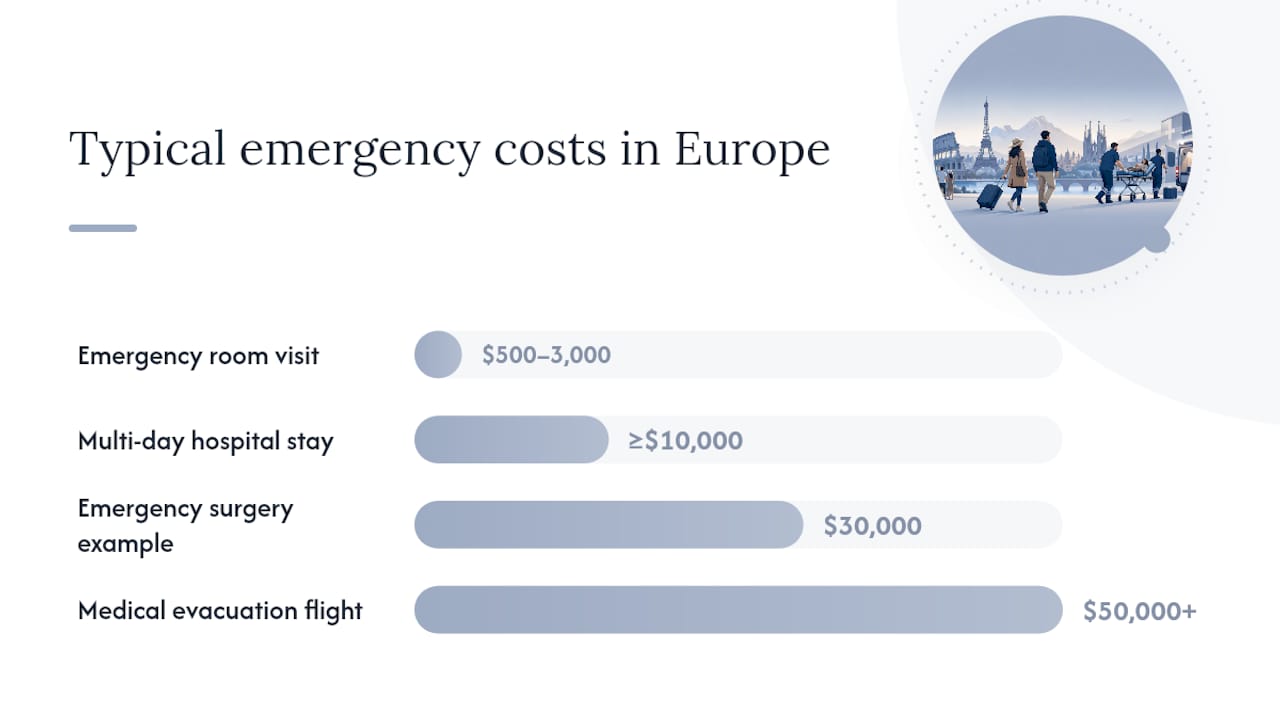
Private U.S. health insurance isn't much better abroad. Many domestic plans operate on a reimbursement-only basis outside the country, which means you pay the hospital upfront and file a claim later, hoping it gets approved. That structure works fine for a $200 urgent-care visit. It works badly for a $30,000 emergency surgery, which is well within range for a serious injury or illness in Western Europe.
The financial exposure adds up fast:
- A single emergency room visit in Europe can run several hundred to a few thousand dollars depending on the country and severity.
- A multi-day hospital stay easily reaches five figures.
- Medical evacuation flights, when a serious injury requires transport to a better-equipped facility or back to the U.S., commonly cost $50,000 or more.
A dedicated travel medical policy closes that gap with three things domestic plans typically lack: 24/7 emergency assistance lines, established local provider networks, and in some cases direct-pay arrangements with hospitals so you're not fronting cash mid-crisis. Providers such as Seven Corners and IMG built their entire business around exactly this kind of coverage. Beneficiaries weighing their options should also review what Medicare does and doesn't cover while traveling before assuming any existing supplement will help overseas.
What Your Passport Has to Do With Your Insurance Paperwork
Insurance and passports intersect more than most travelers expect. Every insurance certificate needs to match your travel documents exactly, and a name mismatch, an expired passport, or unclear validity can create problems at the exact moment you need your coverage to work.
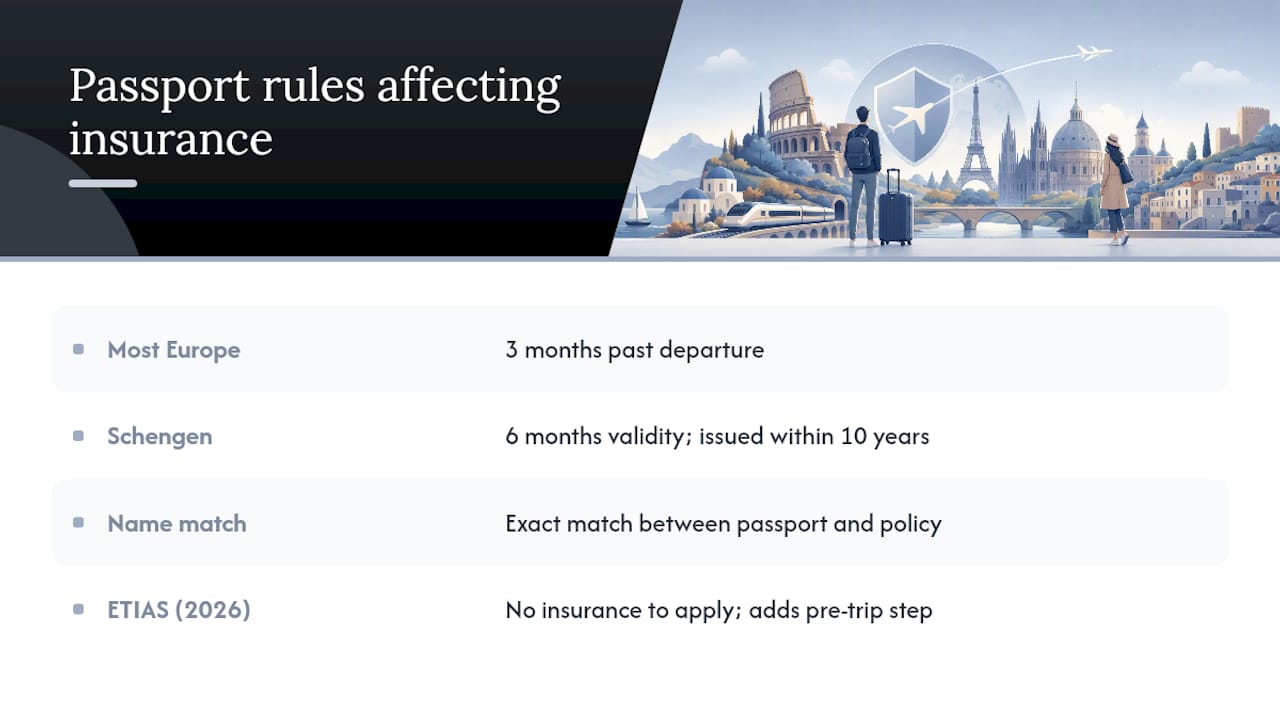
Most European countries require your passport to remain valid for at least three months past your departure date, and Schengen rules typically require six months of remaining validity plus a recent issue date within the last ten years. If your passport doesn't meet that window, no insurance certificate can save your trip, because you'll be denied boarding or entry before insurance ever becomes relevant.
Name matching matters just as much. If your insurance certificate lists a maiden name, a shortened name, or a typo that doesn't match your passport exactly, a border officer or claims adjuster can treat that as a discrepancy worth questioning.
One more planning note for 2026: the EU's ETIAS travel authorization doesn't require proof of insurance to apply, but it does add a step to your pre-trip timeline that's worth mapping out alongside your insurance purchase. Passportcenter's guides on ETIAS requirements for Americans and what to do with an expired or soon-to-expire passport cover the documentation side in detail.
A Travel-Document Expert's Pre-Trip Checklist
Here's the short version of what actually matters, stripped of the noise: buy medical and evacuation coverage with real limits, not just a low headline price. If you need a Schengen visa, request the dedicated certificate, not a generic policy letter, and print two copies. Enroll in the State Department's Smart Traveler Enrollment Program before you leave, and save your insurer's emergency line and policy number somewhere you can access it without Wi-Fi.
If you're older or managing a chronic condition, don't stop at buying a plan. Ask your doctor for a brief letter listing your diagnosis, medications, and dosages, and carry it alongside your prescriptions in their original bottles. I've seen this single document resolve a pharmacy or hospital situation abroad faster than any amount of insurance paperwork, simply because it gives a foreign provider something concrete to work from immediately.
— David
How Passportcenter Helps You Get the Paperwork Right
Insurance only works if your passport and travel documents hold up at the border first. There are free resources available that cover passport validity windows, renewal timing, and the exact ETIAS steps U.S. travelers need before flying to Europe.

If your passport is getting close to that six-month Schengen cutoff, start there before you finalize any insurance purchase. Passportcenter's guide to passport validity rules for Europe walks through exactly how much time you need left on your passport for different countries, and the ETIAS guide for Americans breaks down the new authorization timeline so it doesn't collide with your travel dates. If your passport has already expired or is about to, the emergency passport guide connects you to expedited courier services that can turn a weeks-long wait into a matter of days. Check your passport status on Passportcenter before you lock in your insurance certificate, so both documents line up when it counts.
Sources
Verify Schengen insurance minimums directly through the EU's visa insurance criteria, confirm enrollment and safety guidance at travel.state.gov, and check Medicare's own travel coverage limitations before assuming any existing plan follows you overseas.
This article is general information, not a substitute for advice from a qualified financial advisor. Consult a qualified financial professional about your own circumstances before acting on anything here.
- Schengen Visa Insurance Requirements: Coverage Limits & Repatriation Rules | EntryPolicies
- Does health insurance cover you abroad? | UnitedHealthcare
- Europe Travel Insurance: Plans & Prices (2026) | Squaremouth