
DOS NFR on a passport application stands for Department of State Non-Refundable Fees, the mandatory administrative charges you pay when submitting a U.S. passport application. These fees cover the government's cost of processing your file, not the guarantee of receiving a passport. The State Department retains them regardless of whether your application is approved or denied. Knowing this upfront protects you from a costly surprise, especially since a first-time adult applicant can lose at least $165 if their application is rejected with no legal refund mechanism available.
What fees constitute DOS NFR on a U.S. passport application?
The DOS NFR on a passport application breaks down into two primary charges and several optional ones. Each fee goes to a different recipient, which is where many applicants get confused.
Primary fees paid to the Department of State:
- Passport book fee (adult, first-time or renewal): $130
- Passport card fee (adult, first-time): $30
- Both book and card together: $160
Execution fee paid to the acceptance facility:
The execution fee is a separate transaction payable to the acceptance facility, not the State Department. This distinction matters because paying the wrong recipient causes delays and can complicate your application status. Most acceptance facilities charge $35 for this identity verification service.
Optional fees:
- Expedited service fee: $60, paid to the Department of State for faster processing
- 1-2 day delivery fee: Varies by carrier, paid directly to the delivery service
The total financial exposure on a rejected application, including expedited and delivery fees, can reach $247.05. That figure makes careful preparation non-negotiable.
Pro Tip: Most acceptance facilities do not accept credit cards. Bring a personal check or money order made out to "U.S. Department of State" for the application fee, and a separate check or cash for the execution fee payable to the acceptance facility.

Why are passport fees non-refundable, and what is the one narrow exception?
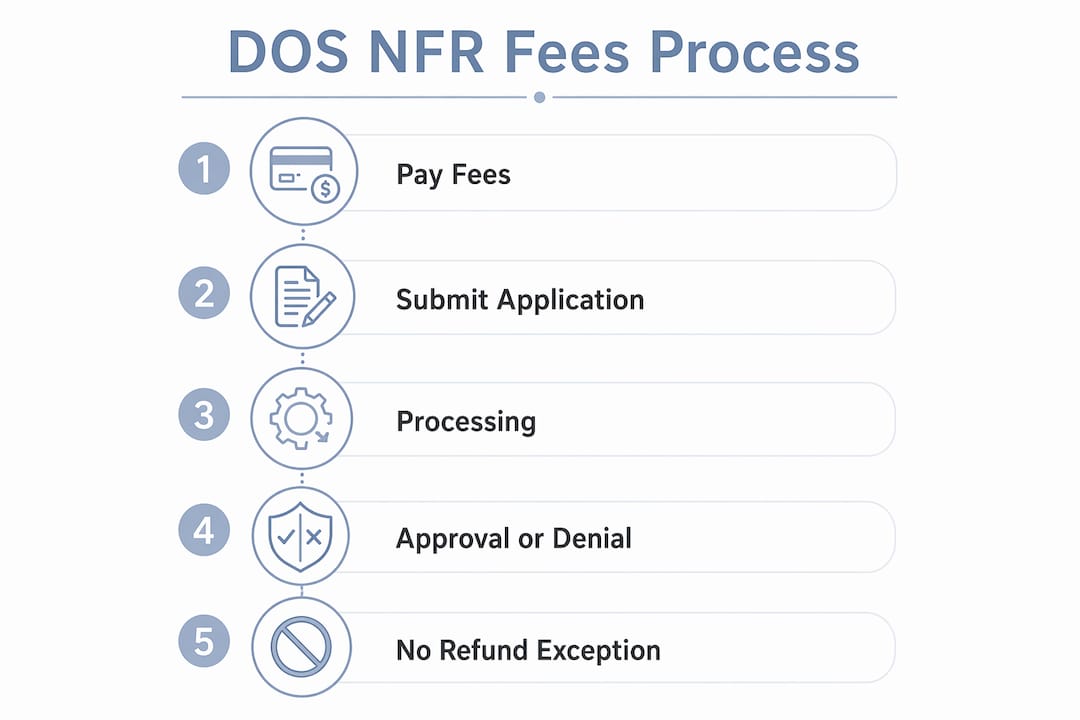
The non-refundable rule exists because the State Department earns the fee by processing your file, not by issuing your passport. Fees cover administrative costs and are retained by the government regardless of outcome. Federal law requires this. The government's position is that processing is compensation for administrative review, not a guarantee of passport issuance.
Applicants frequently misunderstand this. They treat fees as a deposit toward receiving a passport. The State Department treats them as payment for the work of reviewing the application. That distinction is the entire reason the non-refundable rule holds even when an application is denied for a minor clerical error.
The $60 expedited service fee is the one narrow exception. It may be refunded only if the Department of State fails to meet its own expedited processing timelines. The refund is not available if your application is denied, withdrawn, or delayed for any other reason. The expedited fee refund process can take up to 6 weeks after submitting the refund request online, and you must provide proof that the government missed its deadline.
The conditions for that refund are strict. You submit the request through the State Department's online portal. You provide documentation showing the processing window was exceeded. Without that proof, the $60 stays with the government. Every other fee, including the application fee and execution fee, is non-refundable under all circumstances.
Common reasons passport applications get denied and fees get forfeited
A denied application means you lose your fees and must start over with a new application and full payment. Rejected applications require re-submitting with complete fees again, since initial fees do not carry over. Understanding the most common denial reasons is the fastest way to protect your money.
-
Signing Form DS-11 before your appointment. The signature block on Form DS-11 must remain blank until you are physically present at the acceptance facility. Signing DS-11 early causes immediate disqualification. The acceptance agent cannot process a pre-signed form, and your fees are forfeited.
-
Incorrect or incomplete documentation. Missing a certified birth certificate, failing to provide a government-issued photo ID, or submitting expired documents all trigger denial. The State Department does not hold your application while you gather missing items.
-
Photo errors. Passport photos must meet strict State Department specifications: white background, correct dimensions, no glasses, no head coverings (with limited religious exceptions). A single non-compliant photo can reject the entire application.
-
Name discrepancies. A mismatch between your application name and your supporting documents is a common and avoidable problem. Name formatting issues on passport applications cause more denials than most applicants expect.
-
Incorrect payment. Paying the wrong amount, writing the check to the wrong payee, or using an unaccepted payment method can stall or reject your application before it is even reviewed.
Pro Tip: When you receive a denial letter, read it carefully. The State Department specifies the exact reason for denial and the steps required to reapply. Keep that letter. It tells you precisely what to fix before you spend another $165 or more.
How to avoid losing your DOS NFR fees: best practices for error-free applications
Getting your application right the first time is the most cost-effective approach. Error-free first submission is the single best way to protect your fees. These practices cover the most common failure points.
Completing Form DS-11 correctly:
- Print the form single-sided only. Double-sided forms are rejected automatically.
- Use black ink or type your responses. Blue ink and pencil are not acceptable.
- Do not use correction fluid (white-out) anywhere on the form. Any correction disqualifies the form.
- Leave the signature block completely blank until you are at the acceptance facility.
Documents to bring:
- Original certified birth certificate plus one photocopy
- Valid government-issued photo ID plus one photocopy
- Two compliant passport photos (taken within the last 6 months)
- Completed DS-11 form with the signature block blank
Payment preparation:
- One check or money order payable to "U.S. Department of State" for the application fee
- A separate check or cash for the execution fee payable to the acceptance facility
- If paying for expedited service, confirm the facility accepts that payment method
Pro Tip: Call your acceptance facility the day before your appointment to confirm their accepted payment methods and any facility-specific requirements. Policies vary between post offices, libraries, and county clerk offices.
Common application errors, like questions about marital history on the DS-11, can trip up applicants who are not prepared. Understanding every question on the form before you arrive saves time and protects your fees.
Key Takeaways
DOS NFR fees are non-refundable administrative charges retained by the State Department regardless of application outcome, with the $60 expedited fee as the only narrow exception.
| Point | Details |
|---|---|
| DOS NFR definition | Department of State Non-Refundable Fees cover processing costs, not passport issuance. |
| Financial risk of denial | A rejected application can cost at least $165 with no legal refund available. |
| One refund exception | The $60 expedited fee is refundable only if the State Department misses its own processing deadline. |
| Top denial trigger | Signing Form DS-11 before your acceptance facility appointment causes automatic disqualification. |
| Best protection | Submitting an error-free application the first time is the only reliable way to avoid losing fees. |
The honest truth about passport fees most applicants learn too late
I have reviewed enough passport application situations to say this plainly: the non-refundable fee rule catches people off guard almost every time. Not because it is hidden, but because applicants assume fees work like a deposit. They do not.
The State Department's position has been consistent for years. The moment your application enters the processing system, the government has performed a service. That service costs money regardless of the result. I have seen applicants lose over $200 on a denial caused by a single pre-signed form. The fix would have taken 30 seconds of reading the instructions.
The expedited fee refund is real, but it is narrow. I have seen applicants request it after a denial and receive nothing, because the refund only applies when the government misses its own timeline. Most people who ask for it do not qualify. Do not count on it as a safety net.
My honest advice: treat every dollar you pay as gone the moment you hand over that application. That mindset forces you to check everything twice before you walk into the acceptance facility. It is not pessimism. It is the most practical way to approach a process where the rules are clear and the government holds all the leverage.
— David
Passportcenter has the fee details you need before you apply
Passport fees change, and the rules around refunds are easy to misread on your own. Passportcenter covers current fee schedules, Form DS-11 instructions, processing timelines, and the exact documents you need to bring to your appointment.
Before you pay a single dollar in DOS NFR fees, make sure your application is ready. Visit Passportcenter for plain-language guides on every step of the U.S. passport process, from first-time applications to renewals and expedited requests. Getting it right the first time is always cheaper than starting over.
FAQ
What does DOS NFR mean on a passport application?
DOS NFR stands for Department of State Non-Refundable Fees. These are the mandatory fees you pay when submitting a U.S. passport application to cover administrative processing costs.
Can you get a refund if your passport application is denied?
Passport application fees are non-refundable by federal law, even if your application is denied. You must reapply and pay full fees again.
Is the $60 expedited fee refundable?
The $60 expedited fee is refundable only if the Department of State fails to meet its own expedited processing timeline. It is not refunded due to application denial or withdrawal.
What happens if you sign Form DS-11 before your appointment?
Signing Form DS-11 before appearing at the acceptance facility causes automatic rejection of your application. Your fees are forfeited and you must reapply with a new, unsigned form.
How much do you lose if your passport application is rejected?
A first-time adult applicant loses at least $165 in application and execution fees. Including optional expedited and delivery fees, the total financial loss can reach $247.05 with no refund available.