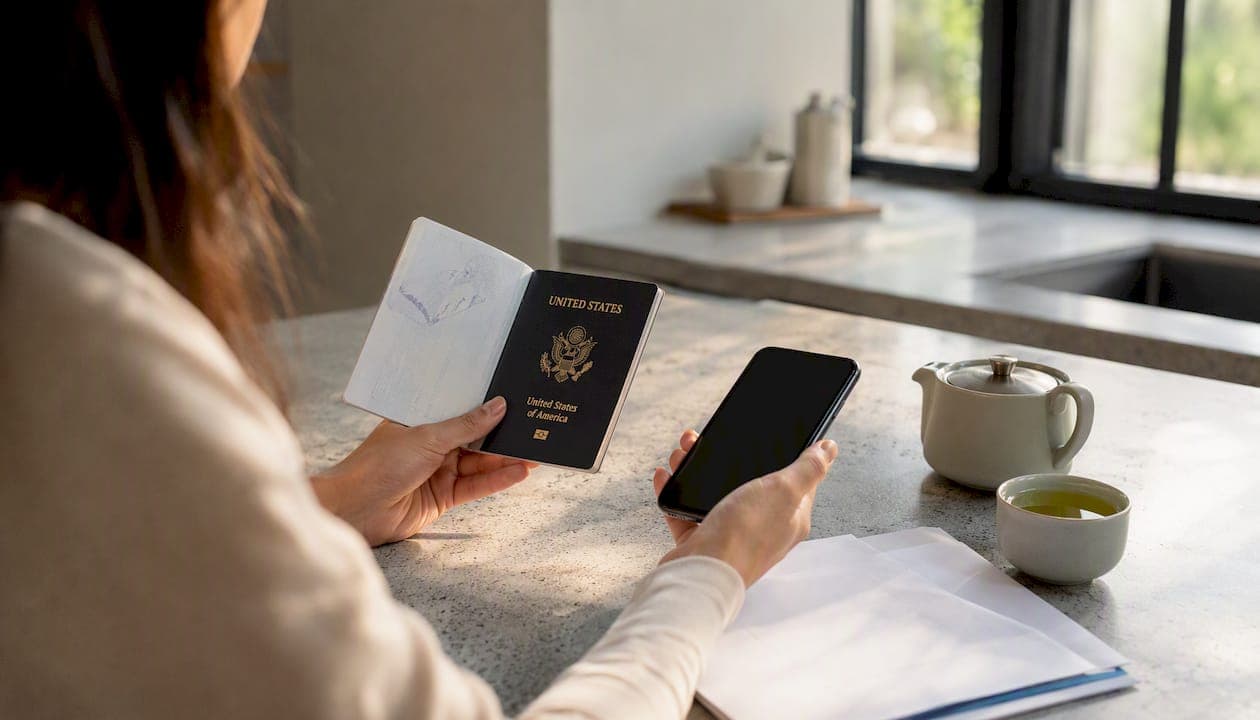
U.S. passport holders can enter Japan visa-free for stays up to 90 days for tourism, business meetings, conference attendance, and similar unpaid activities. No visa application, no eVisa, and no advance authorization is currently required. That said, three checks matter before you board:
- Passport validity: Your passport must be valid throughout your stay. Japan does not require six months of validity beyond your departure date, but your passport cannot expire while you are in the country.
- Blank entry page: You need at least one blank page available for an entry stamp. A passport full of visas and stamps is a boarding problem.
- Onward or return ticket: Immigration officers can and do deny entry if you cannot show proof you plan to leave. Have your return or onward flight confirmation ready.
Pre-register with Visit Japan Web before departure. It takes about 10 minutes, generates a QR code, and moves you into faster digital lanes at the airport. Paper arrival cards remain available, but digital registrations are prioritized.
Last reviewed: June 2026. Rules are subject to change; always confirm with the U.S. State Department and the Embassy of Japan before travel.
Table of Contents
- Do U.S. citizens need a visa for Japan?
- What passport and documents do you need to enter Japan?
- What to expect at Japanese immigration and customs
- Transiting through Japan: do you need a visa or JESTA?
- Common reasons entry is denied and what overstaying costs you
- Pre-travel checklist: what to confirm before you leave
- If your passport needs renewal before you go
- Key Takeaways
- The part most travelers get wrong about Japan entry
- Passportcenter can help if your passport isn't ready
- Official sources to bookmark before you travel
Do U.S. citizens need a visa for Japan?
The short answer is no, for most temporary visits. The Embassy of Japan lists U.S. citizens as eligible for a visa-exempt short-term stay of up to 90 days, covering transit, tourism, business without paid activities, and conference attendance. Japan's Ministry of Foreign Affairs confirms this under its reciprocal visa-exemption arrangements.
What counts as permitted under the exemption?
| Permitted activity | Requires a visa instead |
|---|---|
| Tourism, sightseeing, leisure | Paid employment of any kind |
| Business meetings, negotiations | Freelance or contract work performed in Japan |
| Conference or seminar attendance | Long-term study programs |
| Short-term language study (no paid activities) | Journalism or media production (in some cases) |
| Transit through Japan | Residency or family relocation |
The line immigration draws is paid activity. Attending a business meeting is fine. Getting paid by a Japanese company while on a tourist stamp is not. Officers ask pointed questions about your purpose, and inconsistencies between your stated reason and your actual plans are the fastest route to a denial.
When you do need a visa
If your trip involves paid work, a stay beyond 90 days, enrollment in a formal degree program, or activities that fall outside the exemption categories, you must apply for the appropriate visa before you travel. You cannot change your status of stay from inside Japan on a visa-exempt entry. You must leave and re-enter with the correct long-term visa already in hand.
To apply, contact the Japanese consulate with jurisdiction over your U.S. state of residence. Consulate-specific application procedures and required forms are listed on the Embassy of Japan's visa page. Processing times vary by consulate and visa category, so apply well in advance.
Pro Tip: If your trip purpose is ambiguous — say, a mix of tourism and unpaid consulting — contact the nearest Japanese consulate before you book flights. Getting a clear answer in writing protects you at the border.
What passport and documents do you need to enter Japan?
Your passport is the only document Japan requires for visa-exempt entry, but what you carry alongside it can determine whether immigration waves you through or pulls you aside.
Passport requirements
- Valid for the entire duration of your stay (not just your arrival date)
- At least one blank page for an entry stamp
- Must not be a passport previously reported lost or stolen, even if later recovered and reissued
If your passport is close to expiring or running out of pages, handle that before you book. A passport that expires two weeks after your planned return date is technically valid, but it leaves zero margin for delays.
Supporting documents to carry
- Vaccination records if you are traveling with specific health conditions (no mandatory vaccinations are required for Japan entry, but CDC guidance recommends reviewing country-specific health recommendations before departure)
Who to call if something goes wrong
- Embassy of Japan in the U.S.: — Contact this office before travel for visa questions, consulate jurisdiction, and application procedures.
Pro Tip: Store your Visit Japan Web QR code as a screenshot on your phone and carry a printed copy of your passport's photo page and itinerary. If your phone dies at the airport, the paper backup saves time.
What to expect at Japanese immigration and customs
Before you land
Complete Visit Japan Web registration before your flight. The platform lets you pre-enter your immigration and customs declaration data and generates a QR code that immigration and customs officers scan on arrival. It is free, voluntary, and genuinely cuts wait times. Travelers who skip it use paper forms and standard lanes, which move more slowly at peak arrival periods.
Step-by-step arrival flow
- Disembark and follow signs to immigration. At major airports (Narita, Haneda, Kansai), signage is in English.
- Present your passport and Visit Japan Web QR code at the immigration counter or kiosk.
- Provide biometrics. Most foreign entrants must submit fingerprints and a photo on arrival. Children under 16 and certain diplomatic passport holders are exempt.
- Answer the immigration officer's questions. Typical questions cover your purpose of visit, length of stay, and where you are staying. Keep answers consistent with your documents.
- Receive your entry stamp. Your passport will be stamped with a "Temporary Visitor" status and the length of stay granted, typically 90 days.
- Proceed to baggage claim, then customs.
Customs allowances at a glance
| Item | Allowance / threshold |
|---|---|
| Cash or monetary instruments | Amounts exceeding ¥1,000,000 (or equivalent) must be declared |
| Alcohol | Up to 3 bottles duty-free |
| Tobacco | Up to 200 cigarettes duty-free |
| Gifts and goods | Up to the total value limit duty-free |
| Prohibited items | Narcotics, certain firearms, counterfeit goods — strictly prohibited |
For a broader look at what customs clearance involves when crossing international borders, this customs clearance overview covers the documentation basics.
Pro Tip: Declare anything you are unsure about. Japanese customs officers are thorough, and an honest declaration is always better than a secondary inspection that delays you by hours.
Transiting through Japan: do you need a visa or JESTA?
Transit rules depend on whether you stay airside or pass through immigration.
- Airside transit (no immigration entry): — If you are connecting at Narita or Haneda and your onward flight departs from the same terminal without clearing immigration, you generally do not enter Japan and do not need a visa. Confirm this with your airline before travel, as some connections require a terminal change that involves clearing immigration.
JESTA: a policy change to watch
Japan is actively considering legislation that would require airlines to deny boarding to travelers who have not obtained JESTA (Japan Electronic System for Travel Authorization). As of mid-2026, JESTA is not yet mandatory for U.S. citizens, but the policy direction is clear. Airlines may begin enforcing pre-clearance checks before the law is formally enacted.
Before you book a connecting flight through Japan:
- Confirm with your airline whether JESTA or any pre-authorization is required for your specific itinerary.
- Check the Embassy of Japan's travel page for the latest JESTA status.
- Verify entry documents for your onward destination, not just Japan.
Common reasons entry is denied and what overstaying costs you
Red flags that trigger denial
Immigration officers have full authority to deny entry. The most common triggers:
- No onward or return ticket — This is the single most frequent denial reason for visa-exempt travelers.
Consequences of overstaying
Overstaying your permitted stay is a serious violation. Consequences include fines, detention, deportation at your own expense, and a future entry ban that can last years. You also cannot fix an overstay by simply extending your stay from inside Japan. The rules are explicit: you cannot change your status of stay while in Japan on a visa-exempt entry.
If you are denied entry or face a problem at the border, contact the U.S. Embassy or the nearest U.S. Consulate in Japan immediately. Enrolling in the Smart Traveler Enrollment Program (STEP) before departure means the Embassy can reach you with emergency notifications and provide consular assistance if needed.
Pro Tip: Register with STEP before every international trip, not just Japan. It takes five minutes and gives the U.S. government a way to find and help you if something goes wrong.
Pre-travel checklist: what to confirm before you leave
Run through this list in the week before departure.
- Passport is valid for the entire stay and has at least one blank page
- No lost/stolen flag on your passport (if in doubt, apply for a new one)
- Return or onward ticket confirmed and accessible on your phone and in print
- Visit Japan Web registration completed and QR code saved as a screenshot
- Hotel or accommodation confirmations for your full stay
- Proof of funds (bank statement, credit card, or cash)
- Business invitation or meeting details if traveling for professional purposes
- STEP enrollment completed at step.state.gov
- CDC health guidance reviewed at CDC Japan travel page
- JESTA status confirmed with your airline if transiting or if policy has changed
Traveling with children or minors
Each child needs their own valid U.S. passport. There is no age exemption. If a child is traveling with only one parent or with a non-parent guardian, carry a notarized consent letter from the absent parent or legal guardian. Japanese immigration does not universally require this document, but airlines and U.S. Customs on return may ask for it. For passport photo rules for infants and young children, this parent guide covers the specifics.
Pro Tip: Screenshot your Visit Japan Web QR code and email it to yourself. If you lose your phone or it runs out of battery on the plane, you can pull it up on any device at the airport.
If your passport needs renewal before you go
Check expiration and blank pages first
Pull out your passport right now. Check the expiration date and count the blank pages. Japan requires validity through your entire stay and one blank page per entry stamp. If either condition is not met, you need a new passport before you travel.
Never travel on a passport you previously reported lost or stolen. Even if it was later recovered, it may be flagged in international systems and will cause problems at the border.
Renewal options and realistic timelines
| Service type | Estimated processing time | Best for |
|---|---|---|
| Routine renewal by mail | 6 weeks | Travel more than 3 months away |
| Expedited renewal by mail | 2–3 weeks | Travel 5 weeks away |
| In-person at a passport agency | 2–3 business days | Travel within 2 weeks (appointment required) |
| Registered passport courier | Varies; often faster than mail | Urgent travel; complex cases |
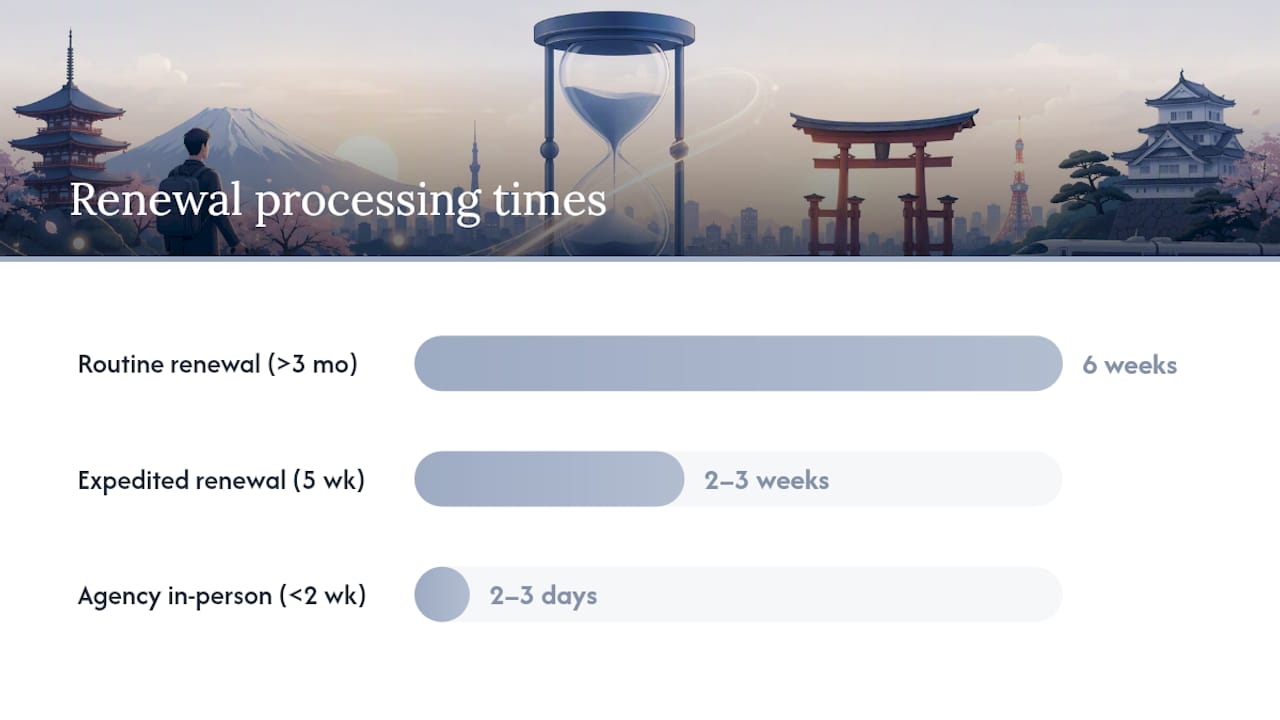
These are general estimates. Actual processing times shift with application volume. Check the State Department's current posted times before you apply.
If your trip is within a narrow window, start the passport renewal process immediately. Waiting even a few days can push you past the cutoff for in-person agency appointments. For a complete list of what to gather before you apply, the passport renewal checklist walks through every required document.
Pro Tip: If you are applying for an expedited passport and your travel date is within two weeks, book a passport agency appointment the same day you decide to travel. Appointments fill fast, especially in spring and summer.
Key Takeaways
U.S. citizens can enter Japan visa-free for up to 90 days for tourism or business meetings, but a valid passport with one blank page and proof of onward travel are non-negotiable before you board.
| Point | Details |
|---|---|
| Visa-free for 90 days | U.S. citizens need no visa for tourism, business meetings, or transit stays under 90 days. |
| Passport must be valid for entire stay | One blank page required; never travel on a previously reported lost or stolen passport. |
| Visit Japan Web speeds arrival | Pre-register before departure to generate a QR code and use faster digital lanes. |
| No paid work on visa-exempt entry | Working on a tourist stamp is a denial and deportation risk; apply for the correct visa before travel. |
| Passportcenter for renewal help | If your passport needs renewal before travel, Passportcenter offers free guidance and connects you to expedited courier services. |
The part most travelers get wrong about Japan entry
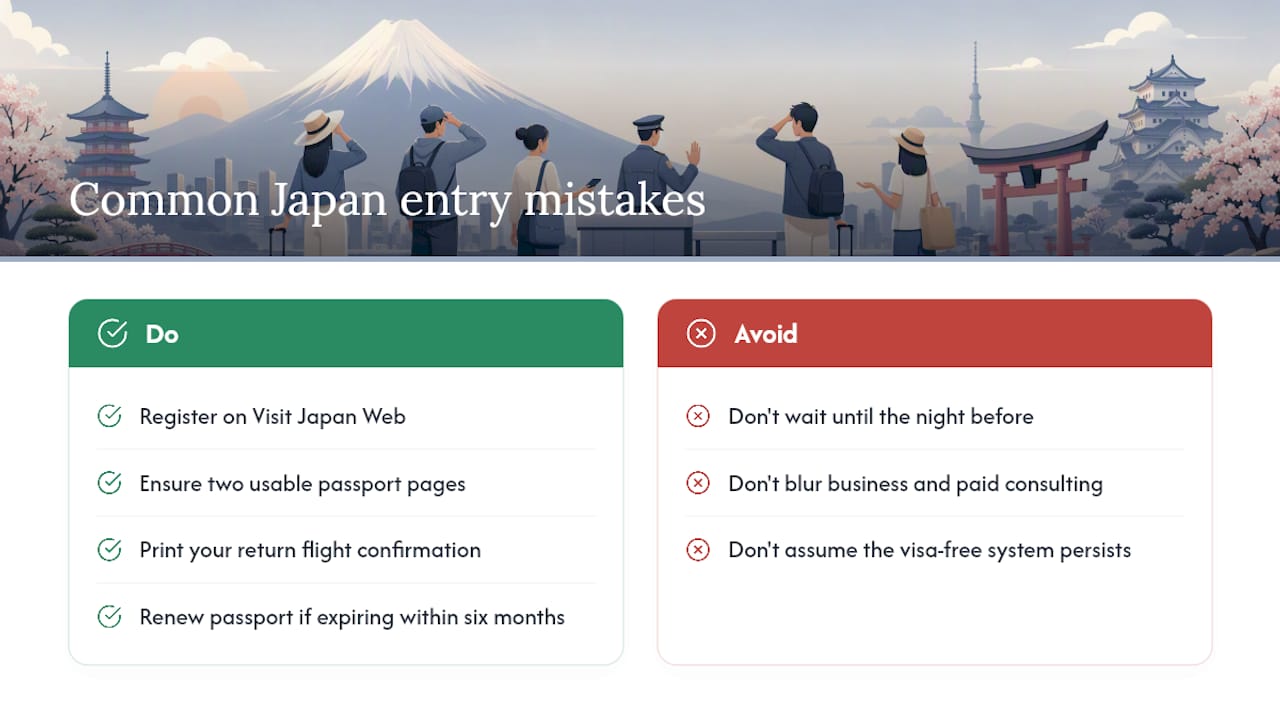
Most travelers heading to Japan focus on the destination and barely glance at their passport until the night before departure. That is where the problems start.
The 90-day visa exemption is genuinely straightforward. Japan is not trying to make entry difficult for U.S. tourists or business travelers. What catches people off guard is the combination of small, fixable issues that compound at the worst possible moment: a passport with two blank pages that turns out to have only one usable one after the airline stamps it, a return flight booked but not printed, a business trip that blurs into paid consulting without the traveler realizing the distinction matters to immigration.
The Visit Japan Web registration is the one step that most travelers skip and most wish they had done. It is not just about speed. It signals to immigration that you are prepared, that your documents are in order, and that you have thought about your trip. Officers notice the difference.
The JESTA situation is worth watching closely. Japan's government has signaled clearly that electronic travel authorization is coming. The question is timing. Travelers planning trips in late 2026 or 2027 should check the current status with their airline and the Embassy of Japan before assuming the current visa-free, no-pre-authorization system still applies.
One more thing: if your passport expires within six months of your travel date, renew it before you book. Not because Japan requires six months of validity — it does not — but because a passport that expires shortly after your return gives you no room for anything to go wrong. Delays happen. Itineraries change. A passport with two years left on it is a problem you never have to think about.
Passportcenter can help if your passport isn't ready
Realizing your passport is expired or nearly full of stamps two weeks before a Japan trip is stressful, but it is fixable. Passportcenter is a free resource built specifically for U.S. travelers in exactly this situation. The site covers renewal timelines, expedited options, what documents to gather, and how to decide between mailing your application and booking a passport agency appointment.
For travelers who need faster processing than the standard mail route allows, Passportcenter connects you to registered passport courier services that can move your application through the system more quickly. The referral model is transparent: Passportcenter provides the guidance for free, and if you choose to use an expedited courier partner, those services charge their own fees.
Check your passport expiration date, count your blank pages, and if either is a problem, start the renewal process now before your travel window closes.
Passportcenter provides general travel document information, not legal or immigration advice. Confirm current entry rules with the U.S. State Department and the Embassy of Japan before travel.
Official sources to bookmark before you travel
| Source | What it covers |
|---|---|
| Visit Japan Web | Pre-register immigration and customs data; generate arrival QR code |
| U.S. State Department — Japan Travel Advisory | Entry rules, passport requirements, safety advisories, and consular contacts |
| Embassy of Japan in the United States | Visa categories, consulate jurisdiction, application procedures |
| MOFA Visa Exemption Page | Official list of visa-exempt countries and 90-day stay conditions |
| STEP — Smart Traveler Enrollment Program | Register your trip so the U.S. Embassy can contact you in an emergency |
| CDC Japan Travel Health | Recommended vaccinations and health guidance for Japan travel |
| Passportcenter | Free U.S. passport renewal guides, timelines, and expedited courier referrals |