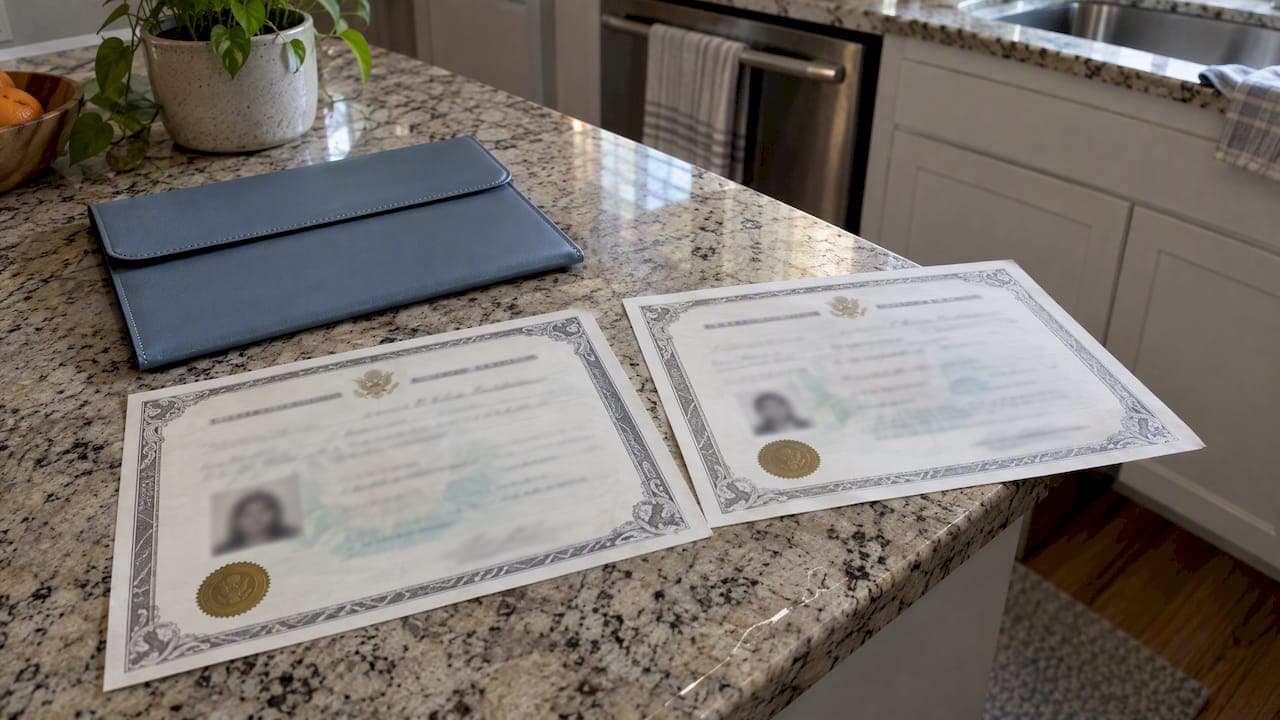
Both documents prove you are a U.S. citizen. The difference is how you became one. A Certificate of Naturalization (Form N-550) goes to people who were born abroad and became citizens by completing the naturalization process. A Certificate of Citizenship (Form N-560) goes to people who were born abroad and are already citizens, either from birth through a U.S. citizen parent or by deriving citizenship after birth.
If you are holding one of these papers and wondering what it is worth, or you are trying to figure out which one applies to you, this guide walks through it in order. We also cover what to do with the certificate when you apply for a passport, and what to do if you lose it.
TL;DR
- Certificate of Naturalization: issued to people who were born outside the U.S. and chose to become citizens through naturalization.
- Certificate of Citizenship: issued to people who acquired citizenship at birth abroad or derived it later, usually through a parent.
- Both are primary proof of U.S. citizenship. Neither is a travel document, and neither replaces a passport at the border.
- A valid, full-validity U.S. passport is also conclusive proof of citizenship, so most people use the certificate once, to get their first passport, and then store it safely.
- Lost or damaged? File Form N-565 with USCIS to replace either document.
Table of Contents
- The short answer: two documents, two paths
- Side-by-side comparison
- Certificate of Naturalization: who holds it
- Certificate of Citizenship: who holds it
- Do you actually need the certificate?
- Neither certificate is a travel document
- Perspective: what we tell people who hold one of these
- Lost, stolen or damaged certificate: how to replace it
- What does not count as proof of citizenship
- Can a naturalized citizen still be deported?
- How to decide which document you have or need
- Using your certificate to get a passport fast
- Common mistakes to avoid
- FAQ
- Sources
The short answer: two documents, two paths
The confusion comes from the fact that both papers do the same job. The USAGov page on certificates describes both as proof that someone is a U.S. citizen. What separates them is the route you took.
Citizenship is the status. Naturalization is one specific way to get that status: a lawful permanent resident, or other eligible noncitizen, completes the legal process and takes the oath. USAGov's naturalization page makes the same point: naturalization is voluntary, and not every citizen is naturalized. Someone born in Texas is a citizen and never naturalized. Someone born in Mexico to a U.S. citizen mother may be a citizen from birth and also never naturalized.

So the question to ask is not which document is better. It is which path is yours.
Side-by-side comparison
| Certificate of Naturalization | Certificate of Citizenship | |
|---|---|---|
| Form number | N-550 | N-560 |
| Who gets it | People born abroad who became citizens through naturalization | People born abroad who acquired citizenship at birth or derived it after birth |
| How you qualify | Meet eligibility, pass the process, take the oath | Already a citizen under the law, usually through a U.S. citizen parent |
| Application for a first copy | Issued at the oath ceremony | Form N-600 |
| Replacement | Form N-565 | Form N-565 |
| Proof of citizenship? | Yes, primary evidence | Yes, primary evidence |
| Travel document? | No | No |
The form numbers come from USCIS's guide to commonly used immigration documents and the USCIS Form N-600 FAQ.
Certificate of Naturalization: who holds it
USCIS issues a Certificate of Naturalization to a person who was born outside the United States and became a citizen through naturalization. In practice, you receive it at your naturalization ceremony, right after you take the Oath of Allegiance.
The certificate carries identifying information about you and confirms your citizenship. Check it before you leave the ceremony. Your name, date of birth and other details should be exactly right. Fixing an error later takes paperwork and time.
You hold this document if:
- You came to the U.S. as an immigrant, held a green card, and later applied for citizenship.
- You completed the process as an adult and attended an oath ceremony.
Certificate of Citizenship: who holds it
A Certificate of Citizenship is for people who are already citizens under the law but never went through naturalization. USCIS explains that you file Form N-600 to get this certificate as evidence of your own or your child's citizenship.
Typical holders include:
- Acquired citizenship at birth abroad. You were born outside the U.S. to one or two U.S. citizen parents and met the legal requirements that applied when you were born.
- Derived citizenship after birth. Your parent naturalized while you were a minor and met the conditions in the law, so you became a citizen automatically.
These rules depend on the year you were born and your parents' circumstances. The USCIS Policy Manual states that people who meet the requirements to acquire, derive or naturalize are eligible to receive a certificate from USCIS documenting their citizenship. If you are not sure which path applies to you, check your acquisition path before you file any forms. Guessing wrong can stall an application.
Do you actually need the certificate?
Often, no. This surprises many people.
Under 22 U.S.C. § 2705, a valid U.S. passport is conclusive proof of citizenship while it is valid. The State Department's citizenship evidence page lists the documents that prove citizenship when you apply for a passport. If you already hold a full-validity, undamaged passport, you generally do not need to dig out your certificate for daily life, travel or employment verification.
Here is when the certificate matters:
- Applying for your first passport. You submit the certificate as your citizenship evidence.
- Replacing a passport that is lost, stolen or not full validity. You may need the certificate again.
- Certain benefit or records requests where an agency asks for primary evidence.
- Backup. It is the one document that is hard to replace quickly, so keep it safe.
The practical advice we give most people: use the certificate to get your first passport, then treat the passport as your everyday proof. Keep the certificate in a fireproof box or safe. Do not carry it in your wallet.
Neither certificate is a travel document
A certificate proves you are a citizen. It does not let you board an international flight or cross a border by air. For that you need a passport. If you have a certificate but no passport, the next step is a passport application, and the timeline matters.
As of October 2026, according to the State Department's Get Your Passport Fast page, routine service takes 4 to 6 weeks, not counting mailing time, which can add up to 2 weeks. Expedited service costs an additional $60 and takes 2 to 3 weeks, per the State Department's processing times page. Urgent travel within 14 days requires an appointment and proof of the trip.
Two things to remember if your certificate is your citizenship evidence:
- Your original certificate is mailed with your application and returned separately. Build that into your timeline.
- If you are close to a departure date, read our guide to the current U.S. passport processing time before you pick a service level.
Perspective: what we tell people who hold one of these
We run a free information site for U.S. travelers, and the certificate question comes up constantly, usually in the same breath as a trip date. Here is the honest version of what we see.
Most people treat the certificate as if it must travel with them. It should not. It is the document you hand over once, for your first passport, and then protect. The passport does the daily work.
The second thing we see is people paying for a Certificate of Citizenship they do not need. If you are a parent who naturalized and your child derived citizenship, the goal is often just a passport for a family trip. You may be able to apply for the child's passport directly with the State Department, using your own Certificate of Naturalization, the child's foreign birth certificate and proof of your custody. The State Department's citizenship evidence page lists what each situation requires. Filing Form N-600 is optional in that case, and it adds cost and months. It can still make sense as a permanent record, but it is not a prerequisite for travel.

The third thing: do not panic if the certificate is lost. It is a hassle, not a disaster. If you have a valid passport, you are still covered.
We are not a government agency and we do not file anything for you. We explain the rules, point you to the official forms, and, when you are short on time, we connect you with registered expedited passport courier services.
— David
Lost, stolen or damaged certificate: how to replace it
Both certificates are replaced with the same form: Form N-565, Application for Replacement Naturalization/Citizenship Document, filed with USCIS. USAGov describes the replacement process and links to the form. USCIS sets the fee, so check the current amount on the form page before you file.
Before you start, ask whether you need a replacement at all:
- You have a valid full-validity passport. You are covered for most purposes. Replacement can wait.
- You have no passport and need citizenship evidence. Replacement is likely necessary.
- Your name changed. Gather the marriage certificate or court order. The replacement can reflect the legal change.
If your case is not straightforward, for example you are unsure whether you naturalized or derived citizenship, or records are missing, a licensed immigration attorney is the right professional. An overview of replacing a citizenship certificate explains when replacement may be necessary and how it goes through USCIS.
What does not count as proof of citizenship
People often assume other cards in their wallet work. They do not.
- Social Security card: It is an identity and employment document. It does not establish citizenship, and you cannot use it to apply for a passport. USCIS notes this in its N-600 FAQ.
- Green card: It shows lawful permanent residence, which is the step before naturalization, not citizenship.
- Driver's license or state ID: It shows identity and residence, not citizenship.
It helps to keep these records together with your certificate in one place. A legal documents checklist is a handy way to make sure the important papers are all in one spot and your family knows where to find them.
Can a naturalized citizen still be deported?
It is rare, but the law allows a path. A naturalized citizen can lose citizenship through denaturalization, a federal legal process. The government must prove citizenship was illegally procured or obtained by willful misrepresentation of a material fact. Recent Justice Department cases show what this looks like in practice: one federal court revoked citizenship of a man who naturalized in 2005 despite having been ordered deported in 1994, and another case involved a convicted drug dealer.
Once citizenship is revoked, the person reverts to their prior immigration status and can face removal like any other noncitizen. The USAGov deportation overview explains how that process works. If you have a concern about your own history, talk to an immigration attorney before you file anything. A certificate does not protect citizenship that was obtained through misrepresentation.
How to decide which document you have or need
Work through these questions:
- Were you born in the U.S. or a U.S. territory? Your birth certificate or passport is your proof. You likely have neither certificate.
- Did you go through a naturalization ceremony? You should have a Certificate of Naturalization (N-550).
- Were you born abroad to a U.S. citizen parent, or did a parent naturalize while you were a minor? You may qualify for a Certificate of Citizenship (N-560), obtained through Form N-600.
- Do you already have a valid, full-validity passport? Then you may not need either one right now.
If you are still unsure, look at the document itself. It names its type at the top.
Using your certificate to get a passport fast
If you are applying for your first passport with a certificate and a trip is coming, speed matters. We cover the options in detail:
- How to expedite a passport: the fastest legitimate options, in order.
- Urgent U.S. passport: the rules for travel within 14 days.
- Passport mailing time: why mail adds time on both ends.
PassportCenter.ai is a free resource. We explain the process in plain language, and if you need expedited or professional help, we connect you with registered passport courier services. You can start at the PassportCenter.ai home page or read about the real cost of expediting before you decide. You can always apply through government channels yourself.
Common mistakes to avoid
- Mailing a photocopy. Passport applications need the original certificate, or a certified copy where the rules allow it.
- Laminating the certificate. Do not. A laminated document can be rejected.
- Carrying the original every day. Leave it in safe storage. Make a copy for your records, and never treat the copy as proof.
- Paying for an N-600 you do not need. Check whether you can apply for the passport directly first.
- Assuming a Social Security card works. It does not.
- Waiting until the last month. Routine processing runs 4 to 6 weeks plus mailing.
FAQ
Is there a difference between naturalization and citizenship?
Yes. Citizenship is your legal status. Naturalization is one way to get it: a noncitizen completes the legal process and becomes a citizen. Citizens born in the U.S., or who acquired or derived citizenship, never naturalized, but every naturalized person is a citizen.
Do I need my naturalization certificate if I have a U.S. passport?
Not for everyday needs. A valid, full-validity passport is conclusive proof of citizenship while it lasts. You will want the certificate again if you must replace a lost passport or apply for something that asks for primary evidence, so keep it stored safely.
Is a Social Security card a Certificate of Citizenship?
No. A Social Security card is an identity and employment document and does not establish citizenship. You cannot use it as citizenship evidence for a passport. Use a certificate, a birth certificate or a full-validity passport instead.
Can I travel internationally with just a certificate?
No. Neither certificate is a travel document. You need a valid U.S. passport. If you do not have one, apply with your certificate as citizenship evidence and allow for processing and mailing time.
What if I lose my certificate?
File Form N-565 with USCIS to replace either document. The agency sets the fee, so confirm it on the form page. If you hold a valid passport, you may not need the replacement urgently.
Sources
- USAGov: Get or replace a Certificate of Citizenship or Naturalization
- USAGov: Naturalization
- USAGov: Understand the deportation process
- USCIS: Commonly Used Immigration Documents
- USCIS: Form N-600 FAQ
- USCIS Policy Manual, Volume 12, Part K, Chapter 1
- State Department: Citizenship evidence for a passport
- State Department: Get Citizenship Evidence for a U.S. Passport
- State Department: Get Your Passport Fast
- State Department: Get Your Processing Time
- Justice Department: Federal judge revokes citizenship of immigration and identity fraudster
- Justice Department: District court revokes U.S. citizenship of convicted drug dealer