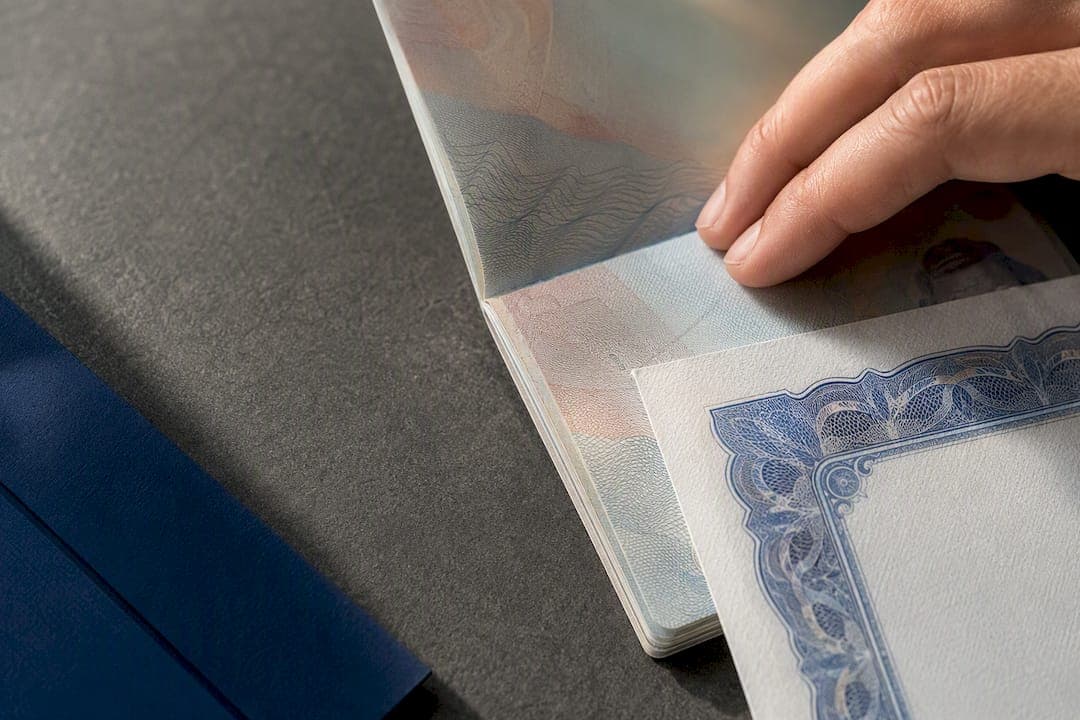
If your name changed less than a year ago and matches your ticket problem, file Form DS-5504 by mail with your current passport and a certified name-change document, usually at no cost. If it's been longer than a year, you'll renew with Form DS-82 by mail if you qualify, or apply in person with Form DS-11. Without certified proof of the name change, expect DS-11 no matter how much time has passed.
TL;DR:
- Filing Form DS-5504 is the fastest and most cost-effective option if your name was legally changed within the past 12 months and the current passport was issued in your new name.
- If more than a year has passed since your name change, eligibility for Form DS-82 depends on your passport's issuance date, condition, and whether you can attach certified proof of your name change.
- Incorrect or incomplete submission, especially missing certified documents or using the wrong form, is the main cause of processing delays and rejections.
- Changes in divorce decree language often complicate the process unless explicit language restoring your former name is included, possibly requiring additional documentation or in-person filing.
- Booking travel before your correction completes is acceptable as long as the name on your ticket matches the passport you will present at borders and check-in, with in-person updates preferred close to departure for urgent trips.
Table of Contents
- Passport Name Mismatch on Your Ticket: Which Form Do You Need?
- What Documents You Actually Need to Send
- How to Submit: Mailing DS-5504/DS-82 vs. Applying With DS-11
- The Edge Cases That Trip People Up
- What You'll Actually Pay and How Long It Takes
- Your Pre-Mail Checklist Before You Seal the Envelope
- Already Booked a Flight? Here's What to Do About the Name Mismatch
- How Far Ahead of Your Trip You Need to Finish This
- Updating Your Name Everywhere Else Once the Passport Is Fixed
- What Actually Causes Rejections, and Why Most Are Preventable
- When a Courier Referral Makes Sense
- Sources
Passport Name Mismatch on Your Ticket: Which Form Do You Need?
The one-year rule decides almost everything here. If your current passport was issued and your name legally changed within the past 12 months, Form DS-5504 is your fastest route. It handles both name changes and printing or data errors, and you send it by mail with your existing passport, one photo, and a certified copy of your legal name-change document.
Miss that one-year window and DS-5504 is off the table. You'll need to check DS-82 eligibility instead. That form works only if all of these are true:
- Your passport was issued within the last 15 years.
- You were 16 or older when it was issued.
- The passport is undamaged, with no water stains, tears, or missing pages.
- It was issued in your current name, or you can attach a certified name-change document.
Fail any one of those checks and you're filing Form DS-11 in person at an acceptance facility or passport agency. DS-11 is also mandatory if you're a first-time applicant, your passport was lost, stolen, or damaged, you're applying for a minor, or you simply have no certified proof of the name change to show. A lot of travelers assume they can mail everything regardless of circumstance. That assumption is exactly what stalls applications for weeks.
What Documents You Actually Need to Send
Get the packet right the first time and you avoid the single most common cause of processing delays: submitting the wrong form or incomplete evidence. Here's what belongs in your envelope or your folder for an in-person appointment.
- A certified copy of your name-change document. This means a marriage certificate, divorce decree, or court order bearing a raised seal or the issuing court's certification stamp, not a photocopy you made at home. Only the vital records office or court clerk that issued the original can certify a copy.
- Your most recent U.S. passport, submitted with DS-5504 or DS-82 applications. If you're filing DS-11 because your passport was lost or stolen, you won't have this, and you'll need other identity evidence instead.
- Primary identification in the name you're requesting, such as a driver's license or state ID. If that ID already reflects your new name, some applicants find they need less supporting paperwork, though it does not eliminate the need for the certified name-change document itself.
- One passport photo meeting current specifications: 2x2 inches, color, plain white or off-white background, taken within the last six months.
- Form DS-60 (Affidavit Regarding a Change of Name), required only if you have no certified legal document at all. This form needs two people who've known you under both names, plus proof from at least three public records showing five years of consistent use of the new name.
Pro Tip: Getting a certified marriage certificate or court order from the issuing office is almost always faster and simpler than assembling DS-60 witness affidavits and years of public records. If you have any way to obtain the certified document, skip DS-60 entirely.
How to Submit: Mailing DS-5504/DS-82 vs. Applying With DS-11
Mail applications and in-person applications follow different rules, and mixing them up wastes time you don't have.
For mailed forms, fill everything out in black ink, sign only where indicated, and never use correction fluid on a passport application. The DS-5504 PDF spells out exactly where each signature belongs and which attachments are required. A few mailing basics matter more than people expect:
- Use the exact mailing address printed on your specific form. Some regional addresses are P.O. boxes that only accept USPS delivery, so a courier service like FedEx or UPS may not be able to deliver there at all.
- Send tracked mail. It's the only way to confirm your packet arrived before you start wondering why you haven't heard back.
- Make photocopies of every document before mailing the originals, just in case something gets lost in transit.
In-person DS-11 applications work differently. At an acceptance facility, a clerk reviews your original documents on the spot, photocopies what's needed, and accepts your application immediately if everything checks out. There's no waiting for mail to arrive; the packet is ready for processing the moment you leave the counter.
One detail trips people up either way: the State Department returns certified name-change documents in a separate mailing from your new passport. Don't assume your marriage certificate got lost just because your passport shows up first. For more on what you can and can't send through the mail, see this breakdown of mailing a passport application.
The Edge Cases That Trip People Up
Divorce decrees cause more delays than any other document in this process. If your decree doesn't include explicit language restoring your former name, acceptance staff often won't treat it as sufficient proof on its own. The Foreign Affairs Manual distinguishes between "material" and "immaterial" name discrepancies, and a vague decree usually gets classified as material, meaning you'll need additional identity evidence or an in-person DS-11 filing. If you're unsure how your decree reads, a family law attorney can review the restoration language before you submit anything.
Printing and data errors follow a different track entirely. Catch the mistake and file DS-5504 within one year of the passport's issue date, and the correction is free, with your new passport valid for the full ten-year term. Wait longer than a year to report it, and the replacement passport may only carry validity through the original expiration date rather than resetting the clock.
One number worth remembering: that one-year mark is the hinge on which your entire timeline swings. Cross it, and you shift from a no-cost mail correction to a renewal or in-person process with different fees and different paperwork.
Limited-validity, damaged, or reported lost or stolen passports always require DS-11, regardless of how recently your name changed.
What You'll Actually Pay and How Long It Takes
Name and data corrections through DS-5504 typically carry no fee if your passport is still valid, though expedited service adds a separate charge on top. DS-82 renewals and DS-11 applications carry their own fee schedules that change periodically, so check the State Department's current fee page before you mail anything or head to an appointment.
Processing times vary by season and by how many people are applying at once. Standard service generally takes several weeks; expedited service cuts that down but still isn't instant. If your travel date is close and you're not sure your corrected passport will arrive in time, contact a regional passport agency directly. They handle appointments for travelers with imminent international departures, something standard mail processing simply can't accommodate.
Your Pre-Mail Checklist Before You Seal the Envelope
Run through this before anything goes in the mail or into your appointment folder:
- Confirm you're using the correct form, DS-5504, DS-82, or DS-11, based on the one-year rule and your eligibility.
- Include your certified name-change document, not a photocopy.
- Attach one compliant passport photo.
- Sign every form where required, in black ink, with no corrections.
- Copy everything before you mail the originals.
- Use tracked mail and remember your certified documents come back in a separate envelope.
- If travel is weeks away, call about expedited processing or a passport agency appointment now, not after you've already mailed the packet.
Already Booked a Flight? Here's What to Do About the Name Mismatch
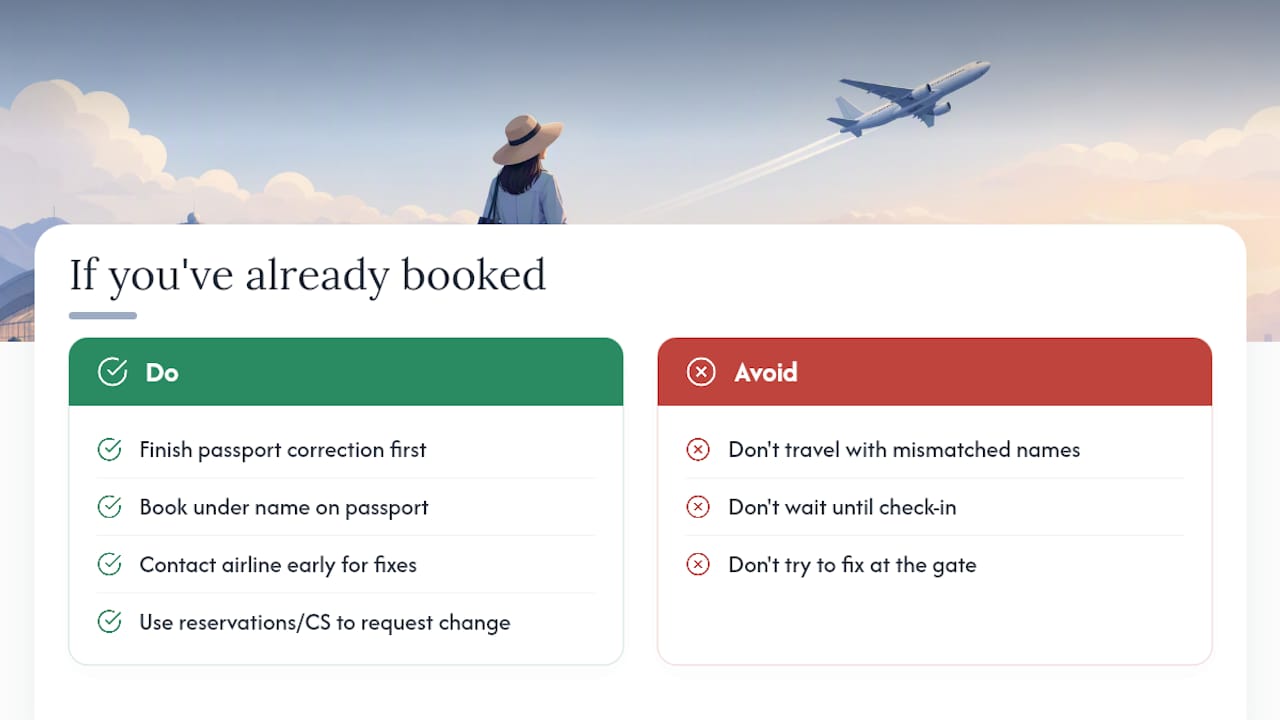
Booking travel before your passport correction is finalized puts you in a common but manageable spot. The State Department doesn't require you to update your passport the moment your name changes; you can keep using your current passport until it expires, as long as the name on your ticket matches the name on the passport you're traveling with.
That flexibility matters if you've already got a ticket booked under your old name and your passport still shows that name too. In that case, nothing needs to change before you fly. The mismatch problem only shows up when your ticket and your passport show two different names, one old and one new, because you updated one but not the other.
If you've already started your passport correction and your ticket is booked under your new name, but your passport correction hasn't been processed yet, contact the airline directly. Most airlines allow a name correction request through their reservations or customer service line, especially when it's a minor discrepancy like a maiden name versus a married name. Airlines generally want the booked name to match the travel document you'll present at the gate, so don't wait until check-in to sort this out.
The safest sequence is this: finish your passport correction first, then book travel, or book travel under whichever name currently appears on your valid passport. Trying to fix a ticket mismatch at the airport, under time pressure, with a gate agent, is a far worse position than handling it by mail or phone weeks in advance.
How Far Ahead of Your Trip You Need to Finish This
There's no single universal deadline the State Department sets for when your name correction must be complete before travel. What matters is that the passport you present at check-in and at border control matches the name on your ticket and any visa documents. That's the real deadline, whatever the calendar says.
Standard processing generally takes several weeks from the day your application is received, not the day you mail it. Add mailing time both directions, and a mail-in correction can realistically take a month or more from start to finish. If your trip is inside that window, standard processing is cutting it close.
Expedited service compresses the timeline but still isn't same-week in most cases. If your departure date is inside a few weeks and your correction hasn't started yet, that's the point where a passport agency appointment or professional courier service becomes worth the extra cost rather than a nice-to-have.
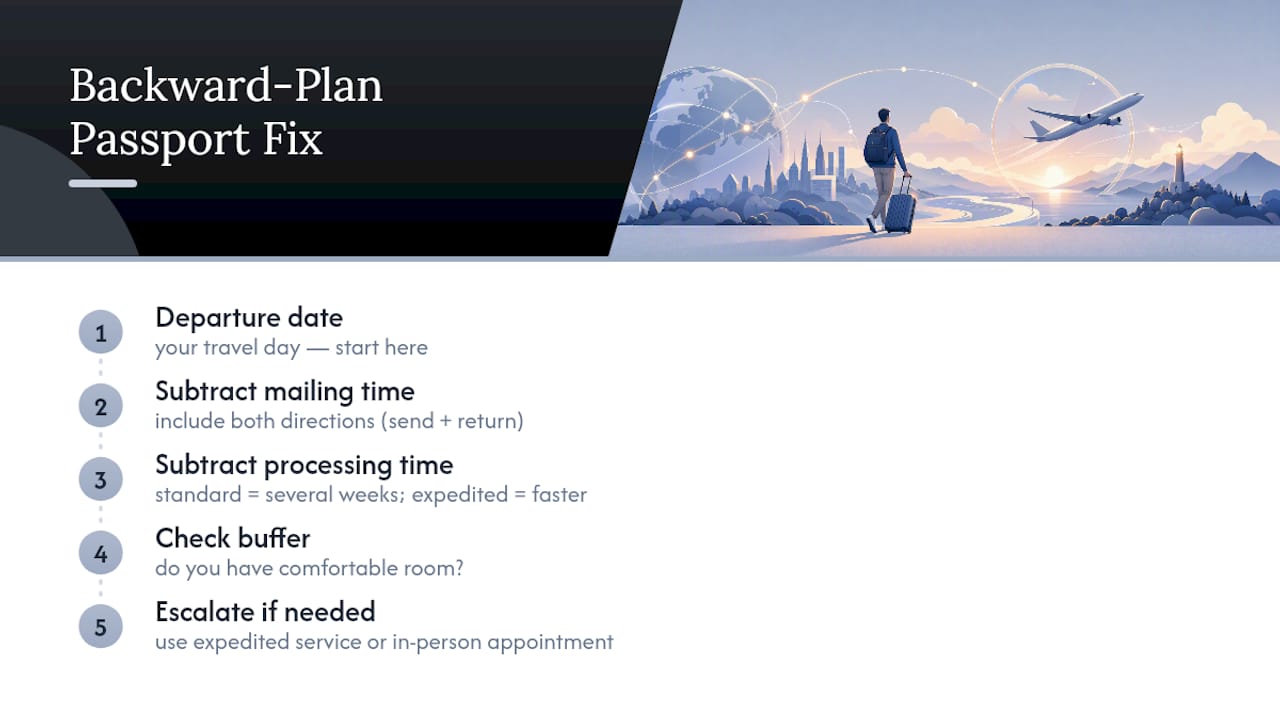
Here's the practical rule: work backward from your departure date, add your mailing time, add your expected processing time, and if the math doesn't leave comfortable room, escalate to expedited service or an in-person appointment immediately. Don't wait for a form rejection letter to discover you miscalculated.
Updating Your Name Everywhere Else Once the Passport Is Fixed
Your corrected passport is the anchor document, but it's not the only place your old name is sitting. Once you're holding the new passport, a few updates keep everything aligned for future travel.
Frequent flyer accounts need the correction next. Most airline loyalty programs let you update your name through your account settings or by calling customer service, though some require a copy of your certified name-change document, the same kind you used for your passport application. Do this before booking your next ticket so your frequent flyer number, ticket name, and passport all match from the start.
Global Entry and TSA PreCheck records also need updating, and that process runs separately from your passport correction. If you skip it, you risk a mismatch between your Known Traveler Number and your new passport the next time you use expedited screening. There's a dedicated process for updating your Global Entry name without losing your existing KTN, which is worth doing in the same sitting as your other updates.
Beyond that, check your airline profiles, hotel loyalty accounts, and any travel insurance policies tied to upcoming trips. None of these carry the legal weight of your passport, but a mismatch on any of them can slow you down at check-in or during a claim.
What Actually Causes Rejections, and Why Most Are Preventable
Nearly every delayed application traces back to the same handful of mistakes: the wrong form for the situation, a photocopy submitted instead of a certified document, or a divorce decree with no explicit restoration clause that the applicant assumed would be sufficient on its own. None of these are complicated fixes once you know to look for them, but they're invisible until you've already mailed the packet and started waiting.
The DS-82 versus DS-11 confusion is especially common among people who renewed by mail once before and assume the same process still applies. Eligibility rules haven't changed, but personal circumstances have, and a passport that's now 16 years old, or a decree that reads differently than remembered, quietly disqualifies someone from the mail-in path they were counting on.
There are guides that walk through eligibility, document requirements, and mailing steps in plain language, and for readers facing a tight travel deadline, there may be options for expedited courier help. If your timeline is generous, self-filing is completely reasonable. If it's not, that's exactly when professional help earns its cost.
— David
When a Courier Referral Makes Sense
This site serves as a free resource to help with form selection when your travel date is closing in fast. If you've read through the eligibility rules above and you're still not sure whether your decree qualifies, or your trip is inside that tight processing window, that's the exact situation where seeking expedited help may be advisable.
The site does not sell passport services directly but may connect readers who need managed, expedited help, faster tracking, professional document review, and guaranteed submission handling, with courier partners who specialize in urgent cases. That's a meaningfully different outcome than mailing your own packet and hoping the timeline holds. For routine corrections with months of runway, the free guides on the site walk you through every form and document requirement step by step. For anything more urgent or more complicated than a straightforward DS-5504 filing, visit Passportcenter to see referral partners and figure out your next move today.
Sources
- Name Change for U.S. Passport or Correct a Printing or Data Error
- DS-5504: Data corrections, name changes, and limited-validity passports (PDF)
- 8 FAM 403.1 name usage and name changes