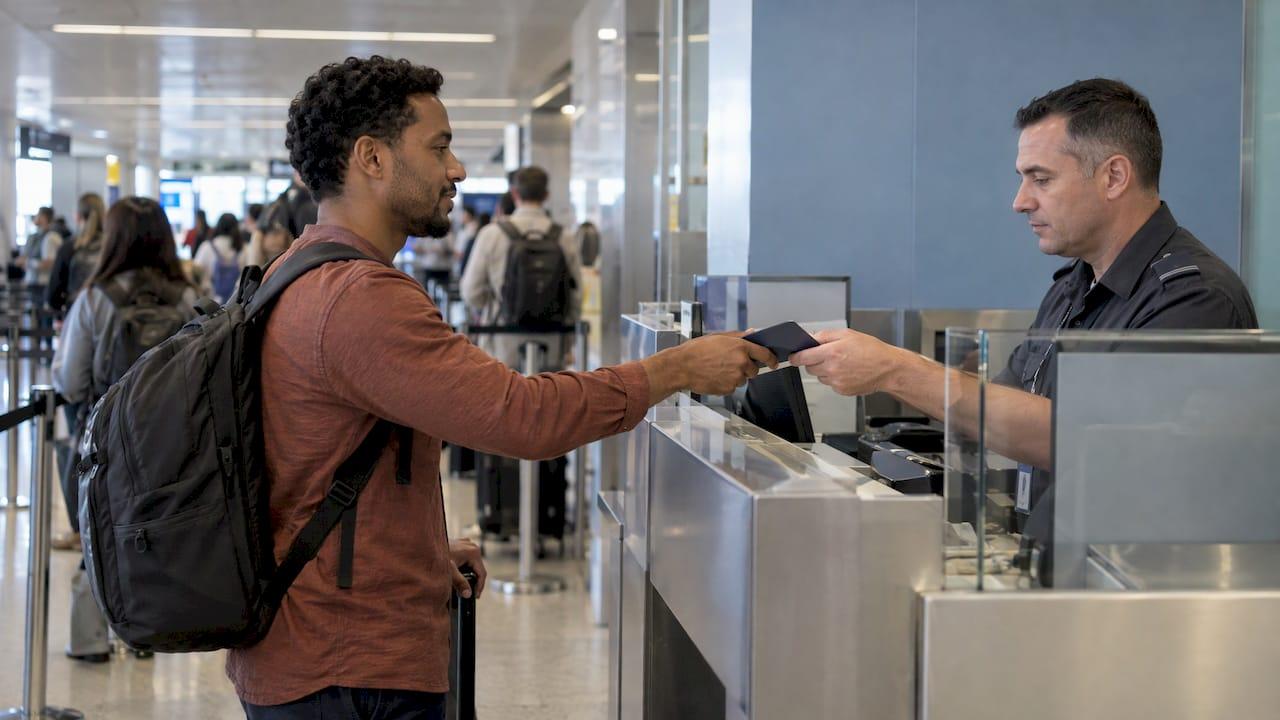
A visa on arrival is a visa you get at the border after you land, not before you leave. Some countries offer it to U.S. passport holders, but many only offer it for certain purposes, and some have moved to online eVisas or free entry stamps instead. The honest truth: the label "visa on arrival" does not mean you can show up with a passport and walk through. Rules, fees and payment methods vary by country and change, so confirm your destination before you book.
This guide cuts through the noise. You will see how a visa on arrival differs from other entry options, which countries have confirmed arrival-visa rules for Americans, what to carry, and how to check current rules.
TL;DR
- A visa on arrival is issued at the border. An eVisa is approved online before you fly. Visa-free entry needs no visa at all.
- Eligibility depends on country and purpose. Paraguay and Indonesia list the United States for arrival visas. Myanmar lists it only for business-type categories, and Bangladesh limits arrival visas to specified groups.
- Plan on a passport valid six months or more, an onward or return ticket, and cash in U.S. dollars for the fee.
- Europe does not require a visa for short U.S. visits, but new entry systems (EES and ETIAS) now matter.
- Always verify with the official government source for your destination before you go.
Table of Contents
- Visa on arrival, visa-free, eVisa, visa waiver: what each one means
- Countries that offer U.S. citizens a visa on arrival
- What to carry for a visa on arrival
- What a visa on arrival really costs
- Do U.S. citizens need a visa for Europe?
- How to check the current rules before you go
- Common mistakes Americans make with arrival visas
- Our perspective
- Need your passport ready in time?
- FAQ
- Sources
Visa on arrival, visa-free, eVisa, visa waiver: what each one means
Travelers mix these four terms up constantly, and the mix-up causes denied boarding. Here is the plain version.
| Entry type | When you get it | What you do | Example of the idea |
|---|---|---|---|
| Visa-free | No approval needed | Show your passport at the border | Short tourist stays in many countries |
| Visa on arrival | At the border, after landing | Pay a fee and sometimes fill out a form | Paraguay, Indonesia |
| eVisa | Online, before travel | Apply, pay, print or save the approval | Vietnam, Cambodia |
| Visa waiver or travel authorization | Online, before boarding | Register for permission; it is not a visa | ETIAS in Europe |
The distinction between these is explained in a breakdown of eVisas, ETAs and visa on arrival: a visa on arrival is issued at the border after you arrive, an eVisa is approved online first, and ETIAS-style authorizations are not visas at all.
Why this matters to you: an airline can refuse to board you if you lack a document the destination requires before arrival. If your destination needs an eVisa, "I will get it at the airport" is not a plan.
Countries that offer U.S. citizens a visa on arrival
Below are destinations where official government pages describe arrival-visa rules that involve U.S. passport holders. Treat this as a starting point, not a complete list. Governments change these programs, and the page you read today may be out of date next year.
Paraguay
Paraguay's consulate in Washington says U.S. passport holders can obtain a visa on arrival at Silvio Pettirossi International Airport in Asunción. According to the consulate's visa page, you need a valid passport and must pay the fee in cash at the airport. The page lists the fee for U.S. citizens as USD 160. It does not state a tourist stay length for this visa, so confirm that with the consulate before you travel.

Indonesia
Indonesian immigration guidance lists the United States among the countries eligible for a tourism visa on arrival. According to the immigration directorate's guidance, you need a passport valid for at least six months and a return or onward ticket. The fee listed is IDR 500,000 per person per arrival. The visa grants 30 days and may be extended once for another 30 days. That page dates from 2022, so check the current immigration site for the fee and any new entry steps before you book.

Myanmar
Myanmar is a good example of why the label misleads. Its foreign ministry's on-arrival visa information lists U.S. passport holders among those who can apply on arrival for business, workshop, seminar, meeting, research, transit and crew visas. The tourist table in the retrieved information does not list the United States. Listed fees and stays are:
- Business: USD 50, 70 days
- Workshop, seminar, meeting or research: USD 40, 28 days
- Transit: USD 20, 24 hours
- Crew: USD 40, 28 days
You need a passport valid at least six months from entry and two recent 4-by-6-centimeter color photos. Other documents, such as invitations, tickets or sponsorship, depend on the visa category. The page is dated 2020, so confirm everything with the ministry or a Myanmar embassy before traveling.
Bangladesh
Bangladesh offers visa on arrival only to specified categories, and officers review your documents at the border. According to the Special Branch guidance, the categories include visitors from countries without a Bangladeshi mission, qualifying business or investment travelers, and other listed special groups. Key terms:
- Maximum stay: 30 days, single entry
- Fee: paid at the port of entry in cash in U.S. dollars, euros or pounds
- Funds: at least USD 500 in cash or a credit card, except for government-duty travelers
- Ticket: a return ticket for short-term stays
If you are a regular tourist, do not assume you qualify. Check the category that matches your trip first.
United Arab Emirates
Dubai Airports lists U.S. citizens among the nationalities eligible for a free visa on arrival, and its passport control page warns that eligibility, visa validity, passport rules and required documents are subject to change. It advises checking current requirements with the UAE embassy before departure. For the practical side, including how the stamp works for Americans, see our guide on the free 90 day UAE stamp for US citizens.
Other places Americans ask about
Several popular destinations have changed their systems or work differently from what travelers expect:
- Egypt: Americans can use an eVisa or get one on arrival. Our Egypt visa guide for U.S. citizens covers both routes and next steps.
- Cambodia: An eVisa is available in advance. See Cambodia eVisa fees, steps and arrival rules.
- Vietnam: The standard route is an eVisa. Read how to apply for the Vietnam eVisa.
- Qatar: Check the Qatar entry requirements for U.S. citizens before booking.
- India: Per the U.S. Embassy in India, U.S. citizens still need to obtain the appropriate visa before traveling unless exempt, and the electronic arrival form is separate from any visa application. Search results mention arrival visa changes for Americans, so verify the current status on India's official visa site before you plan around one.
What to carry for a visa on arrival
Every country sets its own list, but the same items come up again and again in official guidance. Pack them in your carry-on, not your checked bag.
- Passport with enough validity. Indonesia and Myanmar both ask for six months. Treat six months as your default, and leave blank pages if the country stamps.
- Cash in U.S. dollars. Paraguay requires cash at the airport. Bangladesh accepts cash in dollars, euros or pounds. Airport card machines and ATMs can be down or limited, so bring clean, undamaged bills in the amounts listed.
- Return or onward ticket. Indonesia and Bangladesh both ask for one. Airlines often check this at check-in, before you ever reach the border.
- Passport photos. Myanmar asks for two recent photos in a set size. Bring a few extras for any country that might.
- Proof of purpose. If your arrival visa depends on a category, such as business, bring the invitation or sponsorship letter.
- Proof of funds and lodging. Bangladesh states a cash or card minimum. Other countries may ask at the desk.
For related validity rules close to home, our six month validity checklist for the Bahamas shows how the same rule trips up travelers on shorter trips.
What a visa on arrival really costs
The fee is only part of the cost. Count these too:
- The listed fee. From the official pages above: USD 160 for Paraguay, IDR 500,000 for Indonesia, USD 20 to USD 50 for the Myanmar categories.
- Currency and method. Many arrival counters take cash only. Some accept only certain currencies.
- Time at the border. Arrival visas add a queue: one line for the visa, another for immigration. Do not schedule a tight connection right after landing.
- Extension fees. Indonesia allows one 30-day extension, which carries its own cost and paperwork.
If an eVisa exists for your destination, compare it with arrival. An eVisa moves the paperwork to your couch, and you know your status before you pay for flights.
Do U.S. citizens need a visa for Europe?
No, not for short visits. The EU's delegation in Washington says U.S. citizens do not need a visa for short stays in the 30 European countries it lists. Two systems change the border experience, though.
- EES (Entry/Exit System). The European Commission says EES began operating on October 12, 2025. It records passport details, facial images, fingerprints, and entry and exit data for short-stay non-EU travelers at 29 European countries. Full implementation was scheduled for April 10, 2026.
- ETIAS (travel authorization). ETIAS is not a visa. The same Commission page says it will apply to visa-free travelers staying up to 90 days in any 180-day period and must be approved before boarding once operational. The EU delegation page lists a fee of EUR 20, validity of three years or until the passport expires, and a launch scheduled for the last quarter of 2026. Check the official ETIAS page for its current start status before you book a trip.
So Europe is neither visa-free-and-forget nor an arrival-visa destination. Think of it as visa-free with a pre-registration step that is rolling in.
How to check the current rules before you go
Second-hand lists age fast. This routine takes about ten minutes and protects your trip.
- Go to USA.gov's page on visa requirements for U.S. citizens traveling abroad and search your destination to see its entry, exit and visa requirements.
- Open the destination country's own immigration or foreign ministry page. That page sets the fee and documents.
- Call or email the destination's embassy or consulate in the United States if anything is unclear. Dubai Airports itself advises checking with the UAE embassy before departure.
- Ask your airline what it will check at boarding.
- Screenshot or print the rules you relied on and carry them.
Also check your passport itself. If it expires within six months of your return date, many countries will refuse entry, and arrival-visa counters are no exception.
Common mistakes Americans make with arrival visas
- Assuming one rule covers a whole region. Neighbors can differ completely.
- Treating a blog list as official. Lists copy each other. Use the government page.
- Arriving without cash. A counter that takes only cash will not take your card.
- Overlooking purpose. Myanmar and Bangladesh show how business, transit or special categories can qualify while ordinary tourism does not.
- Forgetting the transit leg. Your layover country may have its own rule. Our guide to U.S. transit visa requirements covers the C visa and ESTA basics for people moving through the United States.
- Skipping the passport check. Fix an expiring passport before you pick a destination, not after.
Our perspective
We read official entry rules all day, and our view is simple: the phrase "visa on arrival" is the least reliable thing on a travel blog. It sounds easy, but it hides purpose limits, cash-only counters, validity rules and pages that were last updated years ago.
That is why we send you to the government source first, then explain it in plain language. We built PassportCenter.ai to give you clear explanations, current entry rules and guides by country, free, so you can decide with facts instead of a headline.
When time is short, the passport itself is usually the real bottleneck, not the visa. If your passport expires soon or you need it fast, we connect you with registered expedited passport courier services, and you keep the choice of how to proceed.
David
Need your passport ready in time?
An arrival visa does nothing if your passport is expiring or missing. If your trip is close and your passport needs renewing or replacing fast, we can point you to registered expedited passport courier services that handle the paperwork and the timeline for you.
Start on PassportCenter.ai for free guides on passport renewal, processing times, and country entry rules, then pick the speed that fits your departure date.
FAQ
Which countries give U.S. citizens a visa on arrival?
Official pages describe arrival visas that involve U.S. passport holders in places such as Paraguay and Indonesia, and for business-type categories in Myanmar. Bangladesh limits arrival visas to specified groups. Governments change these rules, so confirm with your destination's official site before booking.
Is a visa on arrival the same as visa-free entry?
No. Visa-free entry means you need no visa for a short stay. A visa on arrival means you apply and pay at the border after landing. You may also have to meet conditions like a return ticket and passport validity.
Can I get a visa on arrival if I only have a credit card?
Not always. Paraguay requires the fee in cash at the airport, and Bangladesh takes fees in cash in dollars, euros or pounds. Carry the exact cash amounts listed by the country, in clean U.S. bills.
Do I need a visa for Europe as a U.S. citizen?
Not for short visits to the listed European countries. You will, however, go through EES registration at the border, and ETIAS approval will be needed before boarding once that system is operating. Check the official ETIAS page for the start status.
Sources
- Consulate of Paraguay in Washington: visas
- Indonesia immigration: visa on arrival
- Myanmar Ministry of Foreign Affairs: on-arrival visa information
- Bangladesh Special Branch: visa on arrival
- Dubai Airports: passport control and visas
- U.S. Embassy in India: message for U.S. citizens
- Gulf News: eVisa, ETA and visa on arrival explained
- EEAS: Travelling to Europe (ETIAS)
- European Commission: EES vs ETIAS
- USA.gov: visa requirements for U.S. citizens traveling abroad