
Short answer: it depends on how you're getting there and where you're going. Puerto Rico and the U.S. Virgin Islands count as domestic travel for U.S. citizens, so no passport is required. Fly to an independent Caribbean nation like Jamaica or the Bahamas, and you need a passport book. Cruise on a closed-loop itinerary and you might skirt by with a birth certificate, though that carries real risk. Whatever you choose, your passport should have validity beyond your return date, and it's smart to double check with your airline or cruise line before you pack.
TL;DR:
- Most Caribbean independent countries require a valid passport book for air travel, while a passport card is insufficient for entry or return by air.
- U.S. territories like Puerto Rico and the U.S. Virgin Islands are considered domestic travel, so a standard driver’s license or passport card usually suffices.
- Travel for cruise trips varies: closed-loop cruises often allow boarding with a birth certificate and photo ID, but open-loop or international cruises demand a passport book.
- The six-month passport validity guideline is the safest benchmark, as airline policies often enforce this even if destination countries do not require it.
- Always confirm both government requirements and your airline or cruise line policies two to four weeks before departure to avoid boarding issues or missed trips.
Table of Contents
- Caribbean Passport Requirements: A Quick Checklist by Travel Mode
- How Strict Is the Six-Month Passport Validity Rule?
- Passport Book, Passport Card, or Something Else?
- Why Cruise Passengers Should Carry a Passport Anyway
- What U.S. Travelers Should Know About Popular Caribbean Islands
- Passport Expiring or Lost? Here's Your Timeline
- Do Non-Citizens Need Different Documents for Caribbean Travel?
- Pre-Trip Checklist: What to Pack and Double-Check
- Where PassportCenter.ai Fits Into Your Trip Planning
- What Actually Reduces Your Risk on a Caribbean Trip
- Get Your Passport Sorted Before Your Caribbean Trip
- Sources
Caribbean Passport Requirements: A Quick Checklist by Travel Mode
The fastest way to figure out what you need is to match your itinerary type to the rule that governs it. Caribbean travel isn't one uniform system. It's a patchwork of U.S. territory rules, foreign country entry laws, and cruise industry exceptions that don't always line up with each other.
Here's the breakdown that actually matters for planning:
- Flying to an independent Caribbean nation (Jamaica, Dominican Republic, Bahamas, Barbados, and similar): you need a valid passport book. A passport card will not get you through airport immigration or back onto a U.S.-bound flight, since it's only valid for land and sea crossings.
- Flying to Puerto Rico or the U.S. Virgin Islands from the mainland: this is domestic travel. A REAL ID-compliant driver's license, passport card, or Trusted Traveler card like Global Entry works fine for adults. Bring your passport anyway if your trip includes any international leg or a connection through a foreign country.
- Closed-loop cruises (round trips that start and end at the same U.S. port): U.S. citizens can typically board with a certified birth certificate plus a government-issued photo ID, under the CBP closed-loop exception. Adults need the photo ID; children under 16 generally just need the birth certificate.
- Open-loop cruises (different start and end ports, or itineraries touching non-U.S. territories) and international ferries or inter-island flights: treat these like any foreign air travel. Bring your passport book.
- Every itinerary type: confirm your specific airline's or cruise line's documentation policy two to four weeks before departure. Carriers routinely enforce stricter rules than the government requires.
That last point trips up more travelers than any legal technicality. A cruise line can legally demand a passport even when CBP's closed-loop exception would otherwise let you board with a birth certificate. Airlines have denied boarding over expired IDs, unclear name matches, and documents that were technically valid but confused the check-in agent. Confirming the rule twice, once with the government source and once with your specific carrier, costs you five minutes and saves you a ruined vacation.
How Strict Is the Six-Month Passport Validity Rule?
Six months isn't a universal law. It's a guideline the State Department recommends because a large share of countries worldwide enforce some version of it, and immigration officers rarely explain their reasoning if they turn you away at the gate.
Here's what actually happens in practice. Some Caribbean nations only require your passport to remain valid through your length of stay, nothing more. Others insist on three to six months of remaining validity beyond your departure date from that country. A few leave it to the discretion of the individual immigration officer, which means two travelers with nearly identical passports can get different outcomes on the same day at the same checkpoint.
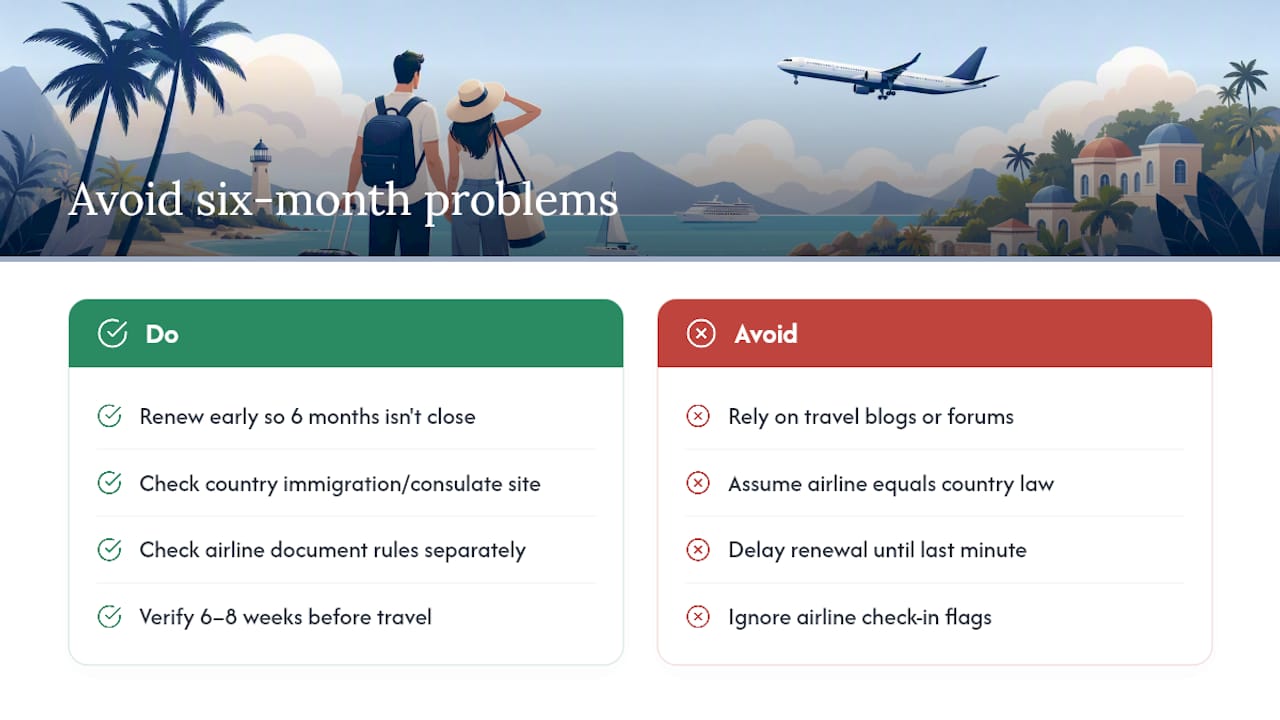
Here's the number that matters: the State Department's blanket advice is six months beyond your return date, and that's the safest benchmark to plan around regardless of your specific destination's stated minimum, because airline check-in staff often apply the six-month rule automatically even when the destination country doesn't strictly require it.
That disconnect between airline policy and government policy is where most denied boardings happen. Your passport might be perfectly valid under Barbados immigration law with four months left, but if the airline's system is programmed to flag anything under six months, you won't get past the ticket counter. This is why the practical move isn't to memorize each country's specific validity threshold. It's to renew early enough that six months is never a close call.
Where to verify the real number for your destination: the country's official immigration or consulate website, not a travel blog or forum post. Airlines also publish document requirements on their own sites, and those are worth checking separately since they don't always match the destination's actual law. If you have an expiring passport and a Caribbean trip within the next year, check requirements six to eight weeks out to leave room for renewal, then verify again 72 hours before departure since policies do occasionally shift.
Passport Book, Passport Card, or Something Else?
A passport book gets you into and out of every country in the world by air, land, or sea, which makes it the only document worth defaulting to for Caribbean travel that involves flying.
The passport card is a different, more limited tool that a lot of travelers misunderstand until they're standing at a gate agent's counter. It's valid for land and sea entry to Canada, Mexico, Bermuda, and the Caribbean, but it does not work for international air travel under any circumstance. If your Caribbean plan includes a flight, the card is useless to you, full stop.
A handful of other documents have narrow, specific uses under the Western Hemisphere Travel Initiative:
- Enhanced Driver's Licenses, issued by a small number of states, work for land and sea border crossings but not air travel.
- Trusted Traveler cards like Global Entry, NEXUS, and SENTRI cover certain land and sea crossings and can double as domestic ID for territory travel, but they're not passport substitutes for flying internationally.
- Certified birth certificates paired with a photo ID satisfy the closed-loop cruise exception specifically, and nothing beyond that narrow scenario.
Pro Tip: If any part of your Caribbean trip touches a plane, whether that's the outbound flight, a connection, or an emergency flight home, carry a passport book. It's the one document that works in every scenario, and it removes the guesswork about which alternative ID applies to which leg of your trip.
If you're not sure which secondary documents count as backup ID for your specific situation, a breakdown of acceptable secondary IDs can clarify what to pack alongside your primary document.
Why Cruise Passengers Should Carry a Passport Anyway
Closed-loop and open-loop are the two terms that determine your documentation options, and the difference comes down to geography, not the cruise line's marketing.
A closed-loop cruise departs from a U.S. port and returns to that same U.S. port without any other stops outside the itinerary's Western Hemisphere loop. An open-loop cruise starts in one port and ends in a different one, or its route includes a segment that breaks the closed pattern. That distinction is what triggers CBP's closed-loop exception, letting citizens re-enter with a birth certificate and photo ID instead of a passport book. Open-loop itineraries don't get that flexibility. Passport book, no exceptions.
Here's where it gets riskier than most travelers assume:
- Cruise lines set their own rules, and they're often stricter than federal law. A cruise line can require every passenger to hold a passport book regardless of itinerary type, and many do, specifically because of what happens next on this list.
- Medical evacuations require a passport book to fly home. If you need emergency care mid-cruise and get airlifted or transported by plane back to the U.S. from a foreign port, a birth certificate won't get you on that flight. Only a passport book will.
- Missing your ship puts you in the same position. Travelers who miss a scheduled departure from a foreign port, whether from a delayed shore excursion or a medical issue, typically have to fly home commercially. Foreign airports require passports for that flight, no exception carries over from the cruise.
The State Department's own guidance is blunt about this: travel with a passport book on any cruise, even a closed-loop one, because the exception exists for boarding convenience, not for the emergencies that actually happen at sea. Check your cruise documents the moment you book, carry physical and digital copies separate from the originals, and have a contingency plan, including accessible funds, in case you need to book an unexpected flight home. If a medical evacuation does occur, documentation requirements for getting home can get complicated fast, and having your passport already in hand removes one major obstacle during an already stressful situation.
What U.S. Travelers Should Know About Popular Caribbean Islands
The Caribbean isn't a single immigration zone, and each island nation sets its own entry rules, stay limits, and paperwork. Here's what U.S. travelers commonly encounter at the most visited destinations, though you should always confirm current requirements before you fly, since policies shift periodically.
- Bahamas: Passport required for air travel; typically allows stays up to 90 days for U.S. tourists; closed-loop cruise exception applies for eligible sailings.
- Jamaica: Passport required for air arrivals; standard tourist stays run up to 30 days, extendable through local immigration.
- Dominican Republic: Passport required; most U.S. tourists get an entry stamp allowing up to 30 days, with extensions available.
- Barbados: Passport required for air entry; tourist stays commonly permitted up to 28 days on arrival.
- Turks and Caicos: Passport required; typical stays allowed up to 90 days for U.S. visitors.
- Aruba: Passport required; an online Embarkation/Disembarkation card (ED card) must be completed before arrival, and tourist stays generally run up to 30 days.
- Curaçao: Passport required; a Digital Immigration Card is mandatory pre-arrival, with typical stays up to 30 days.
A growing number of islands are adding online pre-arrival forms even though they remain visa-exempt for short U.S. tourist stays. That's a meaningful shift from a decade ago, when a stamped passport was often the only paperwork involved. Skipping the online form, even when no visa is required, can hold up your arrival or, in some cases, get you turned away at check-in if the airline verifies compliance before boarding.
One more detail that surprises frequent island-hoppers: transferring between islands, even nearby ones, is often treated as a separate international entry rather than a continuation of your original trip. Flying from Barbados to St. Lucia mid-vacation means going through immigration again on arrival, with its own stay clock and its own passport validity check. Plan your itinerary with that in mind rather than assuming one entry stamp covers a multi-island trip.
Passport Expiring or Lost? Here's Your Timeline
A passport problem discovered two weeks before a Caribbean trip is stressful but rarely fatal to your plans, as long as you know which option fits your timeline.
Routine passport renewal through the State Department typically takes several weeks, which is why the six-month validity buffer matters so much: it gives you room to renew on a normal timeline instead of scrambling. If you're inside that window and your trip is coming up fast, expedited service cuts the wait significantly for an added fee. If your departure is days away, a regional passport agency appointment or a registered expediting courier becomes the realistic path, since those channels are built specifically for last-minute travel.
Here's how to work through the decision:
- Check your remaining validity and your travel date first. If you have more than eight weeks before departure and your passport needs renewing, standard processing is usually enough.
- If you're inside eight weeks, request expedited processing. You'll need Form DS-82 for renewal by mail (if eligible) or DS-11 for first-time applicants and certain renewal cases, along with a passport photo meeting current size and format specs.
- If your trip is inside two weeks and you have proof of imminent international travel, you likely qualify for an in-person appointment at a regional passport agency, which requires documented proof of travel dates.
- If your passport is lost or stolen, report it immediately and file Form DS-64 alongside a new application, since a replacement follows a distinct process from a standard renewal.
Pro Tip: Don't wait until your passport is actually expired to start this process. The moment you know a Caribbean trip is on the calendar, check your expiration date and start the renewal clock, especially if you're anywhere near that six-month cutoff.
For readers working against a tight deadline in a specific region, a regional fast-track guide walks through which local agency or courier option actually saves the most time.
Do Non-Citizens Need Different Documents for Caribbean Travel?
Lawful permanent residents living in the U.S. need to carry their Green Card (Form I-551) or another valid immigration document to re-enter the country after Caribbean travel, separate from whatever passport rules the destination country applies.
Foreign nationals residing in the U.S. follow their own country's passport rules and whatever visa arrangement exists between their nationality and their Caribbean destination, which can differ substantially from U.S. citizen requirements. If your trip routes back through the U.S. under a program like ESTA, that approval needs to be checked independently of your Caribbean destination's entry rules. The safest move for any non-citizen is a direct check with your home country's consulate and the destination's immigration authority before booking, since assumptions based on a friend's or coworker's experience often don't transfer across nationalities.
Pre-Trip Checklist: What to Pack and Double-Check
The night before a Caribbean trip is the wrong time to discover a gap in your paperwork, so run through this list while you still have time to fix a problem.
- Passport book (and passport card, if your itinerary includes land or sea crossings where it applies).
- Return ticket confirmation and lodging details, since some immigration officers ask for proof of onward travel.
- Travel insurance documentation, particularly useful if a medical situation forces an unexpected flight home.
- A parental consent letter if a minor is traveling with one parent, a grandparent, or another non-parental guardian. Every child needs their own passport regardless of age.
- Physical and digital copies of every travel document, stored separately from the originals.
Pro Tip: Email yourself PDF scans of your passport photo page and any visa or entry forms before you leave. If your documents are lost or stolen abroad, having that backup dramatically speeds up getting an emergency replacement at a U.S. embassy or consulate.
Where PassportCenter.ai Fits Into Your Trip Planning
Passportcenter built its resource hub around exactly this kind of pre-trip confusion. Our guides cover passport photo specifications, acceptable secondary ID documents, and regional expedited-processing steps for travelers working against a deadline.
Use Passportcenter when you need plain-language guidance on renewal timing, application forms, or which document actually applies to your itinerary. Use official government pages, like CBP and the State Department, as your final legal check before booking anything irreversible. Passportcenter connects you to registered expedited courier services when time is genuinely short, but the government sources always have the final word on current law.
What Actually Reduces Your Risk on a Caribbean Trip
If there's one habit worth adopting from everything above, it's this: default to the passport book, even when a shortcut exists.
The closed-loop cruise exception is real and legal, but it exists for boarding convenience, not for the emergencies that actually derail trips. A missed ship or a medical evacuation doesn't care whether your itinerary technically qualified for the birth-certificate workaround. It cares whether you can get on a plane home, and only a passport book guarantees that.
The second habit is treating "the government says" and "my airline says" as two separate questions. They usually agree, but when they don't, the airline's answer is the one that keeps you off the plane at the gate. Confirm both, every time, especially for cruise and inter-island travel where policies vary more than most travelers expect.
Last piece of advice: renew early. The six-month validity window isn't a suggestion; treat it as a hard deadline that triggers action the moment you're inside it. A passport renewal handled two months before a trip is routine. The same renewal handled six days before departure is a stressful scramble that costs more and leaves no room for error.
— David
Get Your Passport Sorted Before Your Caribbean Trip
Passportcenter is the free alternative to guessing your way through Caribbean travel rules. Instead of piecing together answers from outdated blog posts or conflicting airline chat responses, you get plain-language guides on renewal timing, required forms, and document rules built specifically for U.S. travelers.
If your passport is inside that six-month danger zone or you're not sure whether your cruise line's rules are stricter than the federal exception, that's exactly when Passportcenter's guides earn their keep. When time is genuinely tight, the site connects you directly to registered expedited courier services so you're not stuck hoping standard processing finishes before your flight. Start with the passport fast-track guide if your departure date is closing in, or visit Passportcenter to check your renewal timeline before you book anything else.
Sources
- Usa
- After getting your passport | U.S. Department of State
- Documents - Do I need a passport to go on a cruise? | CBP