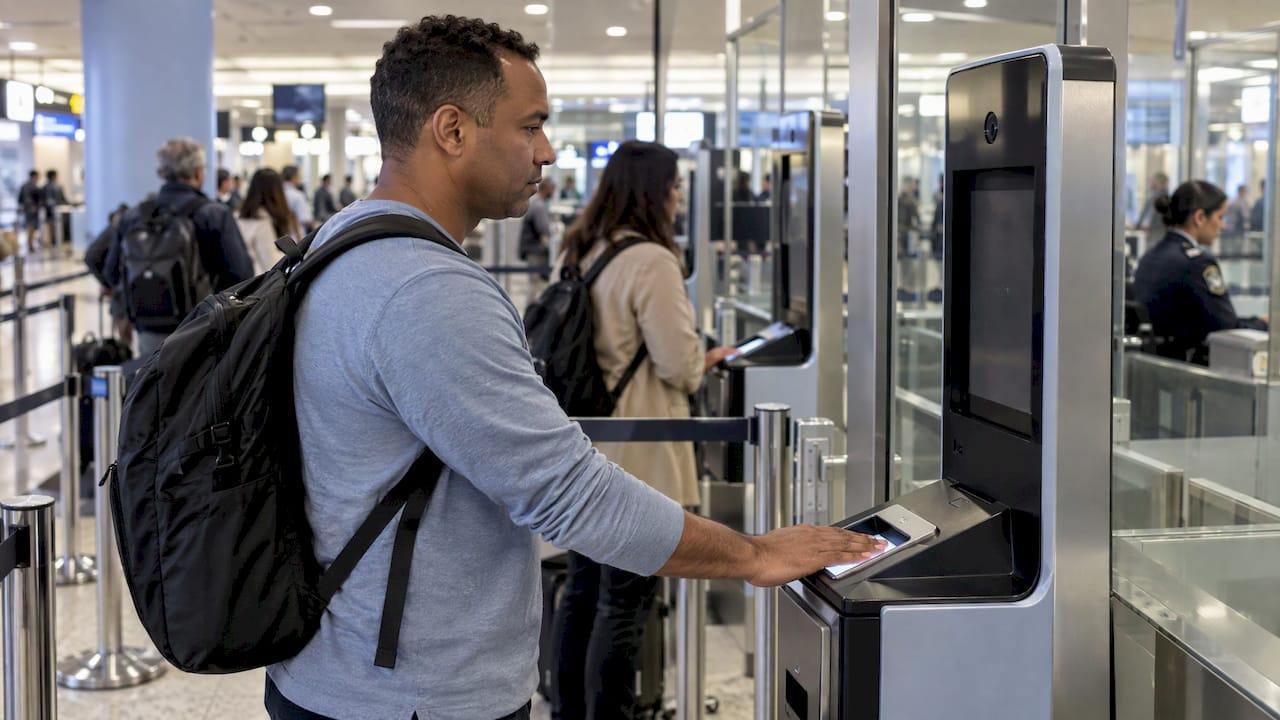
If you are a U.S. citizen visiting Europe for a short stay, the EU's Entry/Exit System (EES) will take a photo of your face and, on your first crossing, scan your fingerprints at the border. There is no form to file before you fly and no fee. You cannot opt out. What you can control is your passport, your paperwork and how prepared you are when you reach the kiosk. This guide covers what is collected, when, who is exempt, what happens with children, and how to avoid the mistakes that cost travelers time.
TL;DR
- The EES is fully operational at all Schengen external borders. U.S. citizens on short stays (up to 90 days in any 180-day period) are registered on arrival.
- Visa-free travelers give four fingerprints and a facial image. Children under 12 are registered but their fingerprints are not scanned.
- Refusing biometric collection means being denied entry. There is no opt-out.
- EES is not ETIAS. EES records you at the border. ETIAS is a separate online travel authorization.
- Your passport matters more than ever: a damaged, soon-to-expire or old passport can end the trip before the biometric scan even happens.
Table of Contents
- What the EES is and where it applies
- Which biometric data you give, and when
- What the border check looks like step by step
- Can you pre-register?
- Children and EES biometrics
- Who is exempt
- What happens if you refuse
- How long your data is kept
- EES versus ETIAS
- Prepare your passport before the scan
- Need a passport fast?
- Our perspective
- FAQ
- Sources
What the EES is and where it applies
The EES is a digital border system. It records entries and exits of non-EU nationals who cross the Schengen area's external borders for short stays of up to 90 days within any 180-day period, according to the Council of the EU. It replaces manual passport stamping with a digital record. The system launched on 12 October 2025 and became fully operational at all external border crossing points on 10 April 2026.
It covers 29 European countries, per the official EES site: Austria, Belgium, Bulgaria, Croatia, Czechia, Denmark, Estonia, Finland, France, Germany, Greece, Hungary, Iceland, Italy, Latvia, Liechtenstein, Lithuania, Luxembourg, Malta, the Netherlands, Norway, Poland, Portugal, Romania, Slovakia, Slovenia, Spain, Sweden and Switzerland. Cyprus and Ireland are not part of it, and passports there are still stamped by hand.
In practice, the check happens at the first Schengen border you cross. If you fly from New York to Rome, you are registered in Rome. If you fly to Dublin and then take a connection into Paris, expect the registration at the Schengen border in Paris.

Which biometric data you give, and when
For travelers who do not need a visa, which includes U.S. citizens on tourist trips, the EES stores four fingerprints and a facial image. Travelers who hold a visa give only the face image, because their fingerprints were already taken when they applied.
The U.S. Embassy in Paris tells Americans to expect fingerprints and facial images to be collected digitally at the border on arrival and on departure. The EES also keeps the data in your travel document, the date and place of each entry and exit, and whether you were ever refused entry.
Here is what that means in plain terms:
| Item | What happens |
|---|---|
| First entry | Passport data, face photo and four fingerprints are captured and a file is created |
| Later entries and exits | Your file is pulled up and your face is checked again |
| Passport stamp | No longer used in EES countries |
| Cost | None |
| Advance application | None required |
The fingerprints are scanned on the first crossing. After that your record exists, so repeat trips are usually quicker. If you get a new passport, expect the system to link it to you at the next crossing.
What the border check looks like step by step
Exact layouts differ by airport, port and land crossing. Some places use self-service kiosks, others use a booth with an officer. The sequence is the same.
- Have your passport open and ready. At a kiosk you scan the photo page.
- Look into the camera for a live photo. Take off glasses, hats and masks first. If you wear glasses daily, our note on what passport photo rules allow for glasses explains why clear, unobstructed face images matter for U.S. documents too.
- Place your fingers on the scanner. In France, the pre-registration devices collect fingerprints of the right hand, or the left hand if the right is not possible. Dry, cold or worn fingertips can fail on the first try, so go slowly and retry if the machine asks.
- Answer the officer's questions. After the kiosk, a border officer still checks your passport and may ask about your trip. The kiosk does not replace this check.
- Keep your trip details at hand. Know your first night's address and your departure date.
The same steps apply in reverse when you leave the Schengen area.
Can you pre-register?
Only partly. The Travel to Europe app lets non-EU travelers pre-register personal information before arriving or leaving. Use is voluntary, and it does not replace the checks by border authorities. There is no separate online EES form and no fee, and registration takes place at the border. Be wary of any website that charges you to "register for EES" in advance. You cannot buy your way past the border scan.
There is also no public place for you to look up your own EES record before you go. Your practical status check is simple: bring the same passport you used last time and expect to be recognized by face.
Children and EES biometrics
Families ask this one most. Children are not exempt from EES registration just because they are young. They are registered like any other non-EU traveler, but fingerprints of children under 12 are not scanned. Their face image is still taken. French authorities say the same: fingerprints are not collected from minors under 12.
A few practical points for parents:
- Every child needs their own passport. Check the issue and expiry dates now, not the week before you fly. Our six-month passport rule guide explains why airlines can deny boarding even when an entry rule is looser.
- Children's passports are valid for a shorter time than adult passports, so a child's passport is the one most likely to be a problem. If you need one fast, see our guide to avoiding child passport consent rejection, since both parents' consent is the usual reason applications stall.
- Have small children stand still and look straight at the camera. A parent can help guide a child at the kiosk.
- If you plan to return to Europe often, remember a registered child has a file too.
Who is exempt
The European Commission lists these groups as not recorded in the EES:
- Nationals of Andorra, Monaco and San Marino
- Holders of a Vatican City State or Holy See passport
- Non-EU nationals with a long-stay visa or a residence permit issued by a country operating the EES
- Certain non-EU family members of EU, Icelandic, Liechtenstein, Norwegian or Swiss citizens who hold a residence card or permit
NATO International Civilians based in any of the 29 countries, and their dependents, are also not recorded. Those based elsewhere who travel there officially are recorded unless another exemption applies.
A U.S. tourist with an ordinary passport falls into none of these groups. If you think you qualify, carry the document that proves it.
What happens if you refuse
You will not be let in. If a traveler refuses to provide biometric data, they are denied entry to the countries using the EES. The EES also stores whether you were refused entry. Do not treat the scan as optional, and do not plan a trip around avoiding it.
If a physical condition makes fingerprinting difficult, tell the officer and let them handle it at the booth.
How long your data is kept
The rules are set in EU law. EES data is kept for three years if you respect the short-stay rules, counted from your exit or refusal of entry, and five years if you overstay, counted from the end of your authorized stay. The system had registered more than 145 million entries and exits by July 2026, so you will be one of very many travelers going through the same process.
The 90-day limit is exactly what the system now tracks automatically, so counting days matters more than before. Our Schengen 90/180 rule guide shows how Americans count their days, with examples.
EES versus ETIAS
These two get mixed up constantly. The European Commission explains the difference:
| EES | ETIAS | |
|---|---|---|
| What it is | Border registration of non-EU travelers | Online travel authorization for visa-free travelers |
| When it happens | At the border, on arrival and exit | Before you begin the journey |
| What you do | Give face image and fingerprints | Apply online, through the official site or app |
| Status | Fully operational since 10 April 2026 | Scheduled to start in the last quarter of 2026, with the exact start date to be announced |
The Commission's own example says an American going to Europe will need an ETIAS authorization once it starts, carriers will check it before departure, and the data will be recorded in the EES at the border. The Commission also warns that fraudulent third-party sites charge extra fees or misuse personal data when you apply, so use only the official ETIAS website or app. Check that official page for the current start date before you book. For the step-by-step on that side, read our ETIAS guide for Americans. A Schengen visa is a different matter again: it involves fingerprints at the application stage, which is why visa holders give only a face image at the EES.
Prepare your passport before the scan
The biometric check starts with your passport, and the passport is where most Americans lose time. Before you travel:
- Check the expiry date. Entry rules and airline rules can differ, and airlines are the ones who deny boarding. Our six-month rule guide walks through the check and the typical two to three week renewal fix.
- Check that the chip and photo page are in good shape. A scuffed or water-damaged data page slows the kiosk read.
- Use the same passport throughout the trip. The system links your biometrics to the document you present.
- Carry proof for your trip. The officer may ask about your stay.
- Allow extra time on your first crossing. Registration adds time, and lines can be longer at busy airports. Build a longer buffer for connecting flights and for ground transfers booked at arrival. If you are driving or arranging a private transfer in Italy, our Italy border document checks explain what to have ready so you do not get refused at the crossing.
If your passport expires soon or you need one in a hurry, do not wait to see if the airline is flexible.
Need a passport fast?
If the passport check above turned up a problem, the quickest route is usually an expedited renewal through the State Department or through a registered passport courier service. PassportCenter.ai is a free resource covering application steps, renewal, child passports, name changes, lost or emergency replacements and processing times, and it connects travelers who need expedited help to registered passport courier services.
Start at PassportCenter.ai to see which route fits your departure date.
Our perspective
Every week, travelers tell themselves the Europe border is the hard part. We think the passport is the hard part. The EES scan takes minutes once you reach the kiosk, but a passport that is too close to expiry, a child's passport nobody checked, or a first-time application filed too late can end a trip months before it starts.
That is why we write in plain language and put the deadline first. Our guides cover the EES, ETIAS, the 90/180 rule and the U.S. passport process in one place, so you can see the whole path from your front door to the Schengen border. When the calendar is tight, we connect you to registered passport courier services built for expedited needs.
Start early, check the dates on every passport in your family, and treat the border scan as routine.
David
FAQ
Do U.S. citizens have to give fingerprints for the EES?
Yes, if you travel visa-free for a short stay. The EES stores four fingerprints and a facial image for visa-exempt travelers. Children under 12 are registered, but their fingerprints are not scanned.
Can I pre-register for the EES before I leave?
There is no required online application and no fee. The voluntary Travel to Europe app lets you pre-register some personal information, but it does not replace the border check. Registration is completed at the border.
What if I refuse to give my biometrics?
You will be denied entry to the countries that use the EES. The refusal is also recorded in the system. There is no opt-out for U.S. travelers.
Is the EES the same as ETIAS?
No. The EES registers you at the border when you arrive and leave. ETIAS is an online authorization you must obtain before travel once it begins. Check the official ETIAS site for its current start date.
Does the EES apply in Ireland and Cyprus?
No. Passports are still stamped manually there. If you connect through another Schengen country, you will be registered at that border.
Sources
- How the entry/exit system works, Council of the EU
- What is the EES?
- FAQs about EES
- Data held by the EES
- U.S. Embassy Paris routine message on the Entry/Exit System
- French pre-registration devices for the EES
- The Entry Exit System is fully operational, European Commission
- Main differences between the EES and ETIAS, European Commission
- The European Union's entry/exit system, EUR-Lex
- Travel to Europe app
- EU Entry/Exit System: U.S. traveler guide, KAYAK