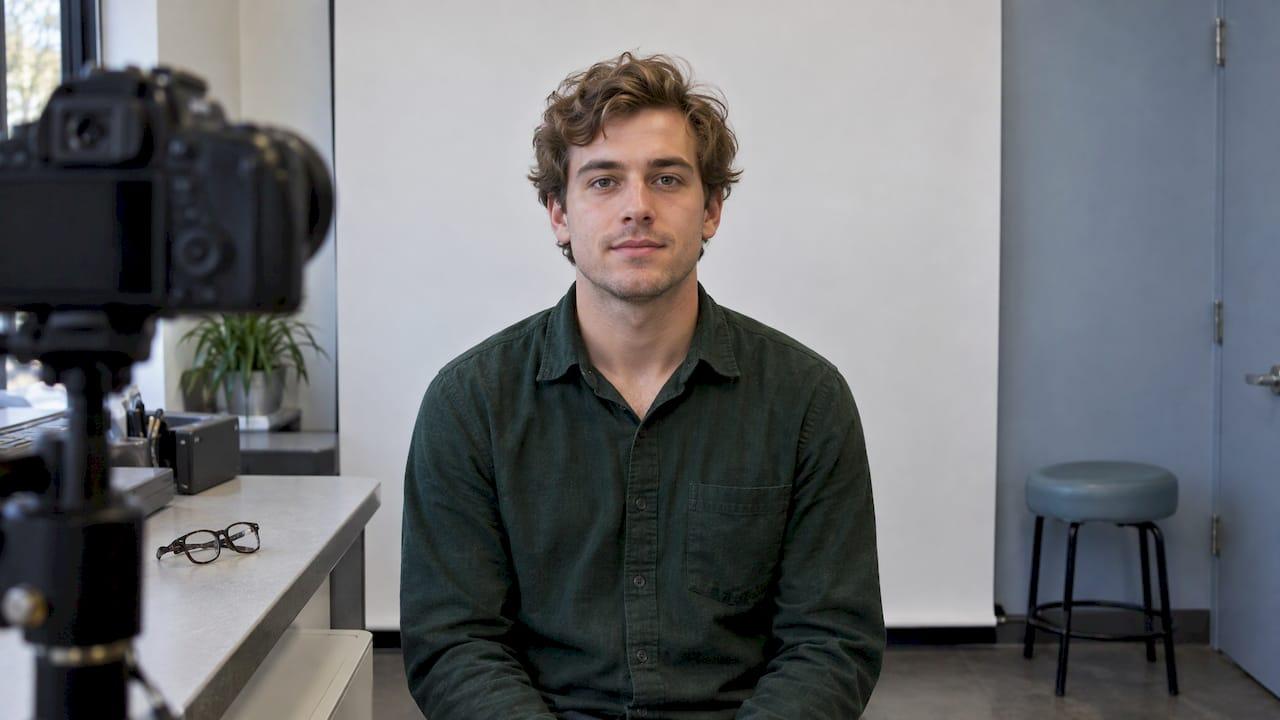
No, you can't wear glasses in a U.S. passport photo. Take off eyeglasses, sunglasses and tinted glasses, and don't rest them on your head. The only exception is narrow: a medical need, backed by a signed statement from a medical professional. Your background must be plain white or off-white.
This guide covers the rule, the exception, the background, and the other small details that get photos rejected. It's written for first-time applicants, parents and anyone renewing before a trip, when a rejected photo can cost you weeks.
TL;DR
- Remove all glasses for a U.S. passport photo. That includes prescription glasses, sunglasses and tinted lenses.
- A medical exception exists, for example protective glasses after eye surgery. It needs a signed statement from a medical professional.
- Use a plain white or off-white background with no shadows, texture, lines or objects.
- Take the photo within the last six months, face the camera directly and keep both eyes open and visible.
- Glare, shadows and blocked eyes are the most common reasons eyeglass photos get rejected, so don't try to work around the rule.
Table of Contents
- The rule: take your glasses off
- What about sunglasses and tinted glasses?
- The medical exception
- Background color: plain white or off-white
- Other checks that cause rejections
- Children and infants
- Take the photo at home without glasses glare
- Our perspective
- If your trip is close
- Pre-submission checklist
- FAQ
- Sources
The rule: take your glasses off
The State Department's current passport photo guidance tells applicants to take off any eyeglasses, sunglasses or tinted glasses and not to rest them on the head for the photo. That applies whether you wear glasses all day or only for reading. It applies to clear lenses and to thin, light frames. There is no frame style or lens type that makes ordinary glasses acceptable.
If you can't see well without your glasses, you only need them off for a few seconds. Use a steady spot, such as a chair or a marked floor position, and keep your eyes open and your head level. Squinting is the most common mistake when people take glasses off. Relax your face, look into the lens and take several shots.
Why the rule exists
The State Department says it adopted the no-eyeglasses policy to improve facial-recognition performance and reduce misidentification. Glasses cause glare, reflections and shadows, and frames can cross the eyes. All of that makes it harder for both officers and software to match your face to your passport.

Since when does it apply?
This isn't a new rule. The State Department's implementation memo says it became effective November 1, 2016, with a one-month implementation period and full enforcement beginning December 1, 2016. If an older relative tells you glasses are fine, they're remembering the old policy. Photos with glasses from before 2016 are no model for a new application.
What about sunglasses and tinted glasses?
Sunglasses are out. So are tinted prescription lenses, photochromic lenses that darken and any glasses that hide the eyes. The State Department lists them together with ordinary eyeglasses in its instruction to remove them.
One detail trips up applicants who read visa guidance. The State Department's visa photo FAQ says medically necessary dark or tinted prescription glasses may be worn for a U.S. passport photo, but dark or tinted glasses are not permitted for a U.S. visa photo. That is a medical case, not a style choice. If you're applying for a passport, don't assume a visa rule applies to you, and don't assume the passport medical allowance covers fashion tints.
The medical exception
The exception is real, but narrow. The Department gives recent ocular surgery that requires protective glasses as an example. According to its eyeglasses policy memo, you need a signed statement from a medical professional, and the frames, glare, shadows and refraction must not obscure your eyes.
If this is you, here is a practical approach:
- Ask your eye doctor for the statement. It should say the glasses are medically necessary to wear at the time of the photo.
- Plan the photo setup around glare. Light the face evenly from the front and slightly to both sides, and keep the camera straight on.
- Take several shots. Check that the frames don't touch or cover your eyes and that there's no reflection on the lenses.
- Submit the statement with your application. Follow the instructions on the form or online system you use.
Acceptance is still up to the agency. The U.S. Embassy in France notes that glare, shadows or blocked eyes are common reasons for rejection of eyeglass photos, and that acceptance remains at the discretion of the passport agency. So even with a valid statement, the cleanest photo you can take is the safest one.
What does not count as a medical reason
Poor vision, light sensitivity that you manage with tinted lenses day to day, and discomfort without glasses aren't the kind of situation the Department describes. Religious head coverings have their own rules; see our guide on the hijab in a U.S. passport photo.
Background color: plain white or off-white
The background question is the second most common one, and the answer is simple. The State Department's online renewal page says to use a plain white or off-white background that is free of shadows, texture, lines, patterns and objects. Its general photo page repeats the same requirement: white or off-white, with no shadows, texture or lines.
So yes, a white background is fine. Here is what each part means in practice:
| Background problem | Why it fails | Fix |
|---|---|---|
| Cream wall with a texture | Texture shows in the photo | Use a smooth white wall or a plain white sheet |
| Shadow behind your head | Shadows aren't allowed | Stand several feet from the wall and light the wall evenly |
| Door frame, picture or outlet in view | Objects aren't allowed | Move to a clear stretch of wall |
| Gray or blue tint | Not white or off-white | Switch off colored lights and fix white balance |
| Another person in the frame | The photo must show only you | Crop out or retake |
The State Department's photo page also advises you to stand several feet away from the background. That does two jobs: it helps your head size come out right and it keeps your shadow off the wall.
Other checks that cause rejections
Glasses and backgrounds are only part of the list. These are the requirements from the State Department's passport photo page that matter most:
- One recent color photo, taken within the last six months.
- Print size: 2 by 2 inches (51 by 51 mm) on photo-quality paper, with a head size of 1 to 1 3/8 inches (25 to 35 mm).
- Face the camera directly, with your full face visible.
- Expression: neutral, or a natural smile with your mouth closed. Both eyes open.
- Lighting: even, with no shadows across the face.
- No edits: no blur, damage, photocopies, scans, filters, software edits or AI changes.
For online renewal, the digital upload rules ask for one color photo taken within six months, a centered and fully visible head, both eyes visible and an original unedited image.
For exact measurements, our passport photo size guide walks through head size and framing. If you're unsure what to wear, see the official clothing rules for passport photos.
Children and infants
The glasses rule is meant for everyone, and it's hard to get a young child to hold still without glasses. Plan for it. The State Department's photo page shows examples of rejected child photos with a plain-background problem, another person in the frame and part of the face blocked. Those are the mistakes parents make most often.
A few ways to make it easier:
- Take the photo when your child is rested and fed. Aim for a quiet time of day.
- Remove glasses just before the shot and take the picture right away, so your child doesn't start squinting or rubbing their eyes.
- Use a plain white sheet under a baby lying on their back, and keep your hands out of the frame.
- Take many pictures. You only need one good one.
For babies, see our infant passport photo guide for parents. If your child's glasses are needed for medical reasons, ask the doctor for a signed statement before you apply, as with an adult.
Take the photo at home without glasses glare
A home photo can work well if you control the light and background. The steps:
- Find a plain white or off-white wall with nothing on it.
- Stand several feet from the wall, facing a window with soft daylight. Avoid direct sun.
- Have someone else hold the phone at eye level, not a selfie at arm's length.
- Remove your glasses and look straight into the lens with a neutral face.
- Check the result for shadows, blur and closed or squinting eyes.
- Don't apply filters or retouching. Print on photo-quality paper at 2 by 2 inches, or upload the original file for online renewal.
Our guide on taking an accepted passport photo at home covers this in more detail. If you prefer a store, a pharmacy photo counter, shipping center or post office photo service can take it for you. Whichever you choose, ask for the glasses to stay off and check the print against the list above before you leave.
Our perspective
Most photo rejections we hear about come from small, avoidable things: glasses left on, a shadow on the wall, a photo that's older than six months. None of them is complicated to fix. All of them cost time.
That's why we write passport guides the way we do. We want you to know the exact rule before you spend money or mail documents. The glasses rule is a good example. It's a simple instruction, there's a clear medical exception with a signed statement, and a clean photo avoids the delay.
We also know that a photo problem gets expensive when your trip is close. If a rejected photo has pushed you against a travel date, the next step is to look at your timeline honestly. We built PassportCenter.ai to explain the government process in plain language and, when speed is the issue, to point you to registered passport courier services that handle expedited cases.
Get the photo right first. Then decide whether standard processing fits your trip.
David
If your trip is close
A bad photo can delay an application, and delays hurt most when you're traveling soon. PassportCenter.ai is a free resource that explains U.S. passport requirements and renewal steps, and it connects travelers who need faster or professional help to registered passport courier services.
Start at PassportCenter.ai to check your timeline and see your options. If you're renewing, our step-by-step renewal guide and renewal checklist help you catch problems before you submit. To confirm you can renew by mail or online, run through the five eligibility checks.
Pre-submission checklist
Before you send your photo, go through this list:
- Glasses are off, and none are resting on your head.
- Both eyes are open and fully visible, with no hair across them.
- The background is plain white or off-white, with no shadows, lines or objects.
- The photo was taken in the last six months.
- Your face is centered, straight on and fully visible.
- The photo hasn't been filtered, edited, scanned or copied.
- For print: 2 by 2 inches, head 1 to 1 3/8 inches, photo-quality paper.
- If a medical exception applies: you have the signed statement from a medical professional.
If you wear glasses every day, also check that your ID photos elsewhere don't confuse the picture. Your driver's license photo doesn't set the passport rule. The State Department's passport photo rules do.
FAQ
Can you wear glasses in a passport photo?
No. For a U.S. passport photo you must take off eyeglasses, sunglasses and tinted glasses. Only a medical exception applies, such as protective glasses after eye surgery, and you need a signed statement from a medical professional.
Can I wear prescription glasses if I can't see without them?
Not for ordinary vision correction. Prescription glasses are still glasses under the rule. Remove them for a few seconds, look into the lens and take several shots. If your glasses are medically necessary, get a signed statement from your doctor and keep the frames and glare away from your eyes.
What background color should a U.S. passport photo have?
Use a plain white or off-white background. It must be free of shadows, texture, lines, patterns and objects. Stand several feet from the wall so your shadow doesn't fall on it.
Can my child wear glasses in a passport photo?
The rule is the same for children. Glasses come off unless there is a medical reason, and then you need a signed statement from a medical professional. The background must be plain, and no other person or hand should appear in the frame.
How recent must my passport photo be?
It must have been taken within the last six months. A photo that's older than that, or one that looks very different from how you look now, can hold up your application.
Sources
- Passport Photos, U.S. Department of State
- New Eyeglasses Policy for Visa and Passport Photographs, U.S. Department of State
- Photo Frequently Asked Questions, U.S. Department of State
- Passport photos, U.S. Embassy & Consulates in France
- Uploading a Digital Photo, U.S. Department of State
- U.S. Passport Photos, U.S. Department of State