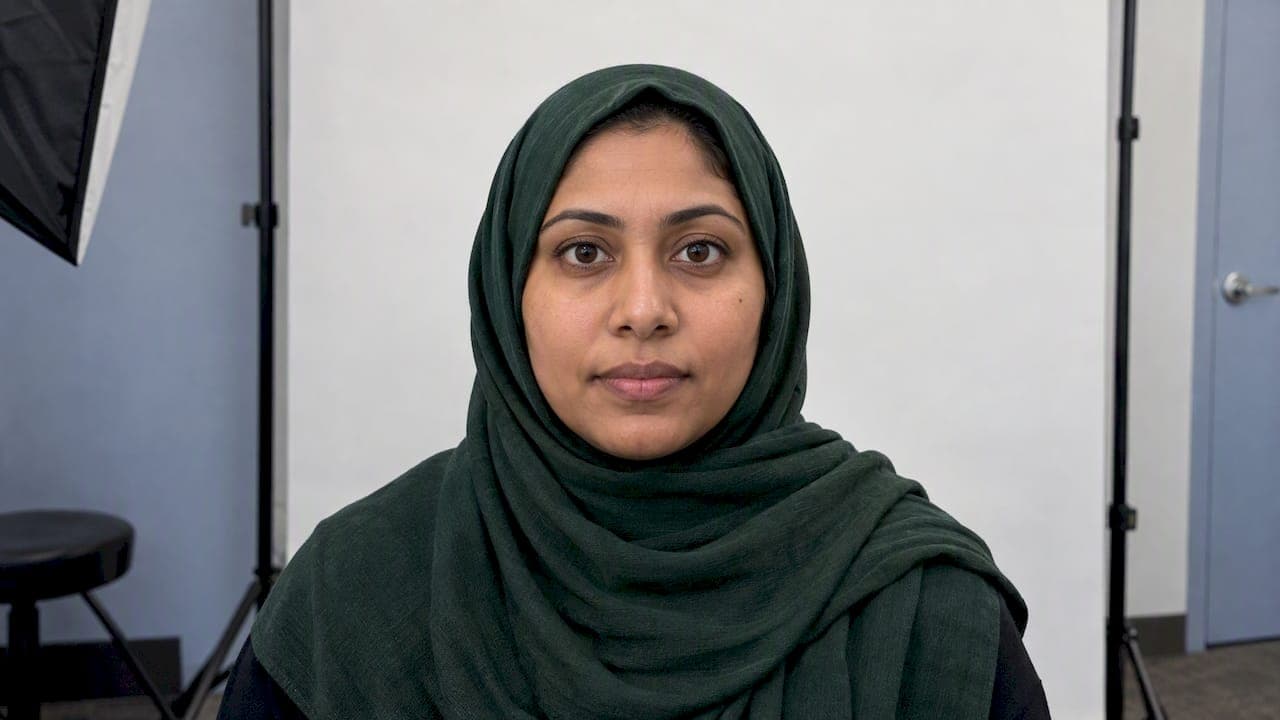
Yes, you can wear a hijab in a U.S. passport photo. The State Department allows head coverings worn for religious purposes, as long as you submit a signed statement saying the covering is religious attire you wear daily in public, and your full face stays visible. That means no shadows and nothing blocking your face. Here is exactly what that looks like in practice, what to write, and how to avoid the mistakes that get photos sent back.
TL;DR
- A hijab or headscarf is allowed in a U.S. passport photo when it is worn for religious purposes. Nonreligious head coverings are not.
- Include a signed statement that the covering is religious attire worn daily in public.
- Your full face must show, from chin to forehead, with no shadows or blocked areas. The covering cannot hide your chin or jaw line.
- Photos are the number one reason the Department puts applications on hold, so check yours before you submit.
- You can also request a formal religious accommodation with your application if another part of the process conflicts with your beliefs.
Table of Contents
- What the State Department actually allows
- The face rule: what must be visible
- The signed statement: what to write
- Religious accommodation requests
- Online renewal versus a paper application
- Common mistakes that get hijab photos rejected
- What about a photo taken years ago?
- Clothing and other details around the photo
- Our perspective
- Need your passport fast?
- FAQ
- Sources
What the State Department actually allows
The rule starts from a general ban. The Department's U.S. Passport Photos page tells applicants to remove hats and head coverings. It then makes an exception for a covering worn for religious purposes, provided you submit a signed statement saying it is religious attire worn daily in public. Medical head coverings are also permitted.

The Department's internal guidance goes into more detail. 8 FAM 402.1 lists scarves, turbans and large skullcaps among the head coverings that are prohibited unless worn for medical or religious purposes. It also says a religious covering may be accepted when you show it is connected to a sincerely held religious belief, not merely a philosophy or lifestyle, and that you wear it continuously in public.
In plain terms, two tests apply:
- Why you wear it. The reason must be religious (or medical). A fashion scarf, a winter hat or a head wrap worn for style does not qualify.
- How you wear it. It must be worn daily in public, so the photo reflects how people actually see you.
If you wear hijab, both tests describe your everyday practice, so the process is usually a matter of paperwork and framing, not of proving anything unusual.
The face rule: what must be visible
The most common reason a hijab photo fails is not the hijab itself. It is how the fabric sits on the face.
The Department requires your full face to be visible, with no shadows or parts of the face blocked (U.S. Passport Photos). Its internal guidance adds that a permitted covering must not partially or completely obscure the face, directly or through shadow, and must not obscure the chin or jaw line (8 FAM 402.1).
Here is what that means for a hijab, line by line:
- Forehead and hairline. Pull the fabric back far enough that your whole forehead shows. Fabric hanging low over the brow, or a thick folded edge that casts a shadow, is a problem.
- Both sides of the face. The fabric should frame your face, not cover your cheeks or ears' front edge so that the outline disappears. Keep both sides of the face clear.
- Chin and jaw. Fabric tucked up under the chin is fine only if it does not cover the chin or jaw line. If the pin or wrap sits high and hides the jaw, adjust it.
- Eyes. Both eyes must be open and visible. For online photos, the Department says to remove anything covering the face unless it is for a documented religious or medical reason, and both eyes must be open and visible (Uploading a Digital Photo).
- Shadows. Shadows count as blocking. A loose drape that falls forward, or lighting from above that darkens the fabric edge across your forehead, can fail a photo that looked fine to you.
The Department's digital-photo examples list a scarf blocking part of the face as unacceptable, and they show an accepted image with the full face visible and no clothing or shadows covering it. Use that as your picture of the target: a plain, evenly lit face with the hijab framing it neatly.
A quick pre-shot checklist
| Check | What you want to see |
|---|---|
| Forehead | Fully visible, no fabric shadow across it |
| Cheeks and sides of face | Clear, with the face outline visible |
| Chin and jaw line | Not covered by fabric or a pin |
| Eyes | Both open, visible, no glare or fabric overlap |
| Lighting | Even, with no dark folds casting shade on the face |
| Fabric | Pulled snug and settled, not drifting forward |
Take several shots and compare them on a large screen, not just on your phone preview.
The signed statement: what to write
The statement is the piece people forget, and its absence is a common reason a hijab photo draws questions. The State Department says to submit a signed statement saying that the head covering is religious attire worn daily in public (U.S. Passport Photos).
In ambiguous cases the Department may ask for more. According to 8 FAM 402.1, it can request a signed statement that explains:
- the religious nature of the headwear,
- whether and for how long you have worn it continuously in public, and
- how submitting a photo without it would substantially burden your religious exercise.
The safest approach is to write a statement that covers all three from the start, so there is nothing to follow up on. A simple version looks like this:
I, [full name], am submitting my passport application with a photo in which I wear a hijab. The hijab is religious attire connected to my sincerely held religious beliefs. I wear it daily in public and have done so continuously since [year]. Submitting a photo without it would substantially burden my religious exercise. Signed: [signature] Date: [date]
A few practical notes:
- Use your own words. Plain and brief is better than elaborate.
- Sign it. An unsigned statement is not what the Department asks for.
- Keep a copy for your records, and attach the original to your application as instructed on the form or in the instructions for your application type.
- Make sure the name on the statement matches the name on your application.
This is a statement from you, not a letter from a religious leader. The Department's published requirement is a signed statement from the applicant.
Religious accommodation requests
There is a separate, broader tool. The Department says applicants may request a religious accommodation when submitting a passport application, a right protected by the Religious Freedom Restoration Act (Passports and Religious Accommodations).
Such a request must include a signed statement explaining how and why your religious beliefs make a specific part of the application process difficult. It must also describe the religious activity or exercise involved and its connection to your beliefs.
For most hijab wearers, the standard head-covering statement is what applies to the photo. The accommodation route is worth knowing about if a different step conflicts with your practice, for example a requirement that is hard to meet for religious reasons. Be specific about which step and why.
Online renewal versus a paper application
The face rule is the same, but how you hand over the photo differs.
For online renewal, you upload a digital photo. The Department's Uploading a Digital Photo page says to remove anything covering your face unless it is for a documented religious or medical reason. If you wear hijab, follow the instructions on the online renewal pages for how to document that reason, and check them again on the day you apply, since the process can be updated.
For a paper application, you submit a printed photo with your form, and the signed statement goes in with it. If you are a first-time applicant or applying in person, ask the acceptance facility to confirm the statement is in the right place in your packet before you hand it over.
Either way, the photo itself has to meet all the standard technical rules beyond the head covering: size, background, expression and so on. Our U.S. passport photo size guide covers the measurements, and our guide on taking an accepted passport photo at home walks through lighting, background and framing, which matters a lot when you are trying to avoid shadows around a hijab.
Common mistakes that get hijab photos rejected
The Department says unacceptable photos are the number one reason it puts passport applications on hold (Uploading a Digital Photo). With a head covering, these are the problems we see described most often:
- No statement. The photo is fine, but nothing explains the covering.
- Shadows across the forehead. A thick fold or overhead light darkens the edge of the fabric.
- Fabric over the chin or jaw. A high wrap or a pin sitting on the jaw line hides part of the face outline.
- A loose drape. Fabric that drifts forward partly covers one eye or one side of the face.
- Wearing a nonreligious covering. A beanie or a fashion scarf is treated as a hat. Generally, nonreligious head coverings must be removed.
- Heavy editing. Brightening or smoothing to remove shadows can make the photo fail in other ways. Fix the lighting instead.
More general application errors are listed in our piece on 12 passport application mistakes that cause delays. If your application was held, read the notice carefully, fix the specific issue it names, and resubmit with a corrected photo and your statement. Do not guess at what was wrong.
What about the color of your hijab? The rules published by the Department focus on visibility of the face and shadows, not on a required fabric color. Even so, a solid, matte covering that contrasts with the background makes the face outline easier to see, which is the thing reviewers look at. Check the background requirements on the Department's photo page before you pick a spot.
What about a photo taken years ago?
If your current passport photo shows you without a hijab, you can submit a new one with it when you renew. The Department's test is how you look and dress daily in public, so a photo that matches your present appearance is the right one. Your signed statement can note how long you have worn it continuously.
If you started wearing hijab only recently, say so truthfully in the statement. The Department's guidance asks whether and for how long you have worn it, which means a shorter period is a fact to state, not a reason to hide anything.
Clothing and other details around the photo
Head covering is only one part of what shows in the frame. Collars, necklines and other clothing choices can also affect how the photo reads. Our guide to official passport photo clothing rules covers what to wear alongside your hijab. If you are applying for a child, see the infant passport photo guide for the extra considerations that come with young children.
Our perspective
We read the same State Department pages you do, and the honest summary is that hijab is not the obstacle people fear. The rule is built around one question: can an officer see your whole face and match it to you? Once you plan the photo around that question, the statement and the framing become routine.
What we see go wrong is not belief or documentation. It is small, avoidable things: a shadow from the fabric fold, a missing signed line, or a photo taken in a hurry the week before a trip. When time is short, a rejected photo costs more than the retake does.
That is why we write these guides in plain language and keep them tied to the official source pages. And when your travel date is close and a hold would cost you the trip, we point you toward registered passport courier services that handle expedited filing, so you are not gambling on the calendar.
David
Need your passport fast?
If your trip is close, the photo is only one of the things that can slow you down. PassportCenter is a free information resource: we explain the steps and timelines, and for urgent cases we connect you with registered expedited passport courier services. We do not process passports ourselves, and you can always apply directly through the government. Start at PassportCenter to see which route fits your timeline.
Before you pay for any expedited help, take your photo, write your statement and read your application once more. Those are the same steps whichever route you pick.
FAQ
Do I have to submit a statement if I wear hijab?
Yes. The State Department says to submit a signed statement saying the head covering is religious attire worn daily in public. In unclear cases it may ask you to explain the religious nature of the covering, how long you have worn it continuously and how a photo without it would burden your religious exercise. Cover those points in your first statement.
Can I wear a headscarf that is not religious?
Generally no. Nonreligious head coverings must be removed for the photo, and the Department's guidance lists scarves among the coverings prohibited unless worn for religious or medical reasons. If your scarf is worn for a religious reason, the signed-statement route applies.
How much of my face has to show?
Your full face must be visible, with no shadows or blocked areas. The covering cannot obscure your chin or jaw line. In practice, that means forehead, both sides of the face, chin and both eyes are all clear.
Does the rule change for online renewal?
The core rule does not: nothing may cover the face except an item worn for a documented religious or medical reason, and both eyes must be open and visible. Check the Department's online renewal pages for how to document the reason, since the process can change.
My photo with a head covering was rejected. What now?
Read the notice to see what the Department flagged. Then retake the photo with even lighting, the face fully visible, and your signed statement included, and resubmit. Checking against the Department's examples before you send it again saves another round of delay.
Sources
- U.S. Passport Photos, U.S. Department of State
- 8 FAM 402.1 Passport Photographs
- Uploading a Digital Photo, U.S. Department of State
- Passports and Religious Accommodations, U.S. Department of State