
If you're heading to parts of sub-Saharan Africa or South America, yellow fever vaccine requirements may determine whether you board your return flight or get turned away at the border. The CDC and WHO both recommend vaccination for travelers aged 9 months and older going to risk areas. Some countries go further and legally require proof of vaccination as a condition of entry. The proof is the International Certificate of Vaccination or Prophylaxis (ICVP), commonly called the "yellow card," and it only becomes valid 10 days after vaccination. This rule is set under the International Health Regulations (IHR) and is non-negotiable at most borders.
Before you book your flights, act on these three things:
- Get vaccinated at least 10 days before you arrive in any country that requires proof.
- Carry your original, stamped ICVP with your passport at all times during travel.
- Check your specific destination's entry rules, including any layover countries, through official embassy or CDC sources.
Table of Contents
- Who does the CDC recommend gets the yellow fever vaccine?
- How do country entry rules and the ICVP actually work?
- When should you get vaccinated, and do you need a booster?
- Who should not get the yellow fever vaccine?
- What side effects should you expect after vaccination?
- Where can U.S. travelers get the yellow fever vaccine?
- How to handle your ICVP before and during travel
- What are your options if you can't be vaccinated?
- Your pre-travel checklist before flying to a yellow fever risk area
- Key Takeaways
- The part most travelers get wrong about yellow fever prep
- Passportcenter helps you check your travel documents before you fly
- Useful sources for verifying yellow fever entry rules
Who does the CDC recommend gets the yellow fever vaccine?
The CDC and WHO recommend the yellow fever vaccine for anyone 9 months of age and older who is traveling to or living in areas with yellow fever risk in Africa and South America. That covers a broad range of travelers: tourists, business travelers, volunteers, and long-term residents alike.
Age matters more than most travelers realize. Here's how eligibility and special considerations break down:
| Age Group | Recommendation | Special Considerations |
|---|---|---|
| Under 6 months | Do not vaccinate | Absolute contraindication |
| 6–8 months | Vaccinate only if travel cannot be avoided | Higher risk of vaccine-associated encephalitis |
| 9 months and older | Routine vaccination recommended for risk-area travel | Standard eligibility |
| 60 years and older | Vaccinate with caution | Higher risk of rare serious adverse events |
| Pregnant | Avoid if possible; vaccinate if travel is unavoidable | Shared decision with clinician |
| Immunocompromised | Generally contraindicated | Clinician evaluation required |
Beyond age, several groups need individualized review before getting vaccinated. People who are pregnant, breastfeeding, moderately immunosuppressed, or who have a thymus disorder should discuss the decision with a clinician rather than walking into any pharmacy and requesting the shot. The same applies to anyone who has had a solid organ transplant or is on immunosuppressive therapy.
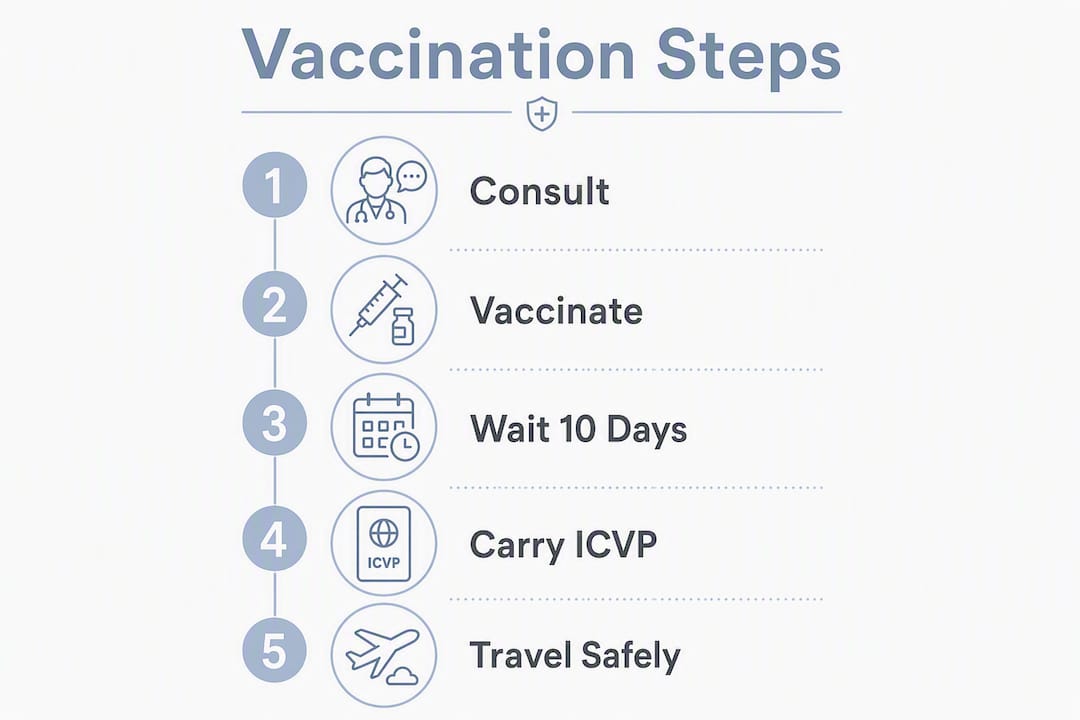
Pro Tip: Ask your travel medicine clinician for a documented risk/benefit discussion if you fall into any special-consideration group. That conversation, and any resulting waiver, should happen well before your departure date, not the week before you fly.
How do country entry rules and the ICVP actually work?
The ICVP is the official document recognized under the International Health Regulations as proof of vaccination. Think of it as a medical passport for your yellow fever shot. Without a valid, stamped ICVP, some countries will deny you entry outright, quarantine you, or vaccinate you on the spot at the port of entry.
There's an important distinction travelers often miss: a CDC or WHO recommendation to get vaccinated is a health advisory. A country's requirement for proof of vaccination is a legal condition of entry. You can ignore a recommendation. You cannot ignore a requirement without consequences.
"A required vaccine is one that travelers must have in order to enter a country, based on that country's regulations. Yellow fever, meningococcal, and polio vaccines may be required by certain countries." CDC Travelers' Health FAQ
Layovers are a frequently overlooked trigger. A brief airport transit through a country with yellow fever transmission risk can create a vaccination requirement for your final destination, even if you never leave the terminal. Plan your itinerary with this in mind.
How to confirm your destination's rules:
- Visit the CDC Travelers' Health country pages and search your destination
- Check the WHO's published country list for yellow fever vaccination requirements
If you arrive without a valid ICVP at a country that requires one, you face three possible outcomes: denial of entry and return to your origin, quarantine until the 10-day post-vaccination window passes, or on-site vaccination at the port of entry (which is not available everywhere and carries its own risks). Check for transportation and assistance options through VIP airport transfer services if you are medically vulnerable or require special support during your arrival.
The 10-day rule is fixed: Your ICVP becomes valid exactly 10 days after vaccination. No exceptions, no workarounds. If you get vaccinated on a Monday, your certificate is not valid until the following Thursday.
When should you get vaccinated, and do you need a booster?
Timing is straightforward once you know the rules. Get vaccinated at least 10 days before you arrive in a country that requires proof. The WHO reports that the vaccine provides immunity in approximately 95% of recipients within one week, but the ICVP validity clock starts at day 10 regardless.

On dosing: a single dose is sufficient for most people. The 2016 amendment to the International Health Regulations removed the booster requirement, and the WHO has confirmed lifetime validity of a single dose for the majority of recipients.
| Situation | Timing Guidance |
|---|---|
| Standard travel to risk area | Vaccinate ≥10 days before arrival |
| ICVP validity start | Day 10 after vaccination |
| Duration of protection | Lifetime for most people (single dose) |
| Booster consideration | Special populations, lab workers, outbreak zones |
A booster may be worth discussing with your clinician if you were vaccinated more than 10 years ago and are now traveling to an active outbreak zone, or if you work in a laboratory setting with yellow fever virus. Pregnant travelers vaccinated during pregnancy may also warrant re-evaluation. These are edge cases, not the norm.
Practical scheduling:
- Book your travel medicine appointment as soon as your itinerary is confirmed.
- If your trip is 3 weeks out, schedule immediately.
- If your trip is less than 10 days away, contact a travel clinic urgently. You may still be vaccinated, but your ICVP will not be valid for entry on arrival.
- Confirm the clinic can issue a stamped ICVP before you book the appointment.
Who should not get the yellow fever vaccine?
Some travelers should not receive this vaccine at all. Others need a careful clinical conversation before proceeding. Knowing which category you fall into before you book a travel clinic appointment saves time and could prevent a serious medical event.
Absolute contraindications (do not vaccinate):
- Infants under 6 months of age
- Severe immunosuppression (HIV with low CD4 count, active malignancy, chemotherapy, high-dose corticosteroids)
- Thymus disorder associated with abnormal immune function (e.g., thymoma, myasthenia gravis with thymectomy)
- Documented severe allergy to any vaccine component, including eggs
Precautions and higher-risk groups (vaccinate only after clinical review):
- Infants 6–8 months (elevated risk of vaccine-associated neurotropic disease)
- Adults 60 years and older
- Pregnant travelers
- Breastfeeding travelers
- Moderate immunosuppression
- Certain chronic conditions affecting immune response
Because serious adverse events can occur, the CDC advises clinicians to administer yellow fever vaccine only to people with a documented travel or entry requirement, or who are traveling to areas with established risk. CDC Healthcare Provider Guidance
For older adults, the calculus is genuinely difficult. WHO data shows that adults aged 60 and older face a higher frequency of rare but serious adverse events, including vaccine-associated viscerotropic disease and neurotropic disease. A clinician should weigh the actual risk of yellow fever exposure against the vaccine risk for each individual, not apply a blanket rule.
Pro Tip: If you have any of the conditions above, schedule a pre-travel consultation at least 4–6 weeks before departure. Clinicians who own the official stamp can also issue a medical waiver on the ICVP form, which you may need if vaccination is contraindicated.

What side effects should you expect after vaccination?
Most people tolerate the yellow fever vaccine well. Common reactions are mild and resolve within a few days.
Typical short-term side effects:
- Soreness, redness, or swelling at the injection site
- Low-grade fever
- Muscle aches (myalgia)
- Headache
- Fatigue lasting 5–10 days
Rare but serious events are a different matter. Two conditions warrant specific attention:
Vaccine-associated viscerotropic disease (YEL-AVD): A rare condition where the vaccine virus replicates in multiple organs, mimicking severe yellow fever infection. It carries a high fatality rate. Risk is elevated in adults over 60 and in people with thymus disorders.
Vaccine-associated neurotropic disease (YEL-AND): Inflammation of the brain or nervous system following vaccination. More common in infants under 6 months (which is why that age group is contraindicated) and in older adults.
Red flags requiring urgent care:
- High fever (above 103°F) within 2 weeks of vaccination
- Yellowing of the skin or eyes (jaundice)
- Severe headache or neck stiffness
- Confusion or altered mental status
- Difficulty breathing or chest pain
Monitor yourself for at least 30 days after vaccination. If you experience any red-flag symptoms, go to an emergency department and tell them you recently received the yellow fever vaccine. You or your provider can also report adverse events through the Vaccine Adverse Event Reporting System (VAERS).
Where can U.S. travelers get the yellow fever vaccine?
The yellow fever vaccine is not available at every pharmacy or doctor's office. Only designated vaccination centers authorized by state health departments can administer the vaccine and issue a valid, stamped ICVP. This is a legal requirement, not a formality.
Where to look:
- Certified travel medicine clinics: The most reliable option. These clinics specialize in pre-travel health and are equipped to issue the ICVP with the required uniform stamp.
- Some pharmacies: Walgreens operates travel health clinics at select locations that offer the yellow fever vaccine and can issue the ICVP. Availability varies by state and location, so call ahead.
- Local and state health departments: Many county health departments are authorized vaccination centers. Check your state health department's website for a list.
- University and hospital travel medicine clinics: Academic medical centers often run dedicated travel health programs with full ICVP stamping capability.
To find an authorized center near you, use the CDC's directory of yellow fever vaccination clinics or contact your state health department directly.
Booking tips:
- Schedule your appointment at least 4 weeks before travel to allow time for the 10-day validity window.
- Confirm the clinic holds the official stamp before you book.
- Bring a valid photo ID, your passport (if available), and a list of current medications and medical conditions.
- Ask the clinic to complete your ICVP on the day of vaccination and verify the stamp is applied before you leave.
Pro Tip: When you arrive at the clinic, ask directly: "Are you an authorized yellow fever vaccination center with the official uniform stamp?" A legitimate center will confirm this without hesitation. If they seem uncertain, find another provider.
How to handle your ICVP before and during travel
Your ICVP is a legal document. Treat it the way you treat your passport, because at some borders, it matters just as much.
How the ICVP is completed:
- The administering clinician fills in your name, date of birth, vaccine details, and date of vaccination.
- The clinician applies the official uniform stamp of the vaccination center. Without this stamp, the document is not valid for entry purposes.
- The clinician signs the certificate.
- You receive the original booklet. Keep it.
Carrying your ICVP safely:
- Keep the original ICVP with your passport in your carry-on bag, not checked luggage.
- Make a photocopy and store it separately (in your checked bag or with a trusted contact at home).
- Consider a photo of the completed ICVP on your phone as a backup reference, but know that most border officials require the original.
- For guidance on carrying original travel documents safely, see Passportcenter's advice on passport handling during travel.
If you lose your ICVP before travel:
- Contact the clinic that administered your vaccine immediately.
- The clinic can issue a replacement stamp on a new ICVP form if they have records of your vaccination.
- If records are unavailable, re-vaccination may be necessary.
- Do not attempt to travel to a country requiring proof without a valid, stamped ICVP.
Your ICVP is valid beginning 10 days after your primary vaccination and, for most people, carries lifetime validity under current IHR rules. There is no expiration date to track for standard travelers.
What are your options if you can't be vaccinated?
If a medical contraindication prevents you from receiving the yellow fever vaccine, you have limited but real options. None of them guarantee entry. That's the honest truth.
Medical waivers:
A clinician who holds the official stamp can issue a medical waiver using the ICVP form. The waiver documents your contraindication and is signed and stamped by the clinician. However, acceptance of a medical waiver is entirely at the discretion of the destination country's border authorities. Some countries accept them routinely. Others do not.
Steps to take if you need a waiver:
- Get a written medical waiver on the official ICVP form from a stamp-holding clinician.
- Contact the destination country's embassy or consulate in the U.S. and ask explicitly whether they accept medical waivers. Get the answer in writing if possible.
- If the embassy cannot confirm acceptance, seriously consider changing your itinerary or destination.
- Purchase comprehensive travel insurance that covers medical evacuation, since you will also be unprotected against the disease itself.
- If you proceed, use strict mosquito-avoidance measures: DEET-based repellents, permethrin-treated clothing, and staying in screened or air-conditioned accommodations.
On-site vaccination at entry:
Some ports of entry offer vaccination on arrival for travelers without proof. This is not universally available, and it creates a problem: you will not be protected for 10 days after that shot, and you may still be denied entry or quarantined during that window.
Checklist for travelers with contraindications:
- Obtain a signed, stamped medical waiver from an authorized clinician.
- Get written confirmation from the destination embassy on waiver acceptance.
- Carry documentation of your medical condition (doctor's letter, medical records summary).
- Purchase travel insurance with medical evacuation coverage.
- Pack and plan for rigorous mosquito protection throughout your trip.
Your pre-travel checklist before flying to a yellow fever risk area
Getting this right is a sequencing problem. Do things in the wrong order and you either miss the 10-day window or arrive without valid documentation.
6+ weeks before departure:
- Confirm whether your destination (and any transit countries) requires proof of yellow fever vaccination.
- Book a travel medicine consultation at an authorized vaccination center.
- Review your medical history for any contraindications.
4–6 weeks before departure:
- Get vaccinated and receive your stamped ICVP.
- Verify the stamp is on the certificate before leaving the clinic.
- Note your ICVP validity start date (10 days after vaccination).
1–2 weeks before departure:
- Confirm your ICVP is valid (day 10 has passed).
- Make a photocopy of your ICVP and passport.
- Check the Mobile Passport Control app for any updates on U.S. re-entry documentation.
Travel day:
- Pack your original ICVP in your carry-on with your passport.
- Have your ICVP accessible for inspection at check-in and at the destination border.
- Know the name and contact of your travel medicine clinic in case questions arise at the border.
Key Takeaways
Travelers to yellow fever risk areas in Africa and South America need a single dose of the vaccine at least 10 days before arrival, a stamped ICVP as proof, and confirmation of their destination's specific entry rules before departure.
| Point | Details |
|---|---|
| ICVP validity timing | Your yellow card becomes valid exactly 10 days after vaccination — plan accordingly. |
| Single dose is sufficient | One dose provides long-lasting protection for most people; boosters are no longer required under IHR rules. |
| Layovers count | A transit stop in a risk country can trigger proof requirements for your final destination. |
| Waivers are not guaranteed | Medical waivers exist but acceptance is at each country's discretion — confirm with the embassy first. |
| Passportcenter | Use Passportcenter to check country-specific entry rules and travel document requirements before you fly. |
The part most travelers get wrong about yellow fever prep
Most travelers focus on whether they need the vaccine. The smarter question is whether their documentation will hold up at the border. The ICVP is not a formality. It is a legal instrument under international health law, and a missing stamp or a certificate issued by an unauthorized clinic can get you turned away even if you are genuinely vaccinated.
The age-related risk question also gets underplayed. Travelers over 60 are often the most motivated to visit remote destinations in Africa and South America, and they are also the group facing the highest risk from rare but serious vaccine-associated events. That is not a reason to avoid vaccination. It is a reason to have a real conversation with a travel medicine clinician rather than walking into a pharmacy and asking for the shot without context.
The other thing worth saying plainly: medical waivers are a last resort, not a travel strategy. If you have a contraindication, the right move is to confirm with the destination embassy before you book, not after. Some countries will not let you in without proof, full stop, regardless of what your doctor has written.
Prepare the paperwork the same way you prepare your passport. Early, carefully, and with the original in your carry-on.
Passportcenter helps you check your travel documents before you fly
Sorting out yellow fever vaccination is one piece of a larger pre-travel document puzzle. Passportcenter gives U.S. travelers a free, plain-language resource to check country-specific entry requirements, passport validity rules, and travel document checklists, all in one place. Instead of piecing together embassy websites and CDC country pages separately, you get a clear picture of what you need before your departure date.
Whether you're confirming visa requirements, checking if your passport has enough validity for your destination, or reviewing what documents to carry alongside your ICVP, Passportcenter has the guidance you need. Head to PassportCenter.ai now and run through the travel document checklist for your specific itinerary before you book your travel clinic appointment.
Useful sources for verifying yellow fever entry rules
Use these official sources to confirm requirements for your specific itinerary. Embassy and consulate pages are the final legal authority on entry rules; CDC and WHO pages give the health guidance and country lists.
| Source | What to look for |
|---|---|
| CDC Yellow Fever Vaccine page | Vaccine recommendations, age guidance, and clinic finder |
| CDC ICVP page | ICVP validity rules, stamping requirements, and waiver guidance |
| CDC Country-by-Country Yellow Fever & Malaria Info | Entry requirements and health recommendations by destination |
| CDC Travelers' Health FAQ | Quick answers on required vs. recommended vaccines |
| WHO Yellow Fever page | Global health guidance, outbreak updates, and single-dose policy |
| WHO Country Vaccination Requirements List | Official list of countries requiring proof of vaccination |
| Destination country's embassy or consulate (U.S.-based) | Legally binding entry rules, waiver acceptance, and transit requirements |
This article provides general travel health information and is not a substitute for professional medical advice. Confirm current vaccination requirements with the destination country's embassy and consult a qualified travel medicine clinician before your trip.