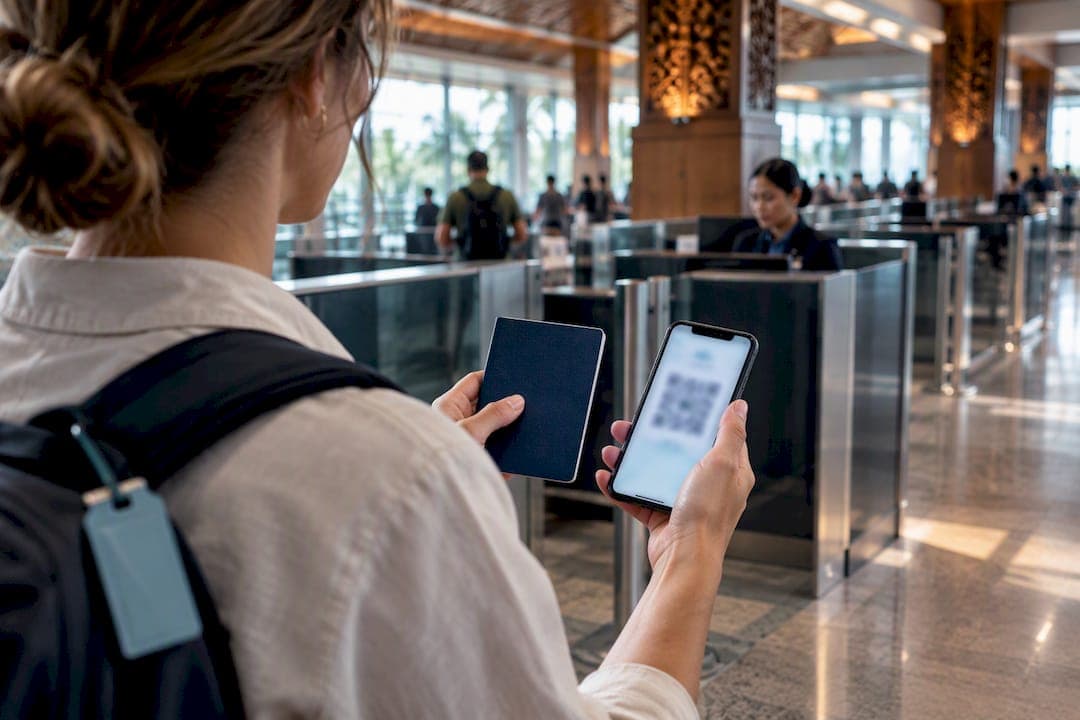
Yes, U.S. citizens need a visa to enter Indonesia. There is no visa-free option for American passport holders. Most travelers use either the Visa on Arrival (VoA), the electronic version of it (e-VoA), or a 30-day e-Visa purchased before departure, and all three let you visit for tourism without pre-clearance from an embassy. A 60-day e-Visa is available if you're staying longer. The right choice depends on how long you're staying and how much queue time you want to avoid at the airport.
TL;DR:
- US citizens cannot enter Indonesia visa-free and must choose between a Visa on Arrival, e-VoA, or a 60-day e-Visa based on trip length and convenience.
- Applying for the e-VoA online before departure offers a faster airport experience and costs the same as purchasing it upon arrival, roughly $35.
- The 60-day tourist e-Visa costs about three times the short-stay fee and can be extended once for an additional 30 days; purpose-specific visas require extra documentation and longer processing times.
- Passport validity must extend at least six months beyond the arrival date, with at least two blank visa pages; early checks prevent rejection at application or entry.
- Overstaying or entering Indonesia on the wrong visa carries heavy fines, deportation risk, and future entry bans, making timely application and proper categorization essential.
Table of Contents
- What Visa Options Do US Citizens Have for Indonesia?
- How Much Does an Indonesia Visa Cost for US Citizens?
- How Do You Apply for an Indonesia Visa From the US?
- What Happens at Indonesian Immigration on Arrival?
- Can You Extend an Indonesia Visa, and What Happens if You Overstay?
- What Health and Insurance Precautions Should You Take?
- Should You Enroll in STEP Before Traveling to Indonesia?
- How This Guide Was Built
- Are Any Travelers Exempt From Indonesia's Visa Requirement?
- What Purpose-Specific Visas Exist Beyond Tourism?
- Are There Current COVID-19 Entry Requirements for Indonesia?
- What If You Leave and Return to Indonesia on the Same Visa?
- Do Transit Passengers Need a Visa for Indonesia?
- What Are the Most Common Reasons Indonesia Visa Applications Get Rejected?
- What's the Smartest Way to Handle an Indonesia Visa Application?
- Get Your Passport Ready Before You Worry About Indonesia's Visa
- Sources
- FAQ
What Visa Options Do US Citizens Have for Indonesia?
The Visa on Arrival is exactly what it sounds like: you land in Indonesia, walk to a counter or kiosk, pay the fee, and get a sticker or stamp in your passport. It covers a 30-day stay and works for tourism, family visits, and general sightseeing. The catch is the line. At Bali's Ngurah Rai Airport during peak season, VoA counters can back up fast, especially right after a wave of international flights lands at once.
That's where the e-VoA comes in. It's the same visa, same 30-day validity, same fee, but you apply online before you fly and get a QR code you show at immigration instead of standing in the payment line. Most travelers who've done both say the e-VoA cuts arrival time significantly. State Department's Indonesia travel guidance, the e-VoA can be extended once for an additional 30 days at a local immigration office, giving you up to 60 days total if needed.
If you already know you'll be in Indonesia longer than 30 days, skip the extension hassle and apply for the 60-day tourist e-Visa directly. This category suits travelers planning extended stays, digital nomads testing out Bali for a couple of months, or anyone attending a longer series of business meetings that don't involve local paid work. Some business e-Visa categories also fall under this longer-duration umbrella, though they carry different documentation requirements than straight tourism.

One rule trips up more travelers than any other: none of these visas permit paid employment or speaking engagements inside Indonesia. If you're flying in for a conference where you're getting paid to speak, or you plan to do remote-adjacent work for a local employer, a tourist e-Visa is the wrong instrument, even if the paperwork looks similar.
Here's how the main options break down:
- Visa on Arrival (VoA): Purchased at the airport, 30-day validity, cash or card at the counter.
- e-VoA: Same 30-day validity, applied for online in advance, QR code scanned on arrival.
- 60-day tourist e-Visa: Applied for online, longer validity, one-time extension possible in some cases.
- Purpose-specific e-Visas: Cover business meetings, social visits, and other non-tourism categories with distinct rules.
Pick based on trip length and how much you value skipping a line. If you're staying under 30 days and want the fastest airport experience, the e-VoA usually wins.
How Much Does an Indonesia Visa Cost for US Citizens?
The standard e-VoA fee is IDR 500,000, which works out to roughly $35, though the exact dollar figure shifts with the exchange rate on any given day. The 60-day tourist e-Visa runs IDR 1,500,000, about triple the short-stay fee, which makes sense given the doubled validity window. Specialized business or purpose-specific e-Visas commonly range higher still, often IDR 2,000,000 to IDR 3,000,000 or more, depending on the category and duration.
Fee Snapshot: e-VoA / 30-day visa: IDR 500,000 (~$35). 60-day tourist e-Visa: IDR 1,500,000. Bali tourism levy: IDR 150,000 per person, paid separately from any visa fee.
If Bali is on your itinerary, budget for one more charge that catches first-time visitors off guard: the Bali tourism levy of IDR 150,000 per person. This isn't a visa fee. It's a separate provincial charge that every visitor to Bali pays, and you can settle it online in advance or at designated counters on arrival.
A few practical notes on payment:
- Pay through the official e-Visa portal directly. Third-party sites often add markup fees for a service you can complete yourself in minutes.
- Your visa confirmation and receipt arrive by email. Print or save a digital copy before you fly.
- Currency conversion fluctuates daily, so treat the dollar figures as estimates, not fixed prices.
How Do You Apply for an Indonesia Visa From the US?
Start at the official e-Visa portal run by Indonesian immigration. This is the only site you need. Skip any third-party service that charges a premium to submit the same form on your behalf.
Here's the process from start to finish:
- Create an account on the official e-Visa portal using a valid email address.
- Select your visa category: e-VoA (30 days), 60-day tourist e-Visa, or a purpose-specific option if you're traveling for business or another qualifying reason.
- Enter your travel details, including arrival date, port of entry, and accommodation address in Indonesia.
- Upload required documents: a digital passport photo, a scan of your passport's biodata page, and proof of onward or return travel.
- Pay the applicable fee through the portal's secure payment gateway.
- Download your approved e-Visa once processing completes, and keep both a digital and printed copy.
Most tourist e-Visa applications process within about 5 working days when your documents are complete and legible. If you haven't heard back after a week, check your spam folder before assuming something's wrong. Approved e-Visas are emailed to the registered address, and delays usually trace back to a blurry photo upload or a mismatched passport number.
Before you even open the application, check your passport. Indonesian immigration requires your passport to be valid for at least six months from your arrival date, with at least two truly blank visa pages. The endorsement page at the back of your passport does not count as a blank page. If you're running close to that six-month mark, this is the moment to check passport validity rules before booking anything.
One more detail that trips up otherwise well-prepared travelers: your e-Visa has to be used within 90 days of the date it's issued. That's not the length of your stay. It's the window during which you must actually arrive in Indonesia. Apply too far in advance of your trip and you risk the visa expiring before you ever board the plane.
Pro Tip: Apply for your e-Visa about two to three weeks before departure. That gives you a buffer for the 5-day processing window plus time to fix a rejected photo or document without scrambling right before your flight.
What Happens at Indonesian Immigration on Arrival?
If you didn't pre-purchase an e-VoA, you'll buy your Visa on Arrival at a dedicated counter before reaching the immigration desks. These lines move, but they move slower than the e-VoA lane, particularly at Bali's airport during high season when several wide-body flights land within the same hour.
Before or shortly after arrival, you also need to complete Indonesia's digital arrival card, known as the e-CD. This generates a QR code immigration officers scan at the checkpoint. Timing matters here: the e-CD cannot be created more than 72 hours before your arrival, so filling it out too early just means it won't be valid yet. Forgetting it entirely, or showing up without the QR code ready, is one of the most common causes of arrival delays.
At the immigration desk, officers typically check:
- Your passport's biodata page and remaining validity
- Your visa stamp or e-Visa QR code
- Proof of onward or return travel
- That you have the required blank visa pages available
Travelers who've gone through both airports report Jakarta's Soekarno-Hatta immigration lines as generally faster outside of peak holiday travel, while Bali's Ngurah Rai gets congested with tourist traffic almost year-round. Neither is difficult to navigate if your paperwork is in order and your e-CD QR code is pulled up before you reach the counter.
Can You Extend an Indonesia Visa, and What Happens if You Overstay?
You can extend a 30-day VoA or e-VoA once, for an additional 30 days, by applying at a local immigration office before your current visa expires. The extension fee runs roughly the same as the original visa fee, around IDR 500,000. This gives you a maximum of 60 days on the short-stay track without switching visa categories entirely.
The 60-day tourist e-Visa follows a different path. Depending on your circumstances, converting to a longer-term stay permit may be possible, but that typically requires working with a local immigration office or a visa agent well before your current visa lapses, not after.
Overstaying is where things get genuinely serious. Indonesian immigration enforces overstay fines of roughly IDR 1,000,000 per day, and prolonged or repeated overstays can lead to deportation and future entry bans. This isn't a soft policy. Officers apply it consistently at exit points.
If you realize you've overstayed unintentionally:
- Go to the nearest immigration office immediately, don't wait until your departure date.
- Bring your passport, visa documentation, and be ready to pay the accumulated fine in cash.
- Contact the U.S. Embassy for a list of local resources, though understand they cannot waive Indonesian fines or resolve the overstay for you.
What Health and Insurance Precautions Should You Take?
The CDC maintains destination-specific health notices for Indonesia, and these notices shift based on regional disease activity, so check them close to your departure date rather than months in advance. Region-specific alerts occasionally apply to particular islands or provinces, and the CDC page is the most current source for that detail.
Travel insurance matters more in Indonesia than in many destinations, mainly because of geography. If you're injured on a remote island or in a rural part of Sumatra or Kalimantan, the nearest hospital equipped to handle serious trauma might be hours away by boat or plane. Insurance that includes medical evacuation coverage, not just standard trip cancellation, is worth the extra premium for exactly this reason.
Before you go:
- Confirm your routine vaccinations are current and check the CDC page for any destination-specific recommendations.
- Buy travel insurance that explicitly names medevac and international hospital coverage, not just baggage loss.
- Pack a basic first-aid kit and any prescription medications in their original labeled containers.
Pro Tip: Photograph your insurance policy's emergency contact number and save it in your phone before you leave, not after you need it. Cell service in remote parts of Indonesia can be spotty, and you don't want to be searching for a PDF at 2 a.m.
Should You Enroll in STEP Before Traveling to Indonesia?
Yes. The U.S. Embassy in Jakarta actively recommends every U.S. citizen enroll in the Smart Traveler Enrollment Program, known as STEP, before arriving in Indonesia. Enrollment is free and takes about ten minutes. In exchange, you get direct alerts about natural disasters, civil unrest, or safety advisories specific to the regions you've listed on your itinerary, sent straight to your phone or email.
This matters more in Indonesia than in many countries because of its earthquake and volcanic activity. STEP enrollment means you're not relying on hotel Wi-Fi and word of mouth to find out about a regional evacuation order.
The embassy and its consular offices can help with:
- Emergency limited-validity passport replacement if yours is lost or stolen
- Contacting family members during a crisis
- General safety guidance and referrals to local resources
What the embassy cannot do matters just as much. It cannot resolve a visa overstay, waive an immigration fine, or intervene with local law enforcement on your behalf. If your legal issue is with Indonesian immigration, that's a matter for Indonesian authorities, not U.S. consular staff. If you're facing an emergency, contact the embassy's after-hours line immediately and keep a printed copy of your passport separate from the original.
How This Guide Was Built
This guide draws on primary sources rather than secondhand summaries. Fee figures, processing times, and visa validity windows come directly from Indonesia's official e-Visa portal, the U.S. State Department's Indonesia travel advisory, the U.S. Embassy in Jakarta, and the CDC's destination health notices.
This site provides information about U.S. passport eligibility, renewal timelines, application steps, and country-specific entry requirements, including e-Visa processes like Indonesia's, with clear explanations of fees and documents.
This piece was researched and written by David, drawing on the official immigration and government sources linked throughout. Every fee and processing time cited here traces back to a government page, listed again in the sources section below for quick verification.
Are Any Travelers Exempt From Indonesia's Visa Requirement?
No exemption applies to U.S. passport holders. Indonesia's visa-free entry program covers a specific list of countries, and the United States isn't on it. This surprises some travelers because Indonesia does offer visa-free access to nationals of several ASEAN member countries and a handful of others for short social or tourism visits, which leads to confusion when Americans see conflicting information online.
The distinction matters because visa-free and Visa on Arrival get used interchangeably in casual conversation, but they're different mechanisms. Visa-free means no visa and no fee, granted to a specific list of passport nationalities for stays typically capped at 30 days with no extension option. VoA and e-VoA both require a fee and an active application or arrival purchase, and they're the mechanisms available to U.S. citizens.
If you're traveling with a companion who holds a passport from a visa-exempt country, don't assume the same rules apply to you. Immigration checks passports individually, and mixed-nationality groups often get separated at the counter simply because one traveler has a different visa pathway than another. Double-check your specific passport's status on the official e-Visa portal rather than relying on general Southeast Asia travel advice, since exemption lists change and Indonesia updates its policy periodically.
What Purpose-Specific Visas Exist Beyond Tourism?
Tourism is only one lane. Indonesia's e-Visa system includes several purpose-specific categories, each with its own eligibility rules and restrictions that matter if your trip involves anything beyond sightseeing.
Business visas cover attending meetings, negotiations, or site visits where you're not receiving payment from an Indonesian source. This is not a work visa. If money changes hands for services rendered in Indonesia, you need a different category entirely.
Social/cultural visas suit longer visits tied to cultural exchange, volunteer work without pay, or extended family visits, typically requiring a sponsoring individual or organization inside Indonesia.
Work visas (KITAS-related permits) are a separate, more involved process from any e-Visa category. They require a sponsoring employer, a work permit from Indonesia's Ministry of Manpower, and typically take weeks rather than days to process. Nobody should attempt to work in Indonesia on a tourist or business e-Visa; immigration treats this as a serious violation.
Student visas apply to enrollment at an Indonesian educational institution and require sponsorship documentation from that school, plus proof of enrollment.
The common thread across every non-tourism category: they require sponsorship, additional documentation, and longer processing windows than the straightforward tourist e-Visa. If your trip has any professional or educational component, verify your category before booking flights, since misclassifying your visit is a fast track to entry denial or fines later.
Are There Current COVID-19 Entry Requirements for Indonesia?
As of 2026, Indonesia has removed its COVID-19 specific entry requirements for international travelers, including U.S. citizens. There's no vaccination proof, testing requirement, or health declaration tied specifically to COVID-19 required for entry at this time.
That said, travel health situations change, sometimes quickly. The most reliable way to confirm current status before you fly is checking the CDC's Indonesia travel health notices page directly, since it reflects the most current guidance rather than information that might be months out of date on a travel blog or forum post.
General health documentation still applies regardless of COVID-19 status. If you're arriving from a country with yellow fever transmission risk, Indonesia may require proof of vaccination, a rule that predates the pandemic and remains in effect independently. Check yellow fever vaccine requirements if your itinerary includes a layover or prior stop in an affected region, since transit through certain countries can trigger this requirement even if your final destination wouldn't otherwise require it.
What If You Leave and Return to Indonesia on the Same Visa?
Leaving Indonesia mid-trip and planning to return complicates things more than most travelers expect. A standard 30-day VoA or e-VoA is a single-entry visa. Once you exit Indonesia, whether for a quick trip to Singapore or a day excursion across a border, that visa is used up. Re-entering requires a fresh VoA, e-VoA, or e-Visa application, along with a new fee payment.
This catches travelers doing regional Southeast Asia itineraries off guard, particularly those hopping between Bali, Singapore, and Malaysia on a single trip. If your itinerary includes leaving Indonesia and coming back, budget for a second visa fee rather than assuming your original visa covers re-entry.
Multiple-entry visas exist for specific purposes, mostly tied to business categories with legitimate ongoing commercial activity in Indonesia, but they require a distinct application process and aren't available through the standard tourist e-VoA or 60-day tourist e-Visa pathways. If your trip genuinely requires multiple entries within a single visa period, that's a conversation to have with the e-Visa portal's business visa category or a local immigration office before you depart, not something to sort out mid-trip.
Do Transit Passengers Need a Visa for Indonesia?
If you're staying within the international transit area of an Indonesian airport and not passing through immigration, you typically do not need a visa. This applies to travelers connecting between international flights without leaving the sterile transit zone.
The moment you clear immigration, even briefly, to collect checked luggage and recheck it, or to leave the airport for any reason during a layover, you're treated as entering Indonesia and the same visa rules apply as any other arrival. Some connecting itineraries force this because certain airports don't offer transit baggage handling between separate airlines, so check your specific routing before assuming you can skip visa paperwork.
If your layover is long enough that you want to explore, or your flights require re-checking luggage through immigration, apply for a standard e-VoA the same way you would for a full visit. There's no dedicated short-transit visa category for U.S. citizens passing through Indonesian airports outside the standard sterile transit zone.
What Are the Most Common Reasons Indonesia Visa Applications Get Rejected?
Blurry or non-compliant passport photos top the list. The e-Visa portal has specific formatting requirements, and a photo taken on a phone with poor lighting or an incorrect background frequently gets bounced back for resubmission, adding days to your timeline.
Insufficient passport validity is the second most common issue. Remember, Indonesia requires six months of validity from your arrival date, not from your application date. If you apply with five months and twenty days remaining, expect a rejection even though it looks close enough on paper.
Missing blank passport pages causes more denials than travelers expect, largely because people forget the endorsement page at the back doesn't count. If you're down to your last blank page, renew before applying, not after.
Mismatched information between your passport and your application, even something as small as a middle name entered inconsistently, triggers manual review and delays. Double-check every field against your passport's biodata page character for character before submitting.
Finally, applying for the wrong visa category causes rejections or, worse, approval followed by denial at immigration. If your trip involves any paid activity, sponsorship, or extended stay beyond tourism, apply for the matching category rather than defaulting to the standard tourist e-Visa because it's the fastest option to complete online.

What's the Smartest Way to Handle an Indonesia Visa Application?
Pre-purchase your e-VoA whenever your travel dates are firm. It's the same price as the airport version, skips the arrival line entirely, and locks in your visa category before you've even boarded the plane. Verify you have at least two genuinely blank passport pages and six-plus months of validity before you start the application, not after a rejection notice.
If your trip runs longer than 30 days, or involves anything beyond straightforward tourism, apply for the 60-day e-Visa or the correct purpose-specific category before departure rather than counting on a local extension to bail you out. Extensions add cost, require an in-country immigration office visit, and eat into vacation time you'd rather spend at the beach.
Enroll in STEP the same week you book your flights. It takes ten minutes and costs nothing.
One habit worth building: photograph your passport's biodata page and your approved e-Visa, then email both to yourself before you leave home. If your physical documents get lost or damaged mid-trip, having a digital backup you can access from any device saves hours of frustration at an immigration office that doesn't move quickly under pressure.
— David
Get Your Passport Ready Before You Worry About Indonesia's Visa
A rejected Indonesia e-Visa application over a bad photo or a passport with too little validity left is a fixable problem, if you catch it early enough. Passportcenter.ai exists to help you catch it early. The site walks through passport eligibility, renewal timelines, and the exact document standards countries like Indonesia require, in plain language, before you're staring down a five-day processing window with a flight already booked.
If your passport is getting close to that six-month validity cutoff, or you're not sure how many blank visa pages you actually have left, that's worth checking now rather than during your e-Visa application. Passportcenter.ai's guides cover exactly this, including a full breakdown of expired passport travel rules for anyone cutting it close. For travelers on a tight timeline, whether you're renewing before a last-minute trip or replacing a lost passport, the site also connects you with vetted expedited courier partners who handle the paperwork faster than standard State Department processing. Start by checking your passport's status against Indonesia's requirements at Passportcenter.
Sources
FAQ
Do I need a visa to enter Indonesia with a US passport?
Yes. U.S. citizens need a visa for every entry into Indonesia, regardless of trip length. Most travelers use a Visa on Arrival, an e-VoA, or a 30 or 60-day e-Visa depending on how long they plan to stay.
How much is the Indonesia visa fee for US citizens?
The standard e-VoA or Visa on Arrival costs IDR 500,000, roughly $35 depending on the exchange rate. The 60-day tourist e-Visa costs IDR 1,500,000, and Bali visitors pay an additional IDR 150,000 tourism levy separate from either fee.
Is it better to get a Bali visa online or on arrival?
Getting the e-VoA online before you fly is generally the better choice. It costs the same as the arrival version but skips the payment counter, which can mean a long wait at Bali's airport during peak travel periods.
How do I apply for an Indonesian visa from the US?
Apply through the official Indonesian e-Visa portal by creating an account, selecting your visa category, uploading your passport photo and biodata page, and paying online. Most applications process within about 5 working days when documents are complete, and your approved visa arrives by email.
What passport requirements apply for an Indonesia visa?
Your passport needs at least six months of validity from your arrival date and a minimum of two genuinely blank visa pages, not counting the endorsement page. Checking these details before applying, using a resource like Passportcenter.ai's passport validity guide, helps you avoid a rejected application.