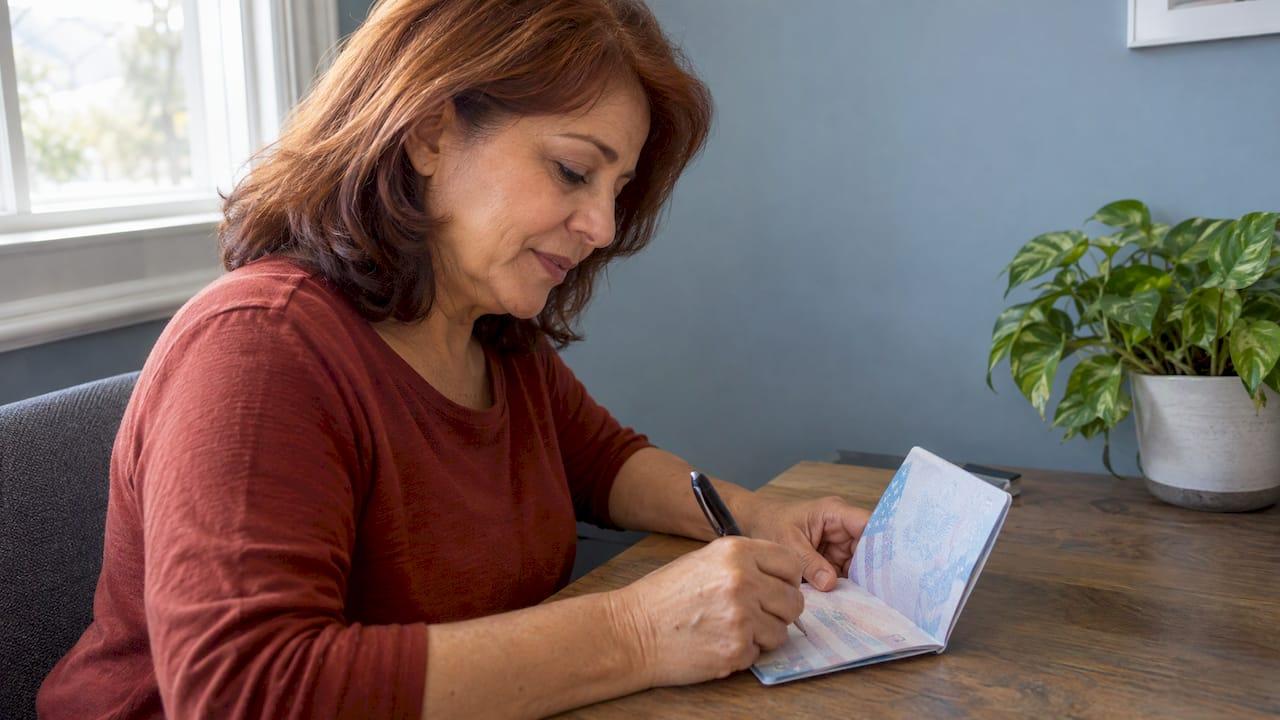
Sign your passport book as soon as it arrives, in blue or black ink, on the signature line inside the book. The State Department says you must sign your full name in blue or black ink inside your passport, and a passport book is valid only when it is signed. An unsigned book can be refused at the airline counter or the border. This guide covers where to sign, what to do about your middle name, how a parent signs for a child, and how to handle a mistake without making it worse.
TL;DR
- A U.S. passport book is not valid until the bearer signs it. A passport card is valid without the bearer's signature.
- Use blue or black ink and sign inside the signature line, to the right of your photo. Do not write anywhere else.
- Sign the way you normally sign. The State Department asks for your full name, and no rule in the regulation sets a middle name format.
- For a child under 16, a parent prints the child's full name, signs their own name next to it, and prints the relationship (mother, father, or guardian).
- Never cross out, erase, or write over a signature. Call the National Passport Information Center first.
Table of Contents
- Is a U.S. passport valid without a signature?
- Where to sign and what ink to use
- Passport signature rules for your name: middle names and everyday signatures
- How to sign a child's passport
- If you cannot sign because of a disability
- What to do if you sign it wrong
- How closely do officers check the signature?
- A quick checklist when your passport arrives
- Need a passport fast after a signing mistake?
- FAQ
- Sources
Is a U.S. passport valid without a signature?
No, not the passport book. The federal rule on passport validity, 22 CFR § 51.4, says a passport book is valid only when signed by the bearer in the designated space. If the bearer cannot sign, a person with legal authority signs instead. The same rule says a passport card is valid without the bearer's signature.
The practical risk is at the point of checking. LegalClarity notes that airlines are financially responsible for passengers who arrive without valid documents. Border officers may send an unsigned book to secondary screening, although some will let you sign on the spot. You do not want to find out which kind of officer you get with a connecting flight at stake.
So treat the signature as part of receiving your passport, in the same minute you check that your name and date of birth are correct. If you are still waiting on the book, the common application errors are worth reading first: our guide to 12 passport application mistakes that cause delays lists them.

Where to sign and what ink to use
Find the signature line
The State Department says the line to sign your name is to the right of your passport photo, on the inside of the book. It is labeled for the bearer's signature. Sign only in that space. Do not sign on the cover, on the photo page outside the line, or on a visa page. Do not mark the machine-readable zone, the two lines of letters and numbers at the bottom of the data page, because scanners read that area.

If your passport card is also in the envelope, follow the layout printed on it. The card and the book are set up differently, and you should sign where the document itself directs.
Choose blue or black ink
The instruction is blue or black ink. That is the whole color rule. Pencil, erasable ink, and markers that bleed through the page are not what the State Department asks for. A few practical points:
- Use a pen that dries fast. Gel and felt-tip pens can take longer to dry and may smear, according to LegalClarity's signing guide. A standard ballpoint or a fast-drying pen is the safer pick.
- Let the ink dry before closing the book. Smudged ink can transfer to the facing page, and marks on the data page are a problem of their own (more on that below).
- Test the pen on scrap paper first. A pen that skips or blobs will not give you a second try on the real thing.
- Sign once, slowly. You do not need to trace it, and you cannot redo it.
Blue and black are both fine. Bridge Legal explains that the key point is a legible signature made in the signature field, not which of the two colors you pick.
Passport signature rules for your name: middle names and everyday signatures
This is the question that causes the most hesitation. The State Department's instruction says to sign your full name. But the regulation itself, 22 CFR 51.4, does not spell out a format for the signature, ink color, or middle name. The ink and full-name wording comes from State Department guidance.
What does that mean for you in practice?
- Sign the way you normally sign. The point of the signature is to match the person who carries the passport. A signature you can reproduce consistently is more useful than a careful one you have never written before.
- Middle name or initial. If your passport prints a middle name, you can sign with the full middle name or with the initial. Sources that cover this question agree that passport rules do not mandate the middle name in the signature, and that consistency with your usual signing habit matters more. If you want the closest fit to the State Department's wording, sign your first name, middle name or initial, and last name.
- Use your own handwriting. Cursive, print, or a mix are all common. Keep it readable. Do not add a flourish that covers the line or runs outside the box.
- Do not worry about a perfect match. Handwriting varies from one day to the next. Catalyst Legal says the signature need not match every other signature you have, but it must be your own.
What an acceptable signature looks like
A few examples of how the same person, here named Maria Elena Santos, could sign:
| How you sign | Fits the rules? | Note |
|---|---|---|
| Maria Elena Santos | Yes | Closest to the "full name" wording |
| Maria E. Santos | Yes | Middle initial, if that is how you usually sign |
| Maria Santos | Yes | Common everyday signature, no middle name |
| A looping signature where only M and S are clear | Yes, if it is your real signature | Keep it inside the line |
| Someone else's name, or a printed name only (adult) | No | The bearer's own signature is required |
This table reflects the State Department's wording plus the fact that the regulation sets no format. It is not an official list of approved styles. If you want certainty about a specific situation, the National Passport Information Center at 1-877-487-2778 can answer it.
One caution if your name changed. Your signature should reflect the name now printed in your passport. If a ticket, passport, and ID do not line up, see our guide on which form fixes a U.S. passport name mismatch.
How to sign a child's passport
Children under 16 get their own passport book, but most cannot sign yet. The State Department's rule is the same on its passport FAQ and its after-you-receive page:
- On the signature line, print your child's full name.
- Sign your own name next to the printed name.
- Print your relationship to the child after your signature, such as mother, father, or guardian.
A signed line might read: Lucas James Carter, Dana Carter (mother). A U.S. embassy page shows the relationship written in parentheses, such as (mother) or (father).
A few things parents get wrong:
- A child who can write should sign. The parent signs only when the child is too young to sign. A capable child should not have a parent sign because the handwriting is messy.
- Do not sign an adult's passport for them. Only an adult with legal authority signs for someone who cannot sign.
- At 16 the rules change. Teens 16 and older apply as adults and sign their own passports. A younger child's passport signed by a parent stays valid until it expires, according to LegalClarity.
- The signature does not replace consent. Applying for a child's passport has its own requirements. Our guide on the child passport consent rules covers them, and a child born abroad to U.S. citizens may need a CRBA to complete the passport application.
If you cannot sign because of a disability
If you can make a mark, an "X" or similar mark can serve as your signature. LegalClarity summarizes the State Department's disability guidance: a witness with a government photo ID may be needed if your existing ID shows a full written signature. If you cannot make any mark, a person with legal authority, such as a court-appointed guardian or an agent under a power of attorney, may sign on your behalf. Call the National Passport Information Center to confirm the steps for your case before you travel.
What to do if you sign it wrong
First rule: do not try to fix it yourself. The State Department's special-issuance guidance says to sign in black or blue ink and not edit your signature. That means no scratching out, no erasing, no correction fluid, no tape, and no second signature on top of the first.
The reason is the validity rule. Under 22 CFR § 51.4, a passport can be treated as invalid if it has been materially changed or has unauthorized alterations, entries, or wear that makes it unfit for travel. A messy fix can do more harm than the original slip.
Common mistakes, as Bridge Legal lists them:
- Leaving the book unsigned.
- Signing the wrong page, such as the photo page, a visa page, or the cover.
- Using an ink color other than blue or black.
- Writing past the edge of the signature box.
- Trying to cover a mistake with correction fluid, tape, or an eraser.
If your signature is illegible, outside the line, or has stray marks, call the National Passport Information Center at 1-877-487-2778 before you do anything else, as Catalyst Legal advises. If a replacement is needed, expect to submit Form DS-11 in person with the passport, a short statement of what happened, a new photo, and fees, according to LegalClarity. Our passport photo size guide helps you get the photo right the first time. Because a replacement takes time, it matters if you have a trip coming. For the bigger picture on validity periods, this explainer on how long U.S. passports last is a useful companion.
Lost or stolen instead? That is a different process, covered in our guides to lost passport replacement and reporting a stolen passport.
How closely do officers check the signature?
Honest answer: rarely closely. Officers mostly compare your face with the photo and check the name and date of birth. LegalClarity observes that border officers compare your face to your photo, not your handwriting to a sample, so a slightly wobbly line is not a reason to replace the passport.
That is not a reason to skip it. The missing signature is a clean, rule-based reason to turn a traveler away, and it takes ten seconds to avoid. Sign it, let it dry, and move on to the rest of your trip checklist: six months of validity for many destinations, matching names on tickets, and any entry authorization your route requires.
A quick checklist when your passport arrives
- Check the name, date of birth, and photo for errors.
- Pick a blue or black pen you have tested.
- Sign in the bearer's signature line, to the right of the photo.
- For a child under 16, print the full name, sign, and print the relationship.
- Let the ink dry fully before closing the book.
- Keep the passport book and card (if you have both) separate from each other when you travel, in case one is lost.
- If anything looks wrong on the page, stop and call 1-877-487-2778.
Our view on passport signatures
We see the signature as the smallest and easiest step in the whole passport process, which is exactly why it is worth doing carefully. Most of the stress people feel around passports comes from the big steps: forms, photos, consent, and processing times. The signature is the one step you control completely, in your own kitchen, in about ten seconds.
Our approach is to keep the rules plain. Sign in blue or black ink, in the signature line, in the way you really sign. For children, follow the State Department's printed-name, signature, relationship format. If something goes wrong, do not improvise a fix.
And if a mistake means you need a replacement before a trip, time matters more than anything. That is where we point travelers to registered expedited passport courier services, so the replacement does not eat the days you have left.
David
Need a passport fast after a signing mistake?
PassportCenter.ai is a free resource for U.S. travelers. We explain passport rules, processing times, and application steps in plain language, and we connect travelers who need expedited or professional help to registered passport courier services.
If a damaged or incorrectly signed passport leaves you short on time, start at PassportCenter.ai to see your options by speed and urgency.
FAQ
Is it okay if my passport isn't signed?
Not for a passport book. Federal regulation says a book is valid only when signed in the designated space. An unsigned book can be refused by an airline or questioned at a border, so sign it as soon as you get it. A passport card is valid without the bearer's signature.
Does my passport signature have to include my middle name?
The State Department's guidance says to sign your full name, but the regulation sets no format for the signature. Most people sign the way they normally sign, with the middle name, an initial, or neither. The goal is a legible signature that is clearly yours.
Can I sign my passport in a different ink color?
Use blue or black. The State Department names those two colors. Avoid pencil, erasable ink, and pens that bleed or smear, and let the ink dry before you close the book.
Who signs a passport for a child?
For a child under 16 who cannot sign, a parent prints the child's full name on the line, signs their own name next to it, and prints their relationship, such as mother, father, or guardian. Once the child is 16 or older, they apply for and sign their own passport.
What if I already signed in the wrong place?
Do not erase, cross out, or add a second signature. Call the National Passport Information Center at 1-877-487-2778 for guidance. If a replacement is needed, expect to apply in person with Form DS-11, the passport, a statement, a new photo, and fees.
Sources
- After You Get Your New Passport, U.S. Department of State
- Frequently Asked Questions about Passport Services, U.S. Department of State
- How to Use Your Special-Issuance Passport, U.S. Department of State
- 22 CFR 51.4, Validity of passports, eCFR
- 22 CFR 51.4, FindLaw
- Passport Frequently Asked Questions, U.S. Embassy in Brazil
- Do I Need to Sign My Passport?, LegalClarity
- How to Sign Your Passport: Ink, Rules, and Placement, LegalClarity
- U.S. Passport Signature Requirements, Catalyst Legal
- What Color Ink Should You Use to Sign Your U.S. Passport?, Bridge Legal
- How and Where to Sign a U.S. Passport, Bridge Legal
- Passport signature and middle name guidance, My Legal Tips